Seerr on GKE Autopilot
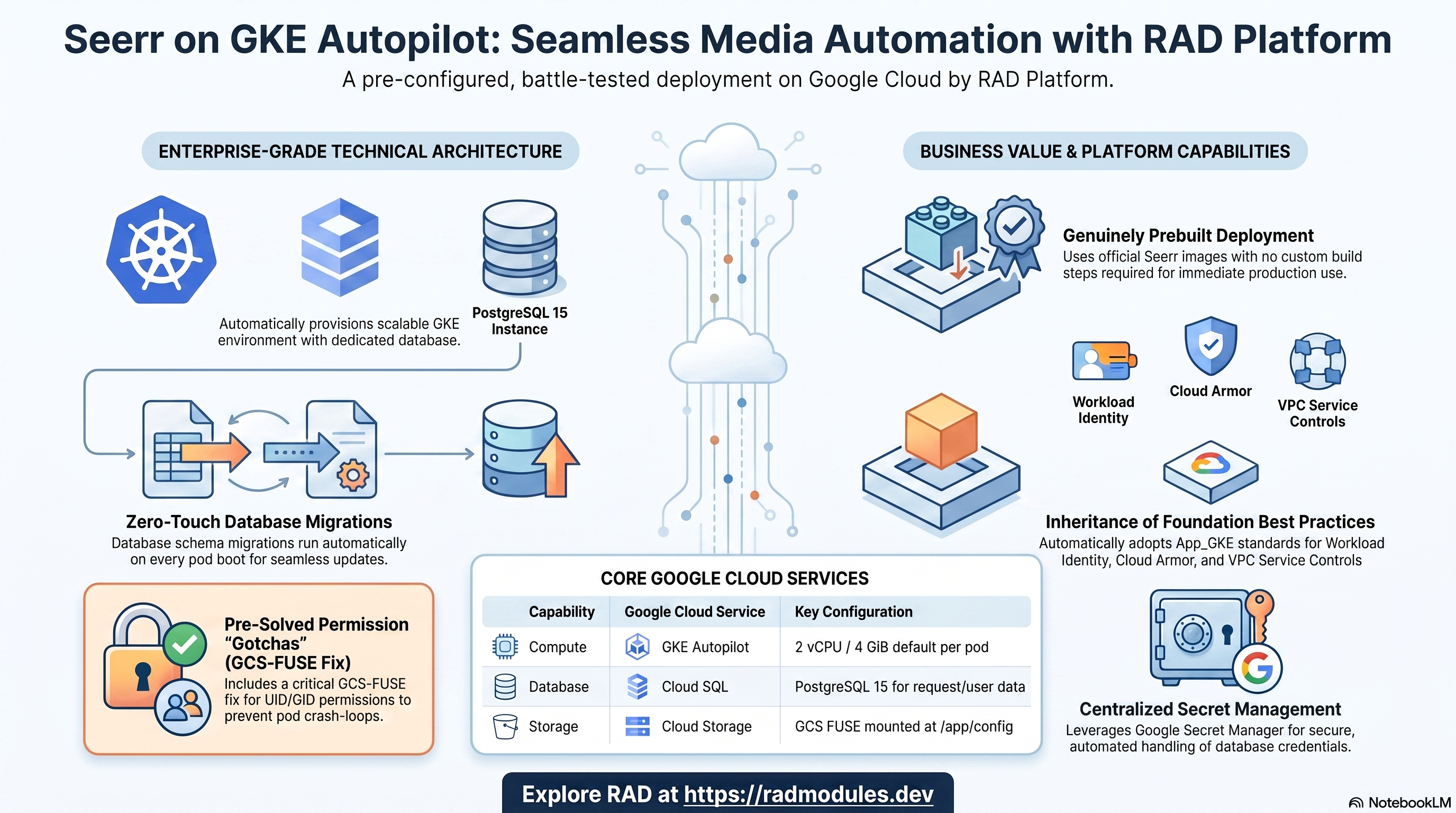
Seerr is the 2026 merger of Jellyseerr and Overseerr — an open-source, MIT-licensed request UI that sits in front of a Jellyfin, Plex, or Emby media server. Users browse and request titles; an admin approves the request, and Seerr calls Sonarr's and Radarr's APIs to trigger acquisition. This module deploys Seerr on GKE Autopilot on top of the App_GKE foundation, which provisions and manages the shared Google Cloud and Kubernetes infrastructure.
This guide focuses on the cloud services Seerr uses and how to explore and operate them from the Google Cloud Console and the command line. For the mechanics common to every GKE application — Workload Identity, ingress, autoscaling, CI/CD, Cloud Armor, IAP, Binary Authorization, VPC Service Controls, backups, and the deployment lifecycle — refer to the App_GKE foundation guide rather than repeating them here.
What Seerr costs on RAD, and how that compares
Running Seerr in your own GCP project costs about $149.81/month in Google Cloud charges; RAD's module fee is a one-time 110 credits (or 99 credits in a RAD-managed project), covering setup and support -- not the ongoing cloud bill, which Google bills you directly in your own project or RAD meters hourly in credits in a RAD-managed one. Or see the Cloud Run guide for the alternative deployment target; either way, if you deploy into a RAD-managed project you can pause the whole thing for free when you are not using it -- see Pause it for free below.
What you pay on RAD
| Your own project | RAD-managed project | |
|---|---|---|
| Module fee | 110 credits, once | 99 credits, once (10% lower) |
| Build time | metered in credits as the build runs (a few credits, typically) | same |
| Google Cloud running cost | ~$149.81/month, billed to your own billing account at Google's list price | ~111 credits/day, metered hourly by RAD at list price plus margin |
Default running cost in your own project
| Resource | US$/month (Google list price, us-central1) |
|---|---|
| GKE Autopilot pod, 2x vCPU / 4 GiB | $79.35 |
| Cloud SQL for PostgreSQL, 1 vCPU / 3.75 GB, zonal, 10 GB SSD | $51.02 |
| NFS/cache file server (small VM) | $13.43 |
| Cloud NAT and networking | $5.00 |
| Cloud Storage (add-ons, backups) | $1.00 |
| GKE cluster management fee | shared across every GKE app in the project; $0 if this is your only cluster, else ~$73 |
| Total | $149.81 |
How it compares
- Running it yourself on a bare VPS is still the cheapest cash option -- Hetzner CPX22 (2 vCPU/4GB) runs about $24/month, a DigitalOcean 2 vCPU/4GB Droplet is also $24/month, and a GCP Compute Engine e2-standard-2 (2 vCPU/8GB) is about $49/month -- plus the admin's own time for backups, security patches and upgrades, which RAD's managed Cloud SQL, Secret Manager and monitoring cover for you -- but RAD's price is never meant to beat a VPS, only to replace the admin time a VPS still needs.
- Seerr sits in front of a household media server rather than the public internet, so it runs continuously but at low traffic -- note this module needs
alwaysOncompute to keep request-triggered acquisition responsive, which is why its own running cost is higher than most apps in this batch.
Pause it for free: delete a RAD-managed project, restore it when you need it
This is the headline for a RAD-managed project. Deleting a RAD-managed project first unlinks its billing, then asks Google to delete the project outright -- Google's own 30-day recoverable soft delete. Unlike deleting one module, this does not tear down Cloud SQL, any VM or the compute resource one by one: the whole project simply stops, and nothing is charged while it waits, because billing is already unlinked.
Restoring, within 30 days and only by the project's owner, asks Google to undelete the project and reattaches its billing account, then asks you to run Update on each deployment to confirm everything came back. Because nothing was individually destroyed, that Update finds the same resources already there -- it is a check, not a rebuild, and an Update never charges the module fee again. This costs only a handful of credits (under US$1) in total for a typical 2-3-deployment chain.
What this needs: you must own the project (not one RAD only manages billing for), you must restore it yourself within 30 days -- after that Google deletes it for good -- and restoring is admitted like creating a new project, so your purchased credit balance must still clear the tier's floor (100 credits for the sandbox tier most study/demo use fits). Google says most services are fully working again within 36 hours of a restore.
One real gap: nightly backups are written to a bucket inside the project, and that bucket has Cloud Storage's soft-delete explicitly turned off, so it is very likely gone as soon as you delete the project -- even though the project itself is recoverable for 30 days. If you have customised the app and want to keep that work, copy a backup out (to Google Drive, or a bucket outside the project) before deleting. For a default install with nothing irreplaceable in it, this does not matter.
Pay only while you use it, the other way: delete and redeploy
In your own project (or once you are past the 30-day restore window above), the alternative is to delete Seerr outright and redeploy it later. A redeploy costs the module fee again, plus the builds -- roughly 110 + 3-6 credits of build time.
Deleting saves money only once Seerr would otherwise sit unused long enough to clear that redeploy cost against its own daily running cost -- against the own-project total above, that works out to about 2 days or more. Most of the running cost here is usually the database and the NFS/cache VM; they stop only when nothing else in the project uses them, so deleting this app while something else shares the project saves only this app's own compute part.
Keep data first: nightly backups go to a bucket inside the deployment and are deleted with it, so copy the latest backup out before deleting if you want to keep it.
Lab sessions and Managed Environments
- Lab sessions, for training: a trainer runs a session for a class. Each participant gets the app in their own Google Cloud project for 15 minutes to 24 hours, within an allowance the trainer sets. Either the trainer funds every place, or each participant pays for their own. Everything is deleted when the session ends and unused credits go back to the trainer.
- Managed Environments, for consultancies: a partner runs the app for a client from a ring-fenced wallet it funds, and settles with the client directly. If the wallet runs low, billing pauses and the data is kept, so nobody receives an unexpected charge. At the end the partner hands the project over and the deployments become the client's own.
- Credits can be bought in more than 20 currencies, including XAF, XOF, NGN, GHS, KES and ZAR, by card, bank transfer or mobile money.
Sources (8 October 2026): Google Cloud Billing Catalog API list prices; radmodules.dev/pricing for RAD's own fees and daily-credit estimates; https://cloud.google.com/resource-manager/docs/delete-restore-projects for the pause/restore mechanics.
1. Overview
Seerr runs as a single Node.js/Next.js pod. The deployment wires together a small set of Google Cloud services:
| Capability | Google Cloud service | Notes |
|---|---|---|
| Compute | GKE Autopilot | Single Node.js process pod, 2 vCPU / 4 GiB by default |
| Database | Cloud SQL PostgreSQL 15 | Holds request/user data; migrations run automatically on every pod boot |
| Object storage | Cloud Storage | A storage bucket mounted at /app/config via GCS FUSE (or an optional StatefulSet PVC) — holds settings.json, Seerr's own app settings |
| Cache & queue | none | Seerr has no Redis or queue dependency |
| Secrets | Secret Manager | Only the generated database password — Seerr's first admin comes from the app's own web setup wizard |
| Ingress | Cloud Load Balancing | External LoadBalancer, optional custom domain + managed certificate |
Sensible defaults worth knowing up front:
- Genuinely prebuilt — no custom image.
Seerr_Common'sscripts/directory is empty.container_image_source = "prebuilt"deploysghcr.io/seerr-team/seerrdirectly. DB_TYPE=postgresis set unconditionally bySeerr_Common— see the Cloud Run guide's §3 for the full explanation; the same trap and the same fix apply here.- Port 5055, health path
/api/v1/status. Confirmed via localdocker runtesting and a live deployment (pod reported3/3 Running,GET /api/v1/statusreturned real JSON viakubectl exec). - A GKE-specific GCS-FUSE permission bug, found and fixed. Seerr's
container runs as
uid=1000/gid=1000. Cloud Run's own gcsfuse integration auto-applies that UID/GID to the mount; the GKE GCS FUSE CSI driver does not — without an explicit fix, the pod crash-loops on first boot withEACCES: permission deniedtrying to create/app/config/logs/.Seerr_Commonmounts the volume withuid=1000,gid=1000,file-mode=0664,dir-mode=0775to fix this. See §3. - Two distinct pieces of state. PostgreSQL holds request/user data.
Seerr's own app settings (connected media servers, discovery sliders,
notification agents) live in a plain
settings.jsonfile under/app/config— regardless of database backend. DB_PASS, notDB_PASSWORD. Seerr's TypeORM datasource reads a specifically-namedDB_PASSenvironment variable. This module setsdb_password_env_var_name = "DB_PASS"to match.
2. Google Cloud Services & How to Explore Them
All commands assume you have run
gcloud container clusters get-credentials <cluster> --region <region> --project <project>
and that PROJECT, REGION, and NAMESPACE are set.
A. GKE Autopilot — the Seerr workload
- CLI:
kubectl get pods,svc -n "$NAMESPACE"
kubectl logs -n "$NAMESPACE" deploy/<service-name> --tail=100
B. Cloud SQL — request/user data
- CLI:
gcloud sql instances list --project "$PROJECT"
gcloud sql databases list --instance=<instance-name> --project "$PROJECT"
C. Storage — Cloud Storage or a block PVC
- CLI:
gcloud storage buckets list --project "$PROJECT" --filter="name~seerr"
kubectl get pvc -n "$NAMESPACE"    # only when stateful_pvc_enabled = true
D. Secret Manager
- CLI:
gcloud secrets list --project "$PROJECT" --filter="name~seerr"
E. Networking & ingress
- CLI:
kubectl get svc -n "$NAMESPACE" -o wide
F. Cloud Logging & Monitoring
- CLI:
kubectl logs -n "$NAMESPACE" deploy/<service-name> --tail=100 -f
3. Seerr Application Behaviour
- No first-deploy database-schema job. Seerr's
dist/index.jscallsdbConnection.runMigrations()explicitly on every pod boot, so there is no init job in this module and none is needed.initialization_jobsis empty by default. - First-run setup is entirely in the app's own web UI. There is no seeded admin credential of any kind — connect to the service and complete Seerr's setup wizard: media server first, then Sonarr/Radarr.
- Health path. Startup and liveness probes both target
GET /api/v1/status. - Inspect job execution (should show nothing, by design):
kubectl get jobs -n "$NAMESPACE"
⚠ The GCS-FUSE UID/GID bug — the GKE-specific gotcha this module fixes
Seerr's container runs as uid=1000/gid=1000 (the node user — confirmed
via docker run ghcr.io/seerr-team/seerr id), and on first boot attempts
mkdir '/app/config/logs/'.
- On Cloud Run, the platform's own gcsfuse integration automatically
applies
uid:1000/gid:1000to the mounted volume, so this works with no extra configuration. - On GKE, the GCS FUSE CSI driver does not default to a writable UID.
A bare
gcs_volumesmount is root-owned, and the non-root container crash-loops withEACCES: permission denied.
Seerr_Common fixes this by setting explicit mount_options on the storage
volume it declares for /app/config:
mount_options = [
  "implicit-dirs", "stat-cache-ttl=60s", "type-cache-ttl=60s",
  "uid=1000", "gid=1000", "file-mode=0664", "dir-mode=0775",
]
This is a known bug class in this catalogue — the same shape of failure was
previously found and fixed on Paperless, CodeServer, and CloudBeaver's GKE
variants (see the repository CLAUDE.md's "GKE gcsfuse UID/GID permission
denied" finding). Seerr is the latest confirmed instance, now fixed at the
Seerr_Common layer so both Application Modules inherit the fix uniformly.
Diagnostic tell, if you ever see this symptom on a fork of this module:
kubectl describe pod -n "$NAMESPACE" <seerr-pod>
# Look for: EACCES: permission denied, mkdir '/app/config/logs/'
4. Configuration Variables
Variables are grouped exactly as they appear on the deployment platform. Only settings specific to or notable for Seerr are listed; every other input is inherited from App_GKE with its standard behaviour.
Group 3 — Application Identity
| Variable | Default | Description |
|---|---|---|
application_name | seerr | Base name for resources. |
application_display_name | Seerr | Human-readable name shown in the platform UI. |
application_version | latest | Pulled directly as the ghcr.io/seerr-team/seerr image tag — no build step involved. |
Group 4 — Runtime & Scaling
| Variable | Default | Description |
|---|---|---|
container_port | 5055 | Confirmed via local docker run and live deployment; the K8s Service and probes must all agree on this value. |
container_image_source | prebuilt | Seerr only supports the official image; Seerr_Common also hardcodes this internally. |
min_instance_count / max_instance_count | 1 / 5 | See §6 below. |
Group 31 — StatefulSet Configuration
| Variable | Default | Description |
|---|---|---|
stateful_pvc_enabled | false | settings.json is small, whole-file JSON state — safe on a GCS FUSE volume at max_instance_count = 1, so a block PVC is optional here, unlike WAL-mode-SQLite apps in this catalogue. |
stateful_pvc_mount_path | /app/config | Matches the GCS FUSE default mount path. |
stateful_pvc_storage_class | standard | HDD pd-standard — settings.json has no high-IOPS need. |
Group 16 — Database
| Variable | Default | Description |
|---|---|---|
database_type | POSTGRES_15 | Required — Seerr has no non-Postgres path. |
application_database_name / application_database_user | seerr / seerr | Forwarded to Seerr_Common, injected as DB_NAME/DB_USER. |
db_password_env_var_name | DB_PASS | Critical — Seerr's datasource reads DB_PASS specifically, not the Foundation's default DB_PASSWORD. |
Group 11 — Workload Automation
| Variable | Default | Description |
|---|---|---|
initialization_jobs | [] | Empty and typically stays that way — dbConnection.runMigrations() runs on every pod boot inside the app itself. |
Group 14 — Cloud Storage
| Variable | Default | Description |
|---|---|---|
gcs_volumes | [] | The permission-corrected storage bucket mount at /app/config is added automatically (see §3); use this for additional volumes only. |
Group 10 — Observability & Health
| Variable | Default | Description |
|---|---|---|
startup_probe / liveness_probe | HTTP /api/v1/status (via Seerr_Common) | Unauthenticated 200 JSON status endpoint; the variant's own variables.tf default (HTTP /) is superseded by Seerr_Common's more accurate default. |
5. Outputs
| Output | Description |
|---|---|
service_name / service_url / service_external_ip | Kubernetes Service identity and address. |
database_instance_name / database_name / database_user / database_password_secret | Cloud SQL instance and Seerr database identifiers. |
storage_buckets | The storage bucket backing /app/config (unused as a mount if stateful_pvc_enabled = true). |
kubernetes_ready | Whether the workload reached Ready state. |
6. Configuration Pitfalls & Sensible Defaults
Risk: Critical (data loss / outage / security) — High (service degraded) — Medium (cost or partial degradation) — Low (minor).
| Setting | Sensible value | Risk | Consequence if wrong |
|---|---|---|---|
DB_TYPE environment variable | Leave Seerr_Common's default (postgres) untouched | Critical | Missing/overridden DB_TYPE silently drops Seerr onto a per-pod SQLite file wiped on every restart. |
GCS FUSE mount_options on /app/config | Leave Seerr_Common's uid=1000/gid=1000 fix in place | Critical | Without it, the pod crash-loops with EACCES: permission denied on first boot — a GKE-only failure mode not seen on Cloud Run. |
db_password_env_var_name | Leave at DB_PASS | Critical | Seerr's TypeORM datasource only reads DB_PASS; the Foundation's default DB_PASSWORD alone is never read. |
max_instance_count | Set 1 if settings changes must never race | Medium | settings.json is a single mutable file — concurrent writers from multiple pods risk a lost write. The module default is 5, looser than the single-writer-safe value. |
stateful_pvc_enabled | Leave false unless you have a specific reason for block storage | Low | settings.json doesn't need POSIX file locking the way a WAL-mode SQLite app would; GCS FUSE is an appropriate default here, unlike apps that genuinely require a real block device. |
For the foundation behaviour referenced throughout — Workload Identity, ingress, autoscaling, CI/CD, Cloud Armor, IAP, Binary Authorization, VPC-SC, backups, and image mirroring — see App_GKE. Seerr-specific application configuration shared with the Cloud Run variant is described in Seerr_Common.
Related guides
- Hands-on lab: Seerr on GKE Autopilot — deploy it step by step, with the console screens and commands at each stage.
- Seerr on Google Cloud Run — the same application on Cloud Run, for when you need the other deployment target.
- Seerr Common — Shared Application Configuration — the configuration shared by both deployment targets.
- Deployed alongside Jellyfin on GKE Autopilot, Prowlarr on GKE Autopilot, Jellystat on GKE Autopilot, Homepage on GKE Autopilot in the Media Server solution.
Need RAD to do something it does not do yet? Request it on the roadmap, or vote on what is already there.