Homepage on GKE Autopilot
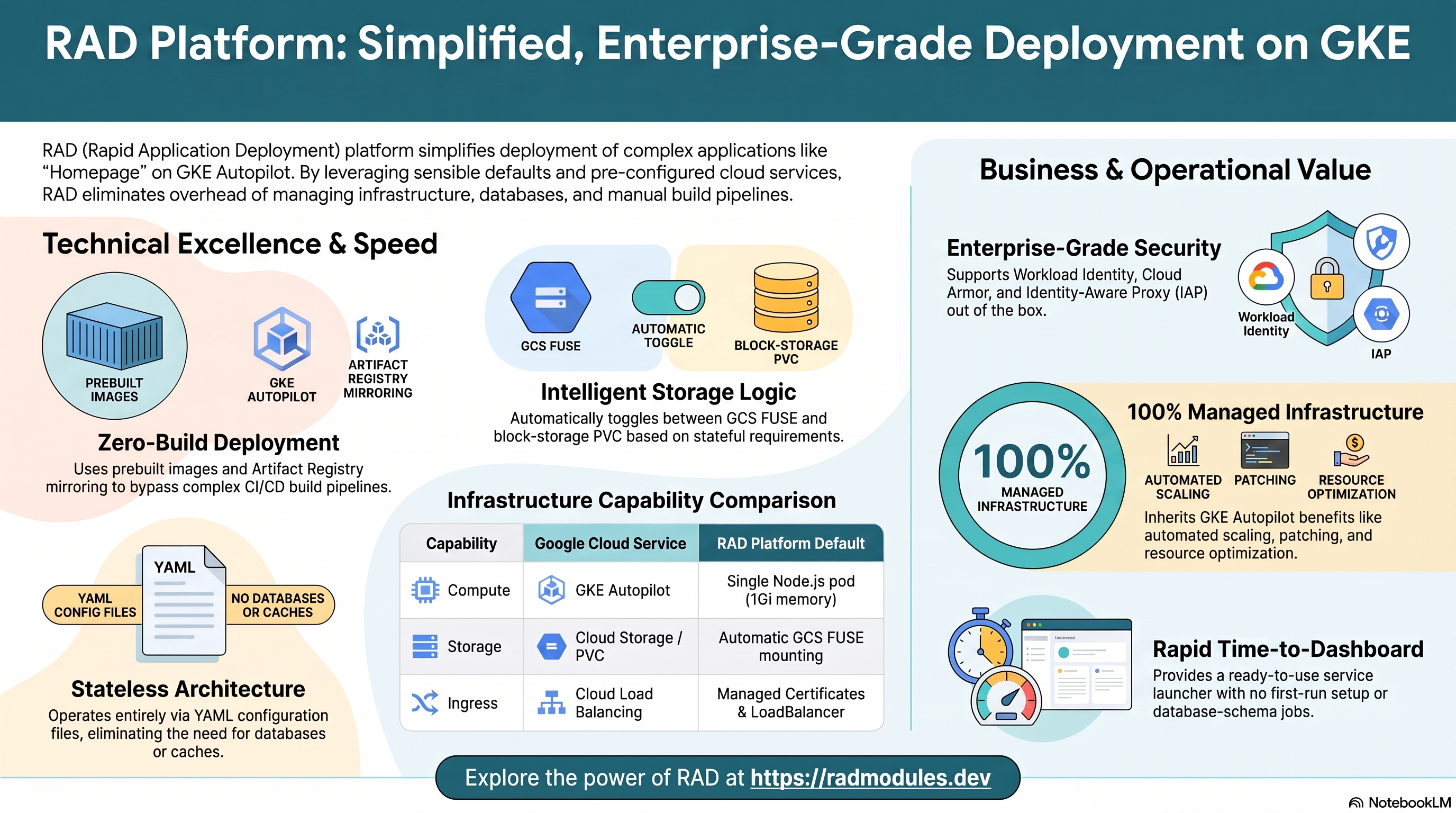
Homepage (gethomepage/homepage) is a self-hosted, highly customizable application dashboard/service-launcher — a Next.js 16 / Node 22 application whose entire configuration (services, bookmarks, widgets, layout) lives in a handful of YAML files, with optional live status/stats widgets for other self-hosted apps you run. This module deploys Homepage on GKE Autopilot on top of the App_GKE foundation, which provisions and manages the shared Google Cloud and Kubernetes infrastructure.
This guide focuses on the cloud services Homepage uses and how to explore and operate them from the Google Cloud Console and the command line. For the mechanics common to every GKE application — Workload Identity, ingress, autoscaling, CI/CD, Cloud Armor, IAP, Binary Authorization, VPC Service Controls, backups, and the deployment lifecycle — refer to the App_GKE foundation guide rather than repeating them here.
What Homepage costs on RAD, and how that compares
Running Homepage on GKE Autopilot pod in your own Google Cloud project costs about $40.29/month in Google Cloud charges, on top of a one-off 40-credit RAD module fee charged once at deploy time. Homepage is the lightest app in this batch by a wide margin — a static dashboard with no database of its own — so its own-project running cost is close to the floor of what any Cloud Run deployment costs. In a RAD-managed project the module fee drops to 36 credits (10% lower) and the running cost is metered hourly in credits instead of billed directly by Google — see Pause it for free below for the one RAD-managed advantage a self-hosted VPS cannot match — or see the Cloud Run guide for the lower-cost option.
What you pay on RAD
| Own project | RAD-managed project | |
|---|---|---|
| Module fee (one-off) | 40 credits | 36 credits (10% lower) |
| Build time | ~3-6 credits per build, either way | ~3-6 credits per build, either way |
| Google Cloud running cost | $40.29/month, billed by Google at list price | ~67 credits/day, metered at list price plus RAD's margin |
Default running cost in your own project
| Resource | US$/month (Google list price, us-central1) |
|---|---|
| GKE Autopilot pod, 1x vCPU / 0.5 GiB | $34.29 |
| Cloud NAT and networking | $5.00 |
| Cloud Storage (add-ons, backups) | $1.00 |
| GKE cluster management fee | shared across every GKE app in the project; $0 if this is your only cluster, else ~73 |
| Total | $40.29 |
The GKE cluster management fee is excluded from the total above because it is shared across every GKE app in the project — $0 if this is the only one, otherwise roughly $73/month split across however many you run.
How it compares
- A self-managed comparison: Hetzner CPX22 (2 vCPU/4GB) runs about $24/mo, a DigitalOcean 2 vCPU/4GB Droplet is the same $24/mo, and a GCP Compute Engine e2-standard-2 (2 vCPU/8GB) is about $49/mo — substantially more than a config-only dashboard with no database needs; a $5-6/month shared-vCPU micro instance from any of the same providers would run it comfortably.
- Homepage has no commercial hosted SaaS of its own — it is distributed only as self-hosted YAML-configured software.
- Because there's no database or file server here, the gap between RAD-managed and a bare VPS is smaller than for almost anything else in this batch — mostly just managed TLS, Secret Manager and monitoring versus doing it by hand.
Pause it for free: delete a RAD-managed project, restore it when you need it
This is the headline advantage of a RAD-managed project, and it costs nothing while paused. Deleting a RAD-managed project unlinks its billing first, then asks Google to delete the project outright — Google's own 30-day recoverable soft delete. Unlike deleting one module, this does not tear down Cloud SQL, any VM, or the compute resource one by one: the whole project simply stops, and nothing is charged while it waits, because billing is already unlinked.
Restoring, within 30 days and only by the project's owner, asks Google to undelete the project and reattaches its billing account, then asks you to run Update on each deployment to confirm everything came back. Because nothing was individually destroyed, that Update finds the same resources already there — it is a check, not a rebuild, and an Update never charges the module fee again. This costs only a handful of credits (under US$1) in total for a typical 2-3-deployment chain.
What this needs: you must own the project (not one RAD only manages billing for), you must restore it yourself within 30 days — after that Google deletes it for good — and restoring is admitted like creating a new project, so your purchased credit balance must still clear the tier's floor (100 credits for the sandbox tier most study/demo use fits). Google says most services are fully working again within 36 hours of a restore.
One real gap: nightly backups are written to a bucket inside the project, and that bucket has Cloud Storage's soft-delete explicitly turned off, so it is very likely gone as soon as you delete the project — even though the project itself is recoverable for 30 days. If you've customised Homepage and want to keep that work, copy a backup out (to Google Drive, or a bucket outside the project) before deleting. For a default install with nothing irreplaceable in it, this does not matter.
Pay only while you use it, the other way: delete and redeploy
In your own project, or once 30 days have passed on a RAD-managed one, there is no free pause — deleting removes the resources for good, and bringing Homepage back means redeploying from scratch. That costs about 43-46 credits (the 40-credit module fee plus a build).
Deleting only saves money once Homepage would otherwise sit unused long enough to clear that redeploy cost against its own running cost — for Homepage, that's about 4 days or more. Most of that running cost is usually the database (and, where this module uses one, the shared file-server VM or GKE cluster) — those stop only once nothing else in the project uses them, so deleting this app while something else shares the project saves only its own compute share.
Keep data first: nightly backups go to a bucket inside the deployment and are deleted with it, so copy the latest backup out before deleting if you want to keep it.
Lab sessions and Managed Environments
Lab sessions, for training: a trainer runs a session for a class. Each participant gets the app in their own Google Cloud project for 15 minutes to 24 hours, within an allowance the trainer sets. Either the trainer funds every place, or each participant pays for their own. Everything is deleted when the session ends and unused credits go back to the trainer.
Managed Environments, for consultancies: a partner runs the app for a client from a ring-fenced wallet it funds, and settles with the client directly. If the wallet runs low, billing pauses and the data is kept, so nobody receives an unexpected charge. At the end the partner hands the project over and the deployments become the client's own.
Credits can be bought in more than 20 currencies, including XAF, XOF, NGN, GHS, KES and ZAR, by card, bank transfer or mobile money.
Sources (8 October 2026): Google Cloud Billing Catalog API list prices; radmodules.dev/pricing for RAD's own fees and daily-credit estimates; Google's project delete/restore documentation for the pause/restore claims.
1. Overview
Homepage runs as a single Node.js/Next.js pod on GKE Autopilot. Like the
Cloud Run variant, it has no database and no cache — its entire state is
a directory of YAML files. What's different on GKE is the storage layer
itself: Cloud Run has no PVC concept, so Homepage_CloudRun always uses a
GCS FUSE volume; Homepage_GKE defaults to the same GCS FUSE approach but
additionally offers a real block-storage PVC as an explicit opt-in.
| Capability | Google Cloud service | Notes |
|---|---|---|
| Compute | GKE Autopilot | Single Node.js pod, 1000m CPU / 1Gi memory by default |
| Database | none | Homepage has no database of any kind; database_type = "NONE" |
| Object storage | Cloud Storage (default) or a block PVC | Default: a storage bucket mounted at /app/config via the GCS FUSE CSI driver. With stateful_pvc_enabled = true: a per-pod standard-rwo PVC (5Gi default) at the same path instead, and the workload becomes a StatefulSet |
| Cache & queue | none | enable_redis = false is hardcoded in main.tf, overriding the foundation's own default of true |
| Secrets | none | No secret is generated — Homepage needs no credentials of its own |
| Ingress | Cloud Load Balancing | LoadBalancer Service by default, with an optional custom domain + managed certificate; ClusterIP is available for internal-only or quota-constrained deployments |
Sensible defaults worth knowing up front:
- Genuinely prebuilt — no custom image, no Cloud Build for the app.
Homepage_Commonsetsimage_source = "prebuilt"andcontainer_build_config.enabled = false;ghcr.io/gethomepage/homepageis deployed directly.enable_image_mirroring = truestill copies it into Artifact Registry (avoids GHCR rate limits), but that is a mirror, not a build. - Port 3000, health path
/api/healthcheck. Confirmed via a live deployment:GET /api/healthcheckreturns an unauthenticated200 "up"once the app is ready (backed by the image's ownHEALTHCHECKdirective).GET /returns the real dashboard HTML (confirmed:<title>Homepage</title>). - Two storage layouts, chosen by
stateful_pvc_enabled. The default (false) runs a statelessDeploymentwith thestorageGCS bucket mounted at/app/config— identical in shape toHomepage_CloudRun. Setting ittrueswitches to aStatefulSetwith a real block-storage PVC at the same path instead (the GCS volume is then automatically disabled to avoid a double-mount). This is a genuine, deliberate platform-driven difference — GKE has PVCs, Cloud Run does not — not an inconsistency between the two variants. The block-PVC mode is what was verified live for this module (see §3). - No database, no Redis — architecturally unusual for this catalogue. Almost every other application module wires a Cloud SQL instance and/or Redis through the foundation; Homepage needs neither. This also means it has none of the usual DSN-wiring, socket-vs-TCP, or password-URL-encoding classes of bugs documented elsewhere in this repository — there is simply no database connection to get wrong.
- Multi-instance safety depends on the storage mode. In the default GCS
FUSE mode,
max_instance_count > 1is genuinely safe — every pod reads the same shared bucket live from disk, with no in-process cache. Withstateful_pvc_enabled = true, eachStatefulSetpod ordinal gets its own separate PVC (standard KubernetesvolumeClaimTemplatessemantics) — running more than one replica in that mode gives each pod an independently diverging config, not a shared dashboard. Keepmax_instance_count = 1whenever the block PVC is enabled. - No authentication of its own.
HOMEPAGE_ALLOWED_HOSTSdefaults to"*"— this only gates theHostheader check on Homepage's/api/*widget-data calls, not real access control. Put it behind IAP, a VPN, or a reverse proxy if you need to restrict who can reach it.
2. Google Cloud Services & How to Explore Them
All commands assume you have run
gcloud container clusters get-credentials <cluster> --region <region> --project <project>
and that PROJECT, REGION, and NAMESPACE are set. The namespace and
other identifiers are reported in the deployment Outputs.
A. GKE Autopilot — the Homepage workload
- Console: Kubernetes Engine → Workloads → select the Homepage workload
for pods, revisions, and events. Kubernetes Engine → Services & Ingress
shows the external IP (if
service_type = LoadBalancer). - CLI:
kubectl get pods,svc -n "$NAMESPACE"
# If stateful_pvc_enabled = true, the workload is a StatefulSet:
kubectl get statefulset -n "$NAMESPACE"
# Otherwise it is a Deployment:
kubectl get deploy -n "$NAMESPACE"
kubectl logs -n "$NAMESPACE" <pod-name> --tail=100
See App_GKE for how Autopilot, scaling, and the workload type (Deployment vs StatefulSet) are managed.
B. Storage — /app/config
The storage mechanism depends on stateful_pvc_enabled:
- Default (
false) — GCS FUSE. Thestoragebucket is mounted at/app/configvia the GCS FUSE CSI driver. It holds every YAML config file Homepage reads (settings.yaml,services.yaml,bookmarks.yaml,widgets.yaml,docker.yaml) plus Homepage's logs.gcloud storage buckets list --project "$PROJECT" --filter="name~homepage"
gcloud storage ls "gs://<bucket-name>/"
gcloud storage cat "gs://<bucket-name>/settings.yaml" - Opt-in (
true) — block PVC. A per-podstandard-rwoPVC (5Gidefault) is mounted at/app/configinstead. Inspect it directly:There is no GCS bucket to inspect in this mode —kubectl get pvc -n "$NAMESPACE"
kubectl exec -n "$NAMESPACE" <pod-name> -- ls -la /app/config
kubectl exec -n "$NAMESPACE" <pod-name> -- cat /app/config/settings.yamlstorage_bucketsoutput is only populated when the module runs in its default (non-PVC) layout.
C. Secret Manager
Nothing to see here — Homepage generates no secrets. Confirming this is itself a useful sanity check on a fresh deployment:
gcloud secrets list --project "$PROJECT" --filter="name~homepage"
# expect: no results
D. Networking & ingress
kubectl get svc -n "$NAMESPACE"
gcloud compute addresses list --project "$PROJECT" --filter="name~homepage"
See App_GKE for custom domains, Cloud CDN, and static IP details.
E. Cloud Logging & Monitoring
kubectl logs -n "$NAMESPACE" <pod-name> --tail=100
gcloud logging read 'resource.type="k8s_container" AND resource.labels.namespace_name="'"$NAMESPACE"'"' \
  --project "$PROJECT" --limit 50
3. Homepage Application Behaviour
- No first-deploy database-schema job. Homepage has no database, so
initialization_jobsis empty by default and no job is needed. - No first-run setup wizard. There is no admin account to create and no
onboarding flow — Homepage renders its dashboard from whatever config
exists in
/app/config(the upstream image's own bundled defaults on a fresh deployment, since the entrypoint self-seeds any missing file). Customize the dashboard by editing the YAML files directly (via the GCS bucket orkubectl exec, depending on storage mode — see §2B) or by configuringdocker.yaml/label-based discovery if you connect it to a Docker/Kubernetes API. - Health path. Startup and liveness probes both target
GET /api/healthcheck— an unauthenticated200 "up", confirmed live.
Verified live: StatefulSet + block PVC
This module's first deployment used stateful_pvc_enabled = true (set in
config/deploy.tfvars), exercising the block-PVC storage path end to end:
- Pod
<service>-0reported1/1 Runningwith 0 restarts. - PVC
data-<service>-0reportedBound. - Boot logs showed a clean sequence: a config-directory ownership fix, the
Next.js server becoming ready, then
settings.yaml/kubernetes.yamlself-seeding onto the empty PVC with no errors. GET /api/healthcheckreturned200 "up".GET /returned the real dashboard HTML (<title>Homepage</title>), not a placeholder or error page.- PVC files were correctly owned (
node:node) — the entrypoint's own chown step at boot handled this; the GCS FUSEuid=1000/gid=1000mount_optionsdocumented forHomepage_CloudRunand the default GKE layout are simply not in play in this mode, since no GCS volume is mounted whenstateful_pvc_enabled = true.
The deploy also confirmed the project's external-IP quota constraint led to
service_type = "ClusterIP" and reserve_static_ip = false for this
specific deployment (see config/deploy.tfvars) rather than the module's
own LoadBalancer/reserve_static_ip = true defaults — a project-level
choice, not a module requirement. Access was verified via
kubectl port-forward rather than an external IP.
4. Configuration Variables
Variables are grouped exactly as they appear on the deployment platform. Only settings specific to or notable for Homepage are listed; every other input is inherited from App_GKE with its standard behaviour.
Group 3 — Application Identity
| Variable | Default | Description |
|---|---|---|
application_name | homepage | Base name for resources. |
application_display_name | Homepage | Human-readable name shown in the platform UI. |
application_version | latest | Passed straight through as the ghcr.io/gethomepage/homepage image tag — no build step. |
homepage_allowed_hosts | * | HOMEPAGE_ALLOWED_HOSTS — comma-separated Host header allowlist for Homepage's own /api/* calls. Not a real access-control boundary. |
Group 4 — Runtime & Scaling
| Variable | Default | Description |
|---|---|---|
container_port | 3000 | Homepage's Next.js standalone server port. Fixed by Homepage_Common; not forwarded to App_GKE. |
container_image_source | prebuilt | Deploys ghcr.io/gethomepage/homepage directly — no Cloud Build for the app. |
cpu_limit / memory_limit | 1000m / 1Gi | Lightweight — Homepage is a single Next.js standalone server. |
min_instance_count / max_instance_count | 1 / 3 | Multiple replicas are only safe in the default GCS FUSE storage mode — see §1 and §3. Keep max_instance_count = 1 when stateful_pvc_enabled = true. |
enable_image_mirroring | true | Mirrors the prebuilt image into Artifact Registry (avoids GHCR rate limits) — not a build. |
enable_cloudsql_volume | false | Homepage has no Cloud SQL — keep false. |
Group 6 — GKE Backend Configuration
| Variable | Default | Description |
|---|---|---|
workload_type | null (resolves to Deployment) | Auto-resolves to StatefulSet when stateful_pvc_enabled = true. |
service_type | LoadBalancer | Homepage is a browser-facing dashboard; use ClusterIP for internal-only access or quota-constrained projects (this module's own live verification used ClusterIP). |
Group 7 — StatefulSet
| Variable | Default | Description |
|---|---|---|
stateful_pvc_enabled | false | true switches Homepage to a StatefulSet with a real block PVC at /app/config instead of the default GCS FUSE volume — the mode verified live for this module. |
stateful_pvc_size | 5Gi | Homepage's YAML config plus logs is tiny; sized to the platform floor. |
stateful_pvc_mount_path | /app/config | Same path as the default GCS FUSE mount — the two are mutually exclusive, never double-mounted. |
stateful_fs_group | 3000 | Pod-level fsGroup for the block PVC (upstream Helm chart default). |
Group 11 — Workload Automation
| Variable | Default | Description |
|---|---|---|
initialization_jobs | [] | Stays empty by default — nothing to bootstrap. |
Group 14 — Cloud Storage & Artifact Registry
| Variable | Default | Description |
|---|---|---|
gcs_volumes | [] | The storage bucket mount at /app/config is added automatically only when stateful_pvc_enabled = false; use this for additional volumes only. |
Group 16 — Database
| Variable | Default | Description |
|---|---|---|
database_type | NONE | Fixed by Homepage_Common — Homepage has no SQL database, full stop. |
Group 10 — Observability & Health
| Variable | Default | Description |
|---|---|---|
startup_probe / liveness_probe | HTTP /api/healthcheck | Unauthenticated 200 "up" — an accurate default matching the image's own HEALTHCHECK directive, forwarded unchanged from Homepage_Common. |
5. Outputs
| Output | Description |
|---|---|
service_name / service_url | Kubernetes Service name and the dashboard URL (port 3000). |
namespace | Kubernetes namespace the workload runs in. |
service_cluster_ip / service_external_ip | In-cluster ClusterIP / external LoadBalancer IP (when reserved). |
storage_buckets | The storage bucket backing /app/config — populated only in the default, non-PVC storage mode. |
statefulset_name | Name of the StatefulSet — populated only when stateful_pvc_enabled = true. |
container_image / container_registry | The deployed image reference and Artifact Registry repository. |
deployment_id / tenant_id / resource_prefix | Naming identifiers. |
project_id / project_number | Project identifiers. |
initialization_jobs | Created initialization job names (empty for Homepage). |
kubernetes_ready | Whether the cluster/workload is ready. |
6. Configuration Pitfalls & Sensible Defaults
Risk: Critical (data loss / outage / security) — High (service degraded) — Medium (cost or partial degradation) — Low (minor).
| Setting | Sensible value | Risk | Consequence if wrong |
|---|---|---|---|
max_instance_count with stateful_pvc_enabled = true | Keep at 1 | High | Each StatefulSet pod ordinal gets its own separate PVC (not shared storage) — scaling beyond one replica in block-PVC mode gives each pod an independently diverging dashboard config, not a consistent shared one. |
stateful_pvc_mount_path / gcs_volumes at /app/config | Leave the automatic mount in place, whichever mode you use | Critical | Removing or misconfiguring this volume loses every YAML config file on the next cold start or pod reschedule — Homepage has no other source of truth. |
HOMEPAGE_ALLOWED_HOSTS | Leave * unless you know the final hostname, then tighten it | Medium | A too-narrow value 400s every API-backed widget (page shell still loads) if the actual request hostname doesn't match; treating it as a real auth boundary is a false sense of security either way. |
| Probe path | Leave at /api/healthcheck | High | An authenticated or nonexistent probe path would leave the pod permanently Ready=False even though the app booted fine. |
enable_redis | Leave the hardcoded false alone (do not attempt to force it via environment_variables) | Low | Homepage has nothing to cache; enabling Redis wastes a Memorystore/NFS-Redis dependency for no benefit. |
workload_type = "Deployment" with stateful_pvc_enabled = true | Leave workload_type unset (null) | Low | A plan-time validation guard rejects this combination outright — a PVC template requires a StatefulSet. |
service_type | LoadBalancer unless quota-constrained | Medium | ClusterIP requires kubectl port-forward for access — fine for internal use or quota-limited projects (as used in this module's own live verification), but not reachable from a browser without it. |
For the foundation behaviour referenced throughout — Workload Identity, autoscaling, ingress and load balancing, CI/CD, Cloud Armor, IAP, Binary Authorization, VPC-SC, backups, and image mirroring — see App_GKE. Homepage-specific application configuration shared with the Cloud Run variant is described in Homepage_Common.
Related guides
- Hands-on lab: Homepage on GKE Autopilot — deploy it step by step, with the console screens and commands at each stage.
- Homepage on Google Cloud Run — the same application on Cloud Run, for when you need the other deployment target.
- Homepage Common — Shared Application Configuration — the configuration shared by both deployment targets.
- Deployed alongside Jellyfin on GKE Autopilot, Prowlarr on GKE Autopilot, Seerr on GKE Autopilot, Jellystat on GKE Autopilot in the Media Server solution.
Need RAD to do something it does not do yet? Request it on the roadmap, or vote on what is already there.