Certification track: Professional Cloud Database Engineer (PCDE)
MongoDB on GKE Autopilot
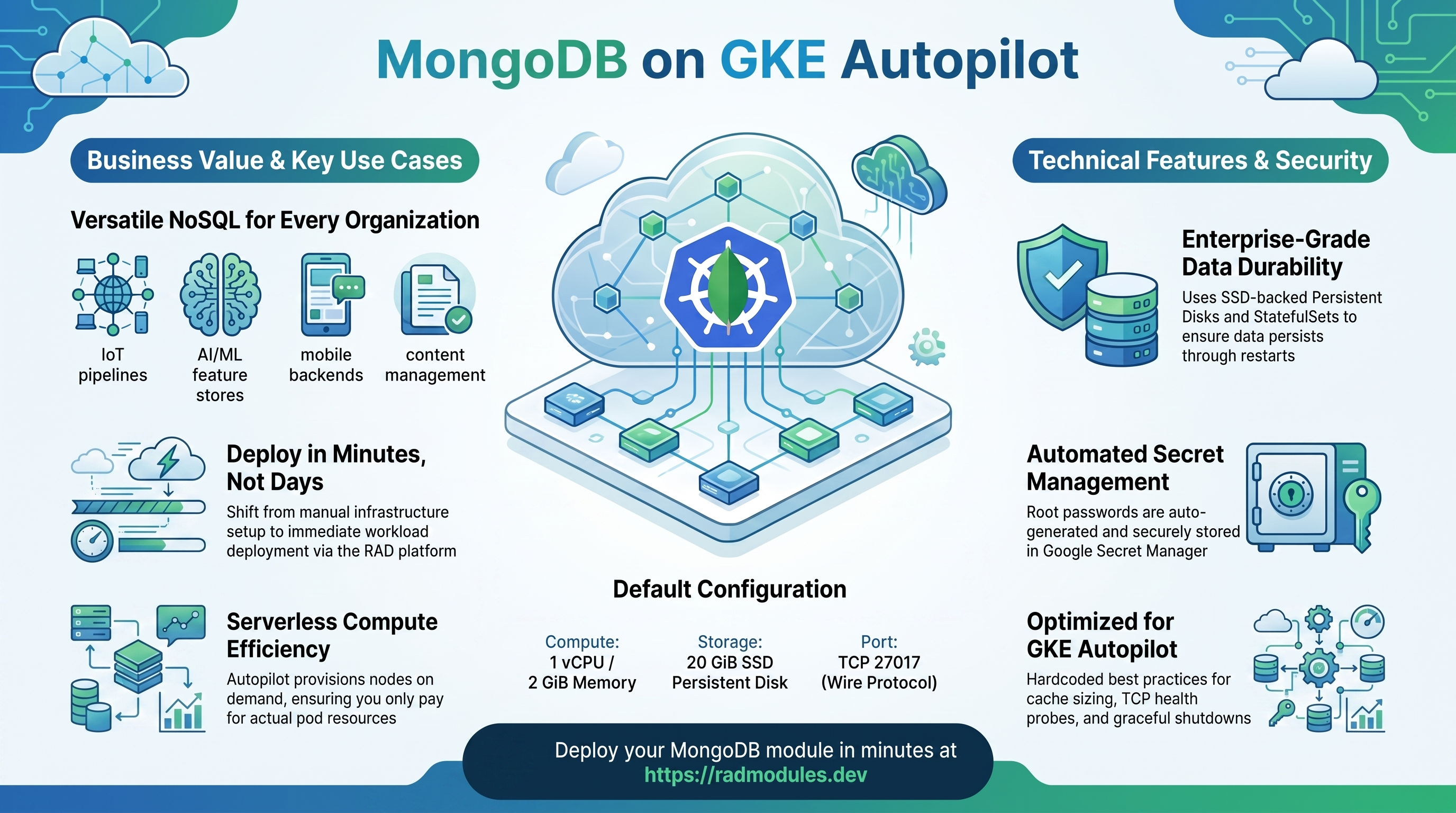
MongoDB is the world's most popular NoSQL document database, used by organisations of every size for content management, IoT data pipelines, mobile backends, and AI/ML feature stores where relational schemas are too rigid. This module deploys MongoDB on GKE Autopilot on top of the App_GKE foundation, which provisions and manages the shared Google Cloud and Kubernetes infrastructure.
This guide focuses on the cloud services MongoDB uses and how to explore and operate them from the Google Cloud Console and the command line. For the mechanics that are common to every GKE application — Workload Identity, ingress, autoscaling, CI/CD, Cloud Armor, IAP, Binary Authorization, VPC Service Controls, backups, and the deployment lifecycle — refer to the App_GKE foundation guide rather than repeating them here.
What MongoDB costs on RAD, and how that compares
Running MongoDB in your own GCP project costs about $96.70/month in Google Cloud charges; RAD's module fee is a one-time 75 credits (or 67.5 credits in a RAD-managed project), covering setup and support -- not the ongoing cloud bill, which Google bills you directly in your own project or RAD meters hourly in credits in a RAD-managed one. If you deploy into a RAD-managed project, you can pause the whole thing for free when you are not using it -- see Pause it for free below.
What you pay on RAD
| Your own project | RAD-managed project | |
|---|---|---|
| Module fee | 75 credits, once | 67.5 credits, once (10% lower) |
| Build time | metered in credits as the build runs (a few credits, typically) | same |
| Google Cloud running cost | ~$96.70/month, billed to your own billing account at Google's list price | ~76 credits/day, metered hourly by RAD at list price plus margin |
Default running cost in your own project
| Resource | US$/month (Google list price, us-central1) |
|---|---|
| GKE Autopilot pod, 1x vCPU / 2 GiB | $39.68 |
| Cloud SQL for PostgreSQL, 1 vCPU / 3.75 GB, zonal, 10 GB SSD | $51.02 |
| Cloud NAT and networking | $5.00 |
| Cloud Storage (add-ons, backups) | $1.00 |
| GKE cluster management fee | shared across every GKE app in the project; $0 if this is your only cluster, else ~$73 |
| Total | $96.70 |
How it compares
- MongoDB's own managed service, Atlas, has a free shared M0 tier and its cheapest dedicated tier (M10, 2 vCPU/2 GB) runs about $57/month (source: https://www.mongodb.com/pricing), run by the project itself with no infrastructure to operate -- the comparison that matters here is less the sticker price and more whether you want the vendor's own cloud or your own GCP project with RAD managing it.
- Running it yourself on a bare VPS is still the cheapest cash option -- Hetzner CPX22 (2 vCPU/4GB) runs about $24/month, a DigitalOcean 2 vCPU/4GB Droplet is also $24/month, and a GCP Compute Engine e2-standard-2 (2 vCPU/8GB) is about $49/month -- plus the admin's own time for backups, security patches and upgrades, which RAD's managed Cloud SQL, Secret Manager and monitoring cover for you -- but RAD's price is never meant to beat a VPS, only to replace the admin time a VPS still needs.
- Either way, this is an application's document database layer, so the running cost above is what actually drives the bill, not the module fee -- and that running cost is the one you can pause (see below).
Pause it for free: delete a RAD-managed project, restore it when you need it
This is the headline for a RAD-managed project. Deleting a RAD-managed project first unlinks its billing, then asks Google to delete the project outright -- Google's own 30-day recoverable soft delete. Unlike deleting one module, this does not tear down Cloud SQL, any VM or the compute resource one by one: the whole project simply stops, and nothing is charged while it waits, because billing is already unlinked.
Restoring, within 30 days and only by the project's owner, asks Google to undelete the project and reattaches its billing account, then asks you to run Update on each deployment to confirm everything came back. Because nothing was individually destroyed, that Update finds the same resources already there -- it is a check, not a rebuild, and an Update never charges the module fee again. This costs only a handful of credits (under US$1) in total for a typical 2-3-deployment chain.
What this needs: you must own the project (not one RAD only manages billing for), you must restore it yourself within 30 days -- after that Google deletes it for good -- and restoring is admitted like creating a new project, so your purchased credit balance must still clear the tier's floor (100 credits for the sandbox tier most study/demo use fits). Google says most services are fully working again within 36 hours of a restore.
One real gap: nightly backups are written to a bucket inside the project, and that bucket has Cloud Storage's soft-delete explicitly turned off, so it is very likely gone as soon as you delete the project -- even though the project itself is recoverable for 30 days. If you have customised the app and want to keep that work, copy a backup out (to Google Drive, or a bucket outside the project) before deleting. For a default install with nothing irreplaceable in it, this does not matter.
Pay only while you use it, the other way: delete and redeploy
In your own project (or once you are past the 30-day restore window above), the alternative is to delete MongoDB outright and redeploy it later. A redeploy costs the module fee again, plus the builds -- roughly 75 + 3-6 credits of build time.
Deleting saves money only once MongoDB would otherwise sit unused long enough to clear that redeploy cost against its own daily running cost -- against the own-project total above, that works out to about 2 days or more. Most of the running cost here is usually the database; it stops only when nothing else in the project uses it, so deleting this app while something else shares the project saves only this app's own compute part.
Keep data first: nightly backups go to a bucket inside the deployment and are deleted with it, so copy the latest backup out before deleting if you want to keep it.
Lab sessions and Managed Environments
- Lab sessions, for training: a trainer runs a session for a class. Each participant gets the app in their own Google Cloud project for 15 minutes to 24 hours, within an allowance the trainer sets. Either the trainer funds every place, or each participant pays for their own. Everything is deleted when the session ends and unused credits go back to the trainer.
- Managed Environments, for consultancies: a partner runs the app for a client from a ring-fenced wallet it funds, and settles with the client directly. If the wallet runs low, billing pauses and the data is kept, so nobody receives an unexpected charge. At the end the partner hands the project over and the deployments become the client's own.
- Credits can be bought in more than 20 currencies, including XAF, XOF, NGN, GHS, KES and ZAR, by card, bank transfer or mobile money.
Sources (8 October 2026): Google Cloud Billing Catalog API list prices; radmodules.dev/pricing for RAD's own fees and daily-credit estimates; https://cloud.google.com/resource-manager/docs/delete-restore-projects for the pause/restore mechanics; https://www.mongodb.com/pricing for the named competitor's price.
1. Overview
MongoDB runs as a StatefulSet on GKE Autopilot. The deployment wires together a focused set of Google Cloud services:
| Capability | Google Cloud service | Notes |
|---|---|---|
| Compute | GKE Autopilot (StatefulSet) | 1 vCPU / 2 GiB by default, single-node mode |
| Persistent storage | Persistent Disk (SSD PVC) | standard-rwo StorageClass, 20 GiB default, mounted at /data/db |
| Secrets | Secret Manager | Auto-generated MongoDB root password |
| Container images | Artifact Registry | Official mongo image mirrored into the project registry |
| Networking | VPC / GKE Service | ClusterIP by default for cluster-internal access; switch to LoadBalancer only if external access to the raw wire protocol is required |
Sensible defaults worth knowing up front:
- No Cloud SQL. MongoDB is its own database engine; Cloud SQL is not
provisioned and
enable_cloudsql_volumeis hardcoded tofalse. - SSD-backed PVC is essential. Without a StatefulSet PVC, all data is lost on
every pod restart.
stateful_pvc_enabled = trueauto-selects a StatefulSet. - Single-node mode only.
min_instance_countandmax_instance_countare both fixed at 1. MongoDB replica sets require additional authentication-key andrs.initiate()setup that is out of scope for this module. - Root password is auto-generated.
MONGO_INITDB_ROOT_PASSWORDis generated and stored in Secret Manager on the first deploy; you never set it in plain text. - TCP probes on port 27017. MongoDB speaks its own binary wire protocol, not HTTP — HTTP probes always fail.
- fsGroup 999 is hardcoded. The official MongoDB image runs
mongodas UID/GID 999; Kubernetes chowns the PVC mount to this GID automatically.
2. Google Cloud Services & How to Explore Them
All commands assume you have run
gcloud container clusters get-credentials <cluster> --region <region> --project <project>
and that PROJECT, REGION, and NAMESPACE are set. The namespace and other
identifiers are reported in the deployment Outputs.
A. GKE Autopilot — the MongoDB StatefulSet
MongoDB runs as a single-pod StatefulSet on Autopilot, which provisions nodes
on demand and bills for the CPU and memory the pod actually requests. Autopilot
must provision a node, attach the PVC, and pull the image before mongod starts
— the startup probe allows up to ~8 minutes to accommodate this.
- Console: Kubernetes Engine → Workloads → select the MongoDB StatefulSet for pod status, events, and resource usage. Kubernetes Engine → Services & Ingress shows the ClusterIP or external LoadBalancer IP.
- CLI:
kubectl get statefulset,pods,svc -n "$NAMESPACE"
kubectl logs -n "$NAMESPACE" statefulset/<statefulset-name> --tail=100
kubectl describe pod -n "$NAMESPACE" <pod-name>   # events and probe status
See App_GKE for how Autopilot, scaling, and the StatefulSet workload type are managed.
B. Persistent Disk — SSD PVC
MongoDB data lives on a Persistent Disk SSD PVC (standard-rwo StorageClass)
mounted at /data/db inside the container. The PVC is provisioned automatically
by GKE when the StatefulSet is created and persists independently of pod restarts,
rolling updates, and node evictions.
- Console: Kubernetes Engine → Storage → PersistentVolumeClaims to see the PVC and its bound volume. Compute Engine → Disks to see the underlying Persistent Disk.
- CLI:
kubectl get pvc -n "$NAMESPACE"
kubectl describe pvc -n "$NAMESPACE" <pvc-name>   # capacity, access mode, status
# Check disk usage inside the running pod:
kubectl exec -n "$NAMESPACE" <pod-name> -- df -h /data/db
The PVC size is set at deploy time by stateful_pvc_size (default 20Gi).
PVC size cannot be decreased after creation. Provision at least 2–3× the
expected initial data volume to avoid the No space left on device crash.
C. Secret Manager — root password
The MongoDB root password (MONGO_INITDB_ROOT_PASSWORD) is auto-generated on
the first deploy and stored as a Secret Manager secret. It is injected into the
pod via the Secret Store CSI driver and never appears in plain text.
- Console: Security → Secret Manager.
- CLI:
gcloud secrets list --project "$PROJECT" --filter="name~mongo-root-password"
gcloud secrets versions access latest \
  --secret=<secret-name> --project "$PROJECT"
To retrieve the root password for a mongosh connection:
ROOT_PASS=$(gcloud secrets versions access latest \
  --secret=<resource-prefix>-mongo-root-password --project "$PROJECT")
kubectl exec -n "$NAMESPACE" <pod-name> -- \
  mongosh --username admin --password "$ROOT_PASS" --authenticationDatabase admin
See App_GKE for the Secret Store CSI integration and rotation.
D. Artifact Registry — container image
The official mongo image is mirrored into the project's Artifact Registry before
deployment so pods never pull directly from Docker Hub. The mirrored image URI is
reported in the container_image output.
- Console: Artifact Registry → select the repository.
- CLI:
gcloud artifacts docker images list \
  <region>-docker.pkg.dev/$PROJECT/<registry-repo> --project "$PROJECT"
E. Networking & ingress
By default the MongoDB Kubernetes Service is ClusterIP — MongoDB is a
database backend meant to be consumed by other in-cluster workloads (e.g.
RocketChat), and ClusterIP already provides cross-namespace access within the
cluster via DNS, so no LoadBalancer is needed. Switch to LoadBalancer only if
external access to the raw MongoDB wire protocol (port 27017) is genuinely
required.
- Console: Kubernetes Engine → Services & Ingress; VPC network → IP addresses.
- CLI:
kubectl get svc -n "$NAMESPACE"
# Get the LoadBalancer external IP:
kubectl get svc -n "$NAMESPACE" <service-name> \
  -o jsonpath='{.status.loadBalancer.ingress[0].ip}'
The mongodb_endpoint output provides the ready-to-use connection URI
(mongodb://<ip>:27017 for LoadBalancer or the in-cluster DNS URI for ClusterIP).
See App_GKE for custom domains, static IPs, and Cloud CDN details.
F. Cloud Logging & Monitoring
Pod stdout/stderr (including mongod startup and query logs) flow to Cloud
Logging. GKE and Persistent Disk metrics flow to Cloud Monitoring.
- Console: Logging → Logs Explorer; Monitoring → Dashboards / Alerting.
- CLI:
gcloud logging read \
  'resource.type="k8s_container" AND resource.labels.namespace_name="'"$NAMESPACE"'"' \
  --project "$PROJECT" --limit 50
3. MongoDB Application Behaviour
- Standalone mode only. This module deploys a single
mongodinstance. MongoDB replica sets (change streams, transactions, oplog replication) require authentication key files andrs.initiate()setup that are outside the scope of this module.max_instance_countis enforced at 1. - First startup initialisation. On the very first boot with a fresh PVC,
MongoDB creates the root user (
MONGO_INITDB_ROOT_USERNAME, defaultadmin) and the initial database (MONGO_INITDB_DATABASE, defaultadmin). These values are immutable after the PVC has been written — changing them after first deploy has no effect (the init script runs only once per data directory). - WiredTiger cache sizing. MongoDB's WiredTiger storage engine defaults its
cache to approximately
(memory_limit − 1 GiB) × 0.5. With the default2Gilimit the cache is ~500 MiB, which is sufficient for development. Scale thememory_limitto4Gi–8Gifor production document workloads. - Startup probe tolerance. GKE Autopilot must provision a node, attach the
PVC, and pull the image before
mongodstarts. The startup probe allows up to ~8 minutes (failure_threshold = 45, checking every 10 seconds). On subsequent pod restarts on a warm node the startup is much faster. - Journal flush on shutdown.
termination_grace_period_secondsis set to 60 seconds (default) so Kubernetes waits formongodto flush the write-ahead journal before forcibly killing the process — preventing journal corruption. - Connection string. The correct format to connect with the root credential
is:
The
mongodb://<username>:<password>@<host>:<port>/<db>?authSource=adminauthSource=adminparameter is required when connecting to non-admin databases with the root account. - Health probes. Both the startup and liveness probes use
type = "TCP"on port 27017. MongoDB speaks its own binary wire protocol — HTTP probes always fail with a protocol error. - No scheduled tasks. MongoDB does not require any platform-side cron jobs.
Application-level tasks (index builds, TTL indices) are managed from within the
application or via
mongosh.
4. Configuration Variables
Variables are grouped exactly as they appear on the deployment platform. Only settings specific to or notable for MongoDB are listed; every other input is inherited from App_GKE with its standard behaviour and defaults.
Group 1 — Project & Identity
| Variable | Default | Description |
|---|---|---|
project_id | (required) | Target Google Cloud project. |
region | us-central1 | Region for the workload and regional resources. |
Group 2 — Deployment Environment
| Variable | Default | Description |
|---|---|---|
tenant_id | demo | Short suffix that makes resource names unique per environment. |
support_users | [] | Emails granted project access and monitoring alerts. |
resource_labels | {} | Labels applied to all resources for cost/ownership tracking. |
Group 3 — Application Identity
| Variable | Default | Description |
|---|---|---|
application_name | mongodb | Base name for resources. Do not change after first deploy. |
application_display_name | MongoDB | Friendly name shown in the Console. |
application_description | (set) | Workload description annotation. |
application_version | 7.0 | MongoDB image version tag; increment to roll out a new version. Major upgrades change the on-disk format — test against a replica before upgrading production. |
mongo_root_username | admin | Root username (MONGO_INITDB_ROOT_USERNAME). Immutable after first PVC write. |
mongo_initdb_database | admin | Initial database created on first startup. Immutable after first PVC write. |
Group 4 — Runtime & Scaling
| Variable | Default | Description |
|---|---|---|
deploy_application | true | Set false to provision infrastructure only. |
cpu_limit | 1000m | CPU per pod. Scale to 2000m for aggregation-heavy workloads. |
memory_limit | 2Gi | Memory per pod. WiredTiger cache ≈ (limit − 1 GiB) × 0.5; scale to 4Gi–8Gi for production. |
min_instance_count | 1 | Minimum replicas. Must be 1 for single-node mode. |
max_instance_count | 1 | Maximum replicas. Enforced at 1 — replica sets are not supported by this module. |
container_port | 27017 | MongoDB wire-protocol port. Sets both the Service port and mongod's listen port. |
enable_image_mirroring | true | Mirror the mongo image into Artifact Registry before deployment. |
enable_vertical_pod_autoscaling | false | Let Autopilot tune resource requests automatically. |
Group 5 — Environment Variables & Secrets
| Variable | Default | Description |
|---|---|---|
environment_variables | {} | Extra non-secret settings. MONGO_INITDB_ROOT_USERNAME and MONGO_INITDB_DATABASE are injected automatically. |
secret_environment_variables | {} | Secret Manager references injected as env vars. Provide MONGO_INITDB_ROOT_PASSWORD here to use a custom password instead of the auto-generated one. |
secret_propagation_delay | 30 | Seconds to wait after the root password secret is created before the pod starts. |
secret_rotation_period | 2592000s | Secret Manager rotation notification frequency. |
Group 6 — GKE Backend & Cluster
| Variable | Default | Description |
|---|---|---|
service_type | ClusterIP | ClusterIP restricts access to within the cluster (sufficient for in-cluster consumers via DNS); LoadBalancer exposes port 27017 with an external IP. |
workload_type | null | Auto-resolves to StatefulSet when stateful_pvc_enabled = true. |
session_affinity | None | No session stickiness required for MongoDB wire-protocol connections. |
gke_cluster_name | "" | GKE cluster name; leave empty for auto-discovery. |
namespace_name | "" | Kubernetes namespace; leave empty to auto-generate. |
termination_grace_period_seconds | 60 | Grace period for mongod to flush the journal before SIGKILL. |
deployment_timeout | 1800 | Seconds Terraform waits for the StatefulSet rollout (covers node provisioning + PVC attach). |
enable_network_segmentation | false | Create Kubernetes NetworkPolicy resources to restrict ingress/egress. |
Group 7 — StatefulSet & PVC
| Variable | Default | Description |
|---|---|---|
stateful_pvc_enabled | null | Set true to enable PVC-backed StatefulSet. Required for data durability. |
stateful_pvc_size | 20Gi | Storage size. Cannot be decreased after creation; provision 2–3× expected data volume. |
stateful_pvc_mount_path | /data/db | Must match MongoDB's --dbpath. Do not change. |
stateful_pvc_storage_class | standard-rwo | GKE Autopilot SSD default. Use premium-rwo for high-throughput workloads. |
stateful_headless_service | null | Create a headless Service for stable pod DNS entries. |
stateful_pod_management_policy | null | OrderedReady or Parallel pod creation order. |
stateful_update_strategy | null | RollingUpdate or OnDelete. |
stateful_fs_group | 0 | fsGroup GID (note: 999 is hardcoded in the module for MongoDB — this variable has no effect). |
Group 8 — Resource Quota
| Variable | Default | Description |
|---|---|---|
enable_resource_quota | false | Cap namespace CPU/memory/object counts. |
quota_memory_requests / quota_memory_limits | "" | Must use binary units (4Gi, 8192Mi) — bare integers are read as bytes and block scheduling. |
Group 9 — Reliability Policies
| Variable | Default | Description |
|---|---|---|
enable_pod_disruption_budget | true | Protect availability during node upgrades. |
pdb_min_available | 1 | Minimum pods available during disruption (for single-node MongoDB, 1 is the only sensible value). |
enable_topology_spread | false | Spread pods across zones. |
Group 10 — Observability & Health
| Variable | Default | Description |
|---|---|---|
startup_probe_config | TCP, 20s delay, failure_threshold 18 | Foundation-level TCP probe input on port 27017. The container's actual startup probe is hardcoded in the module to failure_threshold = 45 (~8 minutes) to cover GKE Autopilot node provisioning + PVC attach + image pull — see Section 3. |
health_check_config | TCP, 30s delay, failure_threshold 3 | TCP liveness probe on port 27017. |
uptime_check_config | disabled | Uptime check — disabled by default as MongoDB is an internal service. |
alert_policies | [] | Optional Cloud Monitoring metric alert policies. |
Group 11 — Jobs & Scheduled Tasks
| Variable | Default | Description |
|---|---|---|
initialization_jobs | [] | Kubernetes Jobs run before the MongoDB pod starts. Not required for MongoDB — no database bootstrap job is needed. |
cron_jobs | [] | Scheduled CronJobs. MongoDB has no required platform-side scheduled tasks. |
Group 12 — CI/CD & GitHub Integration
Standard App_GKE Cloud Build / Cloud Deploy integration — see
App_GKE. Key inputs: enable_cicd_trigger,
github_repository_url, github_token, enable_cloud_deploy.
Group 13 — Filesystem (NFS)
| Variable | Default | Description |
|---|---|---|
enable_nfs | false | NFS is not required for MongoDB — use the StatefulSet PVC instead. |
Group 14 — Cloud Storage & Artifact Registry
| Variable | Default | Description |
|---|---|---|
create_cloud_storage | false | MongoDB does not require a GCS bucket. |
manage_storage_kms_iam / enable_artifact_registry_cmek | false | CMEK options for storage and registry. |
max_images_to_retain | 7 | Recent images to keep in Artifact Registry. |
Group 17 — Backup & Maintenance
| Variable | Default | Description |
|---|---|---|
backup_schedule | 0 2 * * * | Automated mongodump backup cron (UTC). Verify the backup job is active — a missed backup combined with PVC deletion causes permanent data loss. |
backup_retention_days | 7 | Retention; raise to 30–90 for production/compliance. |
Group 19 — Custom Domain & Static IP
| Variable | Default | Description |
|---|---|---|
enable_custom_domain | true | Provisions the Gateway HTTPS ingress (zero-config <ip>.nip.io hostname when application_domains is empty) — unusual for a non-HTTP database service; actual mongodb:// traffic is served by the L4 LoadBalancer Service, not this HTTP(S) ingress. |
application_domains | [] | Custom domain names. |
reserve_static_ip | true | Stable external IP across redeploys. |
network_tags | ["nfsserver"] | Node/pod network tags for firewall rules. |
Group 20 — Identity-Aware Proxy (IAP)
IAP is not recommended for MongoDB (a database, not a web application). Restrict
access instead via service_type = "ClusterIP" or Kubernetes NetworkPolicy.
| Variable | Default | Description |
|---|---|---|
enable_iap | false | Not recommended for MongoDB. Use NetworkPolicy or ClusterIP. |
Group 21 — Cloud Armor
| Variable | Default | Description |
|---|---|---|
enable_cloud_armor | false | Attach a Cloud Armor policy to the Ingress backend. |
admin_ip_ranges | [] | CIDRs allowed privileged access. |
Group 22 — VPC Service Controls & Audit Logging
| Variable | Default | Description |
|---|---|---|
enable_vpc_sc | false | Enforce a VPC-SC perimeter (requires organization_id). |
vpc_cidr_ranges / vpc_sc_dry_run | (set) | Access level CIDRs / dry-run mode. |
enable_audit_logging | false | Detailed Cloud Audit Logs. |
5. Outputs
These values are returned on a successful deployment and are the quickest way to locate and explore the running resources.
| Output | Description |
|---|---|
service_name | Kubernetes Service name. |
namespace | Namespace the workload runs in. |
service_cluster_ip | In-cluster ClusterIP. |
stage_service_cluster_ips | Map of ClusterIPs for stage-specific services (Cloud Deploy). |
service_external_ip | External LoadBalancer IP (when the service type is LoadBalancer). |
mongodb_endpoint | Ready-to-use MongoDB connection URI (mongodb://...). ClusterIP deployments return the in-cluster DNS URI; LoadBalancer deployments return the external URI. |
statefulset_name | Name of the StatefulSet. |
storage_buckets | Created Cloud Storage buckets (empty by default for MongoDB). |
network_name / network_exists / regions | VPC network, presence, available regions. |
container_image / container_registry | Deployed image and Artifact Registry repo. |
monitoring_enabled / monitoring_notification_channels | Monitoring status and channels. |
initialization_jobs | Names of any initialization jobs run. |
deployment_id / tenant_id / resource_prefix | Naming identifiers. |
project_id / project_number | Project identifiers. |
cicd_enabled / cicd_configuration | CI/CD status and details. |
github_repository_url / github_repository_owner / github_repository_name | GitHub repo details. |
artifact_registry_repository / cloudbuild_trigger_name / cloudbuild_trigger_id | Registry and build trigger. |
kubernetes_ready | Whether the cluster/workload is ready. |
vpc_sc_enabled / vpc_sc_perimeter_name / vpc_sc_dry_run_mode | VPC-SC status. |
audit_logging_enabled / artifact_registry_cmek_enabled | Audit logging and CMEK status. |
6. Configuration Pitfalls & Sensible Defaults
Risk: Critical (data loss / outage / security) — High (service degraded) — Medium (cost or partial degradation) — Low (minor).
| Setting | Sensible value | Risk | Consequence if wrong |
|---|---|---|---|
stateful_pvc_enabled | true | Critical | Without a PVC, all MongoDB data is lost on every pod restart, rolling update, or node eviction. |
stateful_pvc_mount_path | /data/db (default) | Critical | Must match MongoDB's --dbpath. Mounting elsewhere causes mongod to write to the ephemeral layer — all data lost on restart. |
MONGO_INITDB_ROOT_PASSWORD | auto-generated (default) | Critical | MongoDB starts without authentication if the env var is absent. Any caller inside the cluster gains unrestricted admin access. Never remove or clear it. |
mongo_root_username / mongo_initdb_database | set once | Critical | Baked into the data directory on first init. Changing after the PVC exists causes startup failure. |
quota_memory_requests / quota_memory_limits | binary units (4Gi) | Critical | Bare integers are read as bytes by Kubernetes, blocking all pod scheduling. |
stateful_pvc_size | 20Gi min, size for workload | High | A full disk causes mongod to crash with No space left on device. Provision 2–3× expected data volume. Size cannot be decreased after creation. |
memory_limit | 4Gi for production | High | WiredTiger cache is ~50% of (limit − 1 GiB). Insufficient cache causes excessive disk I/O and severe query degradation. |
workload_type | null (auto StatefulSet with PVC) | High | Explicitly setting Deployment alongside stateful_pvc_enabled = true fails at plan time. Standalone MongoDB requires StatefulSet for stable PVC binding. |
application_version | test major upgrades first | High | MongoDB major version upgrades change the on-disk storage format. Downgrading is not supported. Always test against a replica of the production PVC. |
backup_schedule | active and tested | High | MongoDB has no built-in automatic backup outside this module's mongodump job. A missed backup combined with deletion of the persistent volume on destroy results in permanent data loss. |
service_type | ClusterIP for DB-tier services (already the default) | High | LoadBalancer exposes port 27017 with a public IP. Leave the ClusterIP default in place unless external access is explicitly required, and use firewall rules or NetworkPolicy if you do switch it. |
termination_grace_period_seconds | 60 (default) | High | Too short a grace period risks journal corruption on shutdown if in-flight writes have not been flushed. |
cpu_limit | 2000m for production | Medium | Aggregation pipelines and index builds are CPU-intensive. Below 500m, complex queries degrade significantly. |
replica set | standalone only | High | This module is single-node. Change streams, transactions, and oplog replication require a replica set — use a Helm-based deployment for multi-node topologies. |
enable_iap | false (default) | Low | IAP is not applicable for database services. Use NetworkPolicy or ClusterIP for access control instead. |
For the foundation behaviour referenced throughout — IAM and Workload Identity, autoscaling, ingress and certificates, CI/CD, Cloud Armor, IAP, Binary Authorization, VPC-SC, backups, and image mirroring — see App_GKE. MongoDB_GKE has no separate Common module; all MongoDB-specific configuration is self-contained in the module.
Related guides
- Hands-on lab: MongoDB on GKE Autopilot — deploy it step by step, with the console screens and commands at each stage.
- Deployed alongside Elasticsearch on GKE Autopilot, Meilisearch on GKE Autopilot, Qdrant on Google Cloud Run in the Shared Data Services solution.
Need RAD to do something it does not do yet? Request it on the roadmap, or vote on what is already there.