Planka on GKE Autopilot
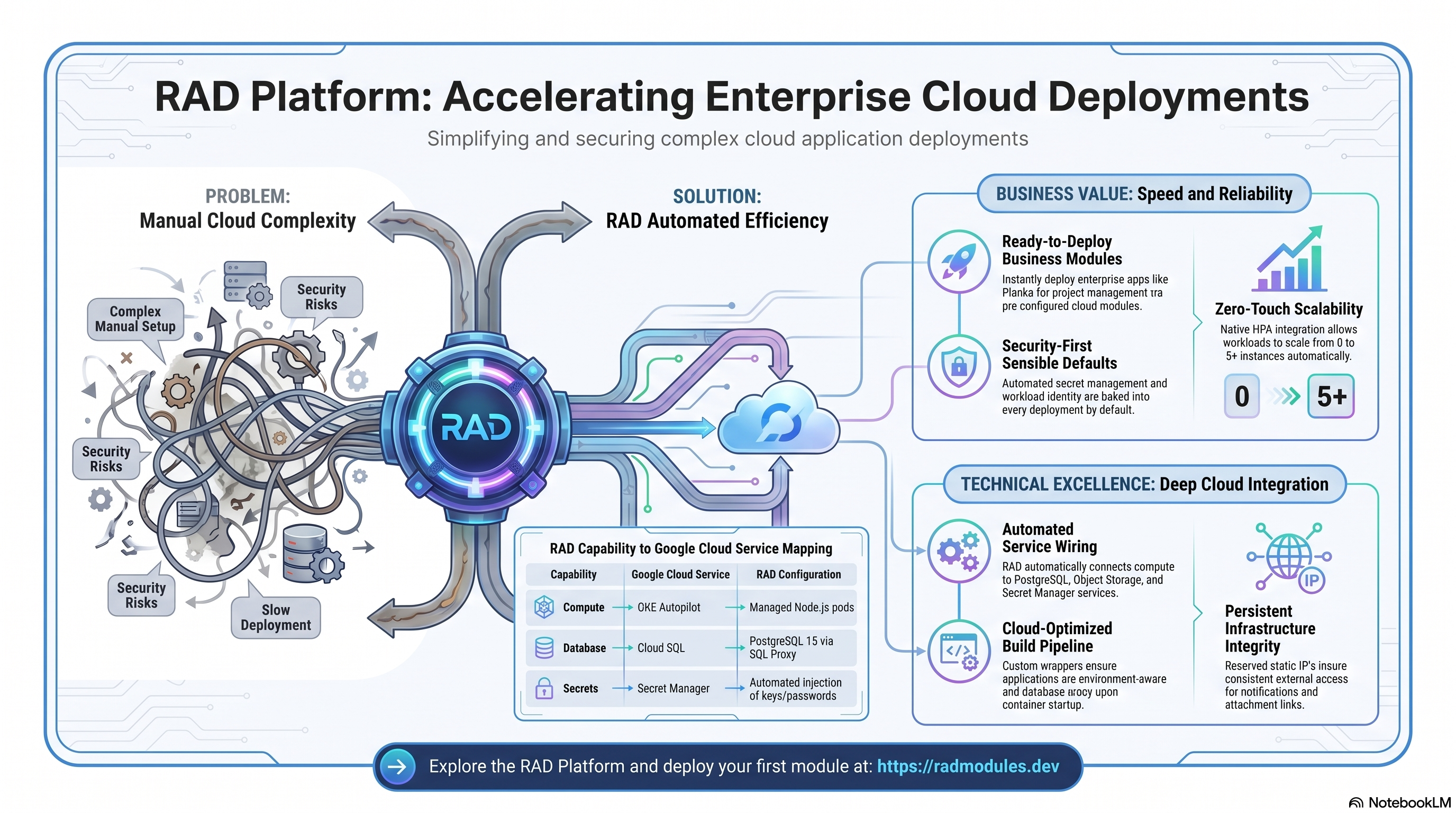
Planka is an open-source, self-hosted, Trello-like kanban board application with a Node.js (Sails.js) backend and a React frontend, used for team and personal project management — boards, lists, cards, due dates, labels, and file attachments. This module deploys Planka on GKE Autopilot on top of the App_GKE foundation, which provisions and manages the shared Google Cloud and Kubernetes infrastructure.
This guide focuses on the cloud services Planka uses and how to explore and operate them from the Google Cloud Console and the command line. For the mechanics common to every GKE application — Workload Identity, ingress, autoscaling, CI/CD, Cloud Armor, IAP, Binary Authorization, VPC Service Controls, backups, and the deployment lifecycle — refer to the App_GKE foundation guide rather than repeating them here.
What Planka costs on RAD, and how that compares
Running Planka in your own Google Cloud project costs about US$136.37/month in infrastructure, plus a one-time module fee of 110 RAD credits (sized at 2 vCPU / 4 GiB on GKE Autopilot pods). RAD charges the module fee once, at deploy time — never again on Update — plus build time metered in credits; Google Cloud usage itself is billed to your own billing account at Google's list price. On a RAD-managed project the same resources are metered hourly in credits at list price plus RAD's margin — about 105 credits/day — and the module fee is 10% lower, at 99 credits. See "Pause it for free" below for how a RAD-managed Planka deployment can be stopped, at no running cost, until you need it again. (or see the Cloud Run guide for the lower-cost option)
What you pay on RAD
| Item | Own project | RAD-managed project |
|---|---|---|
| Module fee | 110 credits (once) | 99 credits (once) |
| Build time | ~3-6 credits, metered per build minute | same, metered in credits at list price + RAD's margin |
| Google Cloud running cost | ~$136.37/month, billed to your own billing account at Google's list price | ~105 credits/day, metered hourly at list price + RAD's margin |
Default running cost in your own project
| Resource | US$/month (Google list price, us-central1) |
|---|---|
| GKE Autopilot pod, 2x vCPU / 4 GiB | 79.35 |
| Cloud SQL for PostgreSQL, 1 vCPU / 3.75 GB, zonal, 10 GB SSD | 51.02 |
| Cloud NAT and networking | 5 |
| Cloud Storage (add-ons, backups) | 1 |
| GKE cluster management fee* | shared across every GKE app in the project; $0 if this is your only cluster, else ~73 |
| Total | $136.37 |
* Not included in the total above — it is shared across every GKE app running in the same project, so it is $0 if this is your only GKE cluster.
How it compares
- We could not verify a current, directly-comparable commercial SaaS price for this exact open-source project, so the honest comparison is a bare self-managed server: Hetzner CPX22 (2 vCPU/4GB,
$24/mo), a DigitalOcean 2 vCPU/4GB Droplet ($24/mo), or a GCP Compute Engine e2-standard-2 (2 vCPU/8GB, ~$49/mo). - RAD is not claiming to beat a bare VPS on sticker price — it usually does not. What RAD adds for the same or a similar dollar figure is a managed database, Secret Manager-held credentials, monitoring, and one-click Update, none of which a bare VPS gives you for free.
- On a bare VPS you are the one applying OS/database security patches, taking and testing backups, and renewing certificates; RAD's managed Cloud SQL, Secret Manager and monitoring handle all three for you.
Pause it for free: delete a RAD-managed project, restore it when you need it
This is the headline option on a RAD-managed project, and it is free while paused. Deleting a RAD-managed project first unlinks its billing, then asks Google to delete the project itself — Google's own 30-day recoverable soft delete. Unlike deleting a single module, this does not tear down the database, any VM, or the compute resource one at a time: the whole project simply stops, and because billing is already unlinked, nothing is charged while it waits.
Restoring — within 30 days, and only by the project's owner — asks Google to undelete the project and reattaches its billing account, then asks you to run Update on each deployment to confirm everything came back. Because nothing was individually destroyed, that Update finds the same resources already there: it is a check, not a rebuild, and an Update never charges the module fee again. The whole restore costs only a handful of credits (under US$1) in build time for a typical chain of deployments. What this needs: you must own the project (not merely have RAD manage its billing), you must restore it yourself within the 30 days — after that Google deletes it for good — and restoring is admitted like creating a new project, so your purchased credit balance must still clear the tier's floor (100 credits for the sandbox tier most study and demo use fits). Google says most services are fully working again within 36 hours of a restore.
One real gap: nightly backups are written to a bucket inside the project, and that bucket has Cloud Storage's soft-delete explicitly turned off, so the backup bucket is very likely gone as soon as you delete the project — even though the project itself is recoverable for 30 days. If you have customised this deployment and want to keep that work, copy a backup out (to Google Drive, or a bucket outside the project) before deleting. For a default install with nothing irreplaceable in it, this does not matter.
Pay only while you use it, the other way: delete and redeploy
The other lever, for an own project (or a RAD-managed one past its 30-day restore window), is to delete Planka outright and redeploy it later. A redeploy costs the module fee again plus the builds — roughly 113-116 credits in total for this module.
Deleting only saves money once Planka would otherwise sit unused long enough to clear that redeploy cost against its own running cost — for this module, that is about 3 days or more of being idle, based on its own US$136.37/month running cost above. Most of that running cost is usually the database and any shared file/cache VM, and they stop only once nothing else in the project uses them, so deleting this app alone saves only its own compute share if something else shares the project.
Keep data first: nightly backups go to a bucket inside the deployment and are deleted with it, so copy the latest backup out before deleting if you want to keep it.
Lab sessions and Managed Environments
- Lab sessions, for training: a trainer runs a session for a class. Each participant gets the app in their own Google Cloud project for 15 minutes to 24 hours, within an allowance the trainer sets. Either the trainer funds every place, or each participant pays for their own. Everything is deleted when the session ends and unused credits go back to the trainer.
- Managed Environments, for consultancies: a partner runs the app for a client from a ring-fenced wallet it funds, and settles with the client directly. If the wallet runs low, billing pauses and the data is kept, so nobody receives an unexpected charge. At the end the partner hands the project over and the deployments become the client's own.
- Credits can be bought in more than 20 currencies, including XAF, XOF, NGN, GHS, KES and ZAR, by card, bank transfer or mobile money.
Sources (8 October 2026): Google Cloud Billing Catalog API list prices; radmodules.dev/pricing for RAD's own fees and daily-credit estimates; Resource Manager: delete and restore projects for the pause/restore mechanics.
1. Overview
Planka runs as a single Node.js web workload, serving both its API and its React frontend from one port. The deployment wires together a small, focused set of Google Cloud services:
| Capability | Google Cloud service | Notes |
|---|---|---|
| Compute | GKE Autopilot | Node.js pod, 2 vCPU / 4 GiB by default |
| Database | Cloud SQL for PostgreSQL 15 | Planka's Knex query builder supports no other engine |
| Object storage | Cloud Storage | A storage bucket is created and mounted at /app/data for attachments, avatars and backgrounds |
| Cache & queue | none | Planka has no Redis or queue dependency — real-time updates ride Socket.io in-process |
| Secrets | Secret Manager | SECRET_KEY and DEFAULT_ADMIN_PASSWORD — both real, functional secrets — plus the database password |
| Ingress | Cloud Load Balancing | External LoadBalancer, reserved static IP, optional custom domain |
Sensible defaults worth knowing up front:
- PostgreSQL is the only supported engine.
Planka_Commonfixesdatabase_type = "POSTGRES_15". - A thin custom build, not the prebuilt image. Planka needs a cloud
entrypoint to compose
DATABASE_URLand deriveBASE_URL, socontainer_image_source = "custom"buildsFROM ghcr.io/plankanban/planka:<version>via Cloud Build. DATABASE_URLis a URL-authority connection string, but SSL is set via separate env vars — never a?sslmode=query parameter. Planka has two independent DB connection paths (the migration CLI and the running server's Sails ORM), each needing SSL configured a different way, and each ignoring a URL-embedded?sslmode=for its own, unrelated reason. On GKE, the Cloud SQL Auth Proxy sidecar listens on127.0.0.1and terminates TLS itself, so the entrypoint sets neitherPGSSLMODEnorKNEX_REJECT_UNAUTHORIZED_SSL_CERTIFICATEfor that loopback connection — no SSL config is needed at all. See the Common guide for the full two-path explanation and the private-IP TCP branch.- Two real, functional application secrets.
SECRET_KEY(session/token signing, required at boot) andDEFAULT_ADMIN_PASSWORD(seeds the initial admin account on first, empty-database boot) are both genuinely consumed by Planka. There is no forced password-reset prompt, so change the seeded password immediately after first deploy. workload_typedefaults toDeployment, notStatefulSet. Planka keeps no local state beyond what's already in Cloud SQL.reserve_static_ip = true(overriding the App_GKE default offalse). The cloud entrypoint derivesBASE_URLfrom the injectedGKE_SERVICE_URL; without a reserved static IP,BASE_URLcan fall back to unreachable internal*.svc.cluster.localDNS, breaking attachment links and email notifications.- Attachments persist by default. The module mounts the
storageGCS bucket at Planka's/app/datapath, which holds every upload type. If you enable a block PVC instead (stateful_pvc_enabled = true), the bucket mount is dropped so the two never collide. - No Redis, no NFS.
enable_redisandenable_nfsboth default tofalse— Planka needs neither a cache/queue backend nor POSIX filesystem sharing.
2. Google Cloud Services & How to Explore Them
All commands assume you have run
gcloud container clusters get-credentials <cluster> --region <region> --project <project>
and that PROJECT, REGION, and NAMESPACE are set.
A. GKE Autopilot — the Planka workload
- CLI:
kubectl get pods,svc -n "$NAMESPACE"
kubectl logs -n "$NAMESPACE" deploy/<service-name> --tail=100
kubectl exec -n "$NAMESPACE" deploy/<service-name> -- env | grep -E 'DB_HOST|DB_IP|BASE_URL'
B. Cloud SQL for PostgreSQL 15
Pods reach the database privately through the cloud-sql-proxy sidecar over
127.0.0.1. On first deploy an initialization Job creates the application
database and role; Planka then runs its own migrations and seed on every pod
start.
- CLI:
gcloud sql instances list --project "$PROJECT"
gcloud sql connect <instance-name> --user=<db-user> --database=<db-name> --project "$PROJECT"
C. Cloud Storage
- CLI:
gcloud storage buckets list --project "$PROJECT" --filter="name~planka"
D. Secret Manager
- CLI:
gcloud secrets list --project "$PROJECT" --filter="name~planka"
gcloud secrets versions access latest --secret=<secret-name> --project "$PROJECT"
E. Networking & ingress
By default the workload is exposed through an external Cloud Load Balancing
IP with a reserved static address. Planka's BASE_URL (used for attachment
links and email notifications) is derived from this address — update
BASE_URL explicitly if a custom domain is layered on afterward.
- CLI:
kubectl get svc -n "$NAMESPACE" -o wide
F. Cloud Logging & Monitoring
- CLI:
kubectl logs -n "$NAMESPACE" deploy/<service-name> --tail=100 -f
3. Planka Application Behaviour
- First-deploy database setup. An initialization Job runs
db-init.sh, idempotently creating the application role and database (noCREATEROLE/CREATEDBneeded). - Schema migrations and seed on every boot. The official image's own
start.shrunsnode db/init.js(migrations + seed) before starting the server. - Real admin bootstrap credential — no forced reset. Planka seeds
admin@example.comwith the generatedDEFAULT_ADMIN_PASSWORDon first (empty-database) boot, with no forced password-reset prompt — log in and change the password via Planka's own UI promptly after deploy. DATABASE_URLcomposed by the cloud entrypoint. Built at container startup from the Foundation-injectedDB_*values (the password is a runtime Secret Manager value, unavailable at plan time). See Planka_Common for the full detail.- Health path. Startup and liveness probes are configured via the
startup_probe/liveness_probevariables. Planka's ownserver/healthcheck.jstargets the root path/with no auth, and this module'sstartup_probe/liveness_probevariables now correctly default topath = "/"to match. - Inspect job execution:
kubectl get jobs -n "$NAMESPACE"
kubectl logs -n "$NAMESPACE" job/<job-name>
4. Configuration Variables
Variables are grouped exactly as they appear on the deployment platform. Only settings specific to or notable for Planka are listed; every other input is inherited from App_GKE with its standard behaviour.
Group 3 — Application Identity
| Variable | Default | Description |
|---|---|---|
application_name | planka | Base name for resources. |
application_version | latest | Used as the PLANKA_VERSION build ARG. |
Group 4 — Runtime & Scaling
| Variable | Default | Description |
|---|---|---|
container_image_source | custom | Planka needs the cloud-entrypoint wrapper — keep custom. |
container_port | 1337 | Planka's native default port; container port and probes must match. |
min_instance_count / max_instance_count | 0 / 5 | HPA scaling bounds. |
container_resources.memory_limit | 4Gi | Planka requires at least 2Gi for reliable operation. |
Group 6 — GKE Backend & Cluster
| Variable | Default | Description |
|---|---|---|
workload_type | null (→ Deployment) | Planka is stateless at the pod level. |
service_type | LoadBalancer | Public-facing kanban app — a ClusterIP override has no reason here. |
session_affinity | ClientIP | Sticky routing so a client stays on one pod. |
Group 14 — Cloud Storage
| Variable | Default | Description |
|---|---|---|
storage_buckets | one storage bucket | Created and auto-mounted at /app/data (unless a block PVC is enabled). |
gcs_volumes | [] | Not needed for uploads — the module already mounts its bucket at /app/data. |
Group 16 — Database Configuration
| Variable | Default | Description |
|---|---|---|
database_type | POSTGRES_15 | Fixed — Knex supports no other engine. |
application_database_name / application_database_user | planka / planka | PostgreSQL database name and application username. |
Group 10 — Observability & Health
| Variable | Default | Description |
|---|---|---|
startup_probe / liveness_probe | HTTP /, 60s delay | The probes actually applied to the deployed pod, now matching Planka's real, unauthenticated health target (server/healthcheck.js). |
startup_probe_config / health_check_config | HTTP /, 60s delay | Foundation-level defaults; superseded by startup_probe/liveness_probe above — effectively inert. |
Group 13 — NFS
| Variable | Default | Description |
|---|---|---|
enable_nfs | false | Not needed — Planka has no POSIX filesystem requirement. |
Group 15 — Redis
| Variable | Default | Description |
|---|---|---|
enable_redis | false | Planka has no cache/queue dependency. |
Group 19 — Custom Domain, Static IP & Networking
| Variable | Default | Description |
|---|---|---|
enable_custom_domain | true | Provisions an Ingress + managed certificate. |
reserve_static_ip | true | Overrides the App_GKE default (false) so BASE_URL resolves to a real, reachable address — see §1. |
5. Outputs
| Output | Description |
|---|---|
service_name / service_url / service_external_ip | Kubernetes Service identity and address. |
database_instance_name / database_name / database_user / database_host / database_port | Cloud SQL connection details. |
storage_buckets | The storage bucket for attachments. |
kubernetes_ready | Whether the workload reached Ready state. |
6. Configuration Pitfalls & Sensible Defaults
Risk: Critical (data loss / outage / security) — High (service degraded) — Medium (cost or partial degradation) — Low (minor).
| Setting | Sensible value | Risk | Consequence if wrong |
|---|---|---|---|
application_database_name / application_database_user | Set once | Critical | Immutable after first deploy; renaming recreates the DB/role and destroys all data. |
container_image_source | custom (default) | High | "prebuilt" deploys the official image directly, skipping the cloud entrypoint — Planka boots with no DATABASE_URL. |
startup_probe / liveness_probe path | / (the module default) | High | Matches Planka's real, unauthenticated health target (per server/healthcheck.js, a plain HTTP GET to / checking for 200). If overridden to another path, the pod can fail to become Ready. |
reserve_static_ip | true (already the module default) | High | false can leave BASE_URL pointed at unreachable internal *.svc.cluster.local DNS, breaking attachment links and email notifications. |
DEFAULT_ADMIN_PASSWORD (generated secret) | Log in and change it immediately after first deploy | Critical | Planka does not force a password reset — anyone who obtains the seeded password can log in as admin indefinitely until it's changed. |
DATABASE_URL / SSL config | Never hand-edit — controlled by the cloud entrypoint via PGSSLMODE/KNEX_REJECT_UNAUTHORIZED_SSL_CERTIFICATE env vars, NOT a ?sslmode= query param | Critical | Planka has two independent DB connection paths with different SSL mechanisms, confirmed by tracing the actual dependency chain: (1) the migration CLI (server/db/knexfile.js) reads KNEX_REJECT_UNAUTHORIZED_SSL_CERTIFICATE; (2) the running server's Sails ORM (sails-postgresql → machinepack-postgresql) parses DATABASE_URL with Node's legacy url.parse(), which silently drops every query parameter including ?sslmode= — so a URL-embedded sslmode does nothing for the runtime path. With no explicit ssl config, raw pg falls back to the PGSSLMODE environment variable, where require means "encrypt AND verify" (not "encrypt only" like classic libpq) — only PGSSLMODE=no-verify skips certificate verification. Cloud SQL's self-signed cert isn't in Node's CA bundle, so anything but no-verify fails at boot with UNABLE_TO_VERIFY_LEAF_SIGNATURE and the Sails orm hook never loads. The GKE loopback connection (Cloud SQL Auth Proxy sidecar) needs neither var set — the proxy already terminates TLS. |
gcs_volumes at /app/data | Leave empty | Medium | The module already mounts its storage bucket at /app/data; a second mount at the same path conflicts. |
quota_memory_requests / _limits | binary units (4Gi, 8192Mi) | Critical | Bare integers are bytes and block all pod scheduling in the namespace. |
For the foundation behaviour referenced throughout — IAM and Workload Identity, autoscaling, ingress and certificates, CI/CD, Cloud Armor, IAP, Binary Authorization, VPC-SC, backups, and image mirroring — see App_GKE. Planka-specific application configuration shared with the Cloud Run variant is described in Planka_Common.
Related guides
- Hands-on lab: Planka on GKE Autopilot — deploy it step by step, with the console screens and commands at each stage.
- Planka on Google Cloud Run — the same application on Cloud Run, for when you need the other deployment target.
- Planka Common — Shared Application Configuration — the configuration shared by both deployment targets.
Need RAD to do something it does not do yet? Request it on the roadmap, or vote on what is already there.