Woodpecker CI on GKE Autopilot
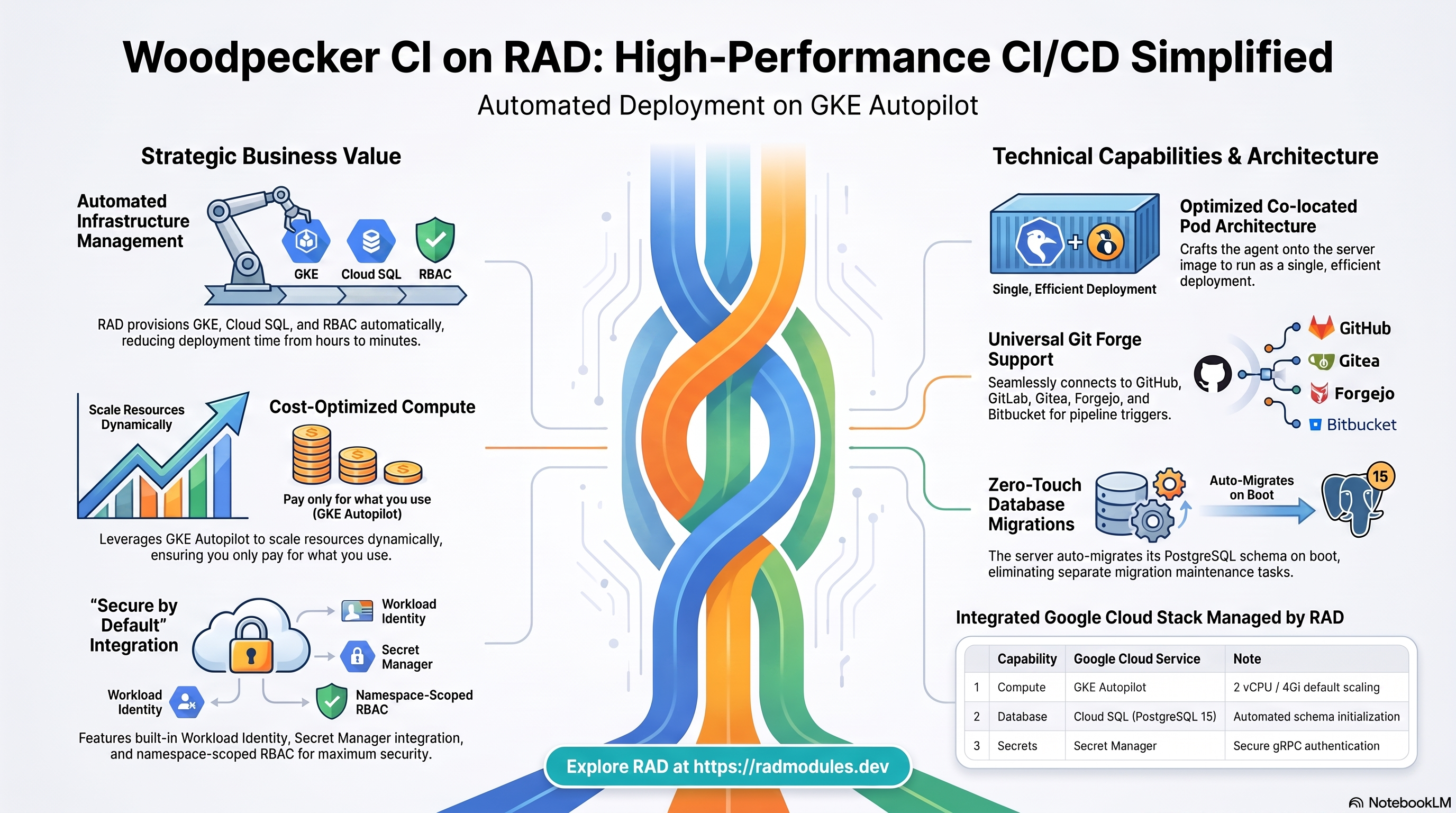
Woodpecker CI is a lightweight, container-native CI/CD engine — a simpler, self-hostable alternative to Drone. Pipelines are defined as YAML files, and each pipeline step runs in its own container. Woodpecker supports GitHub, Gitea, Forgejo, GitLab, and Bitbucket as "forges" — the term Woodpecker uses for the connected git host. This module deploys Woodpecker on GKE Autopilot on top of the App_GKE foundation, which provisions and manages the shared Google Cloud and Kubernetes infrastructure.
There is no Woodpecker_CloudRun, and there will not be one. Woodpecker's
execution backend (WOODPECKER_BACKEND=kubernetes) needs real Kubernetes API
access to dynamically create a pod for every pipeline step — Cloud Run has no
privilege for docker-in-docker and no Kubernetes API to call. See
Woodpecker_Common for the full writeup; this is the
same architectural class of gap as this catalogue's other Common + GKE
only modules (Kopia, RocketChat, Immich, Temporal, Prowlarr,
VictoriaMetrics, Plausible, LobeChat, Supabase).
This guide focuses on the cloud services Woodpecker uses and how to explore and operate them from the Google Cloud Console and the command line. For the mechanics common to every GKE application — Workload Identity, ingress, autoscaling, CI/CD, Cloud Armor, IAP, Binary Authorization, VPC Service Controls, and the deployment lifecycle — refer to the App_GKE foundation guide rather than repeating them here.
What Woodpecker CI costs on RAD, and how that compares
Running Woodpecker CI on GKE Autopilot pods in your own Google Cloud project costs about $136.37/month in Google Cloud charges, on top of a one-off 175-credit RAD module fee charged once at deploy time. Woodpecker needs a PostgreSQL database behind it, which together with the pod itself is most of that $136.37. In a RAD-managed project the module fee drops to 157.5 credits (10% lower) and the running cost is metered hourly in credits instead of billed directly by Google — see Pause it for free below for the one RAD-managed advantage a self-hosted VPS cannot match. Woodpecker is offered on GKE only — there is no Cloud Run variant of this module.
What you pay on RAD
| Own project | RAD-managed project | |
|---|---|---|
| Module fee (one-off) | 175 credits | 157.5 credits (10% lower) |
| Build time | ~3-6 credits per build, either way | ~3-6 credits per build, either way |
| Google Cloud running cost | $136.37/month, billed by Google at list price | ~106 credits/day, metered at list price plus RAD's margin |
Default running cost in your own project
| Resource | US$/month (Google list price, us-central1) |
|---|---|
| GKE Autopilot pod, 2x vCPU / 4 GiB | $79.35 |
| Cloud SQL for PostgreSQL, 1 vCPU / 3.75 GB, zonal, 10 GB SSD | $51.02 |
| Cloud NAT and networking | $5.00 |
| Cloud Storage (add-ons, backups) | $1.00 |
| GKE cluster management fee | shared across every GKE app in the project; $0 if this is your only cluster, else ~73 |
| Total | $136.37 |
The GKE cluster management fee is excluded from the total above because it is shared across every GKE app in the project — $0 if this is the only one, otherwise roughly $73/month split across however many you run.
How it compares
- Woodpecker CI ships as self-hosted software only — its project site carries no hosted SaaS offering (checked 8 October 2026), so the comparison is "manage a VPS yourself" vs "let RAD manage the same Postgres-backed stack."
- A self-managed comparison: Hetzner CPX22 (2 vCPU/4GB) runs about $24/mo, a DigitalOcean 2 vCPU/4GB Droplet is the same $24/mo, and a GCP Compute Engine e2-standard-2 (2 vCPU/8GB) is about $49/mo — enough to run the Woodpecker server, an agent and Postgres together, at a lower sticker price than RAD's managed GKE stack.
- What that price doesn't include: backups, security patches, TLS renewal and the operational load of keeping a CI server patched and online — RAD's managed Cloud SQL, Secret Manager and monitoring absorb that for you.
Pause it for free: delete a RAD-managed project, restore it when you need it
This is the headline advantage of a RAD-managed project, and it costs nothing while paused. Deleting a RAD-managed project unlinks its billing first, then asks Google to delete the project outright — Google's own 30-day recoverable soft delete. Unlike deleting one module, this does not tear down Cloud SQL, any VM, or the compute resource one by one: the whole project simply stops, and nothing is charged while it waits, because billing is already unlinked.
Restoring, within 30 days and only by the project's owner, asks Google to undelete the project and reattaches its billing account, then asks you to run Update on each deployment to confirm everything came back. Because nothing was individually destroyed, that Update finds the same resources already there — it is a check, not a rebuild, and an Update never charges the module fee again. This costs only a handful of credits (under US$1) in total for a typical 2-3-deployment chain.
What this needs: you must own the project (not one RAD only manages billing for), you must restore it yourself within 30 days — after that Google deletes it for good — and restoring is admitted like creating a new project, so your purchased credit balance must still clear the tier's floor (100 credits for the sandbox tier most study/demo use fits). Google says most services are fully working again within 36 hours of a restore.
One real gap: nightly backups are written to a bucket inside the project, and that bucket has Cloud Storage's soft-delete explicitly turned off, so it is very likely gone as soon as you delete the project — even though the project itself is recoverable for 30 days. If you've customised Woodpecker CI and want to keep that work, copy a backup out (to Google Drive, or a bucket outside the project) before deleting. For a default install with nothing irreplaceable in it, this does not matter.
Pay only while you use it, the other way: delete and redeploy
In your own project, or once 30 days have passed on a RAD-managed one, there is no free pause — deleting removes the resources for good, and bringing Woodpecker CI back means redeploying from scratch. That costs about 178-181 credits (the 175-credit module fee plus a build).
Deleting only saves money once Woodpecker CI would otherwise sit unused long enough to clear that redeploy cost against its own running cost — for Woodpecker CI, that's about 4 days or more. Most of this running cost is usually the database — it stops only once nothing else in the project uses it, so deleting this app while something else shares the project saves only its own compute share.
Keep data first: nightly backups go to a bucket inside the deployment and are deleted with it, so copy the latest backup out before deleting if you want to keep it.
Lab sessions and Managed Environments
Lab sessions, for training: a trainer runs a session for a class. Each participant gets the app in their own Google Cloud project for 15 minutes to 24 hours, within an allowance the trainer sets. Either the trainer funds every place, or each participant pays for their own. Everything is deleted when the session ends and unused credits go back to the trainer.
Managed Environments, for consultancies: a partner runs the app for a client from a ring-fenced wallet it funds, and settles with the client directly. If the wallet runs low, billing pauses and the data is kept, so nobody receives an unexpected charge. At the end the partner hands the project over and the deployments become the client's own.
Credits can be bought in more than 20 currencies, including XAF, XOF, NGN, GHS, KES and ZAR, by card, bank transfer or mobile money.
Sources (8 October 2026): Google Cloud Billing Catalog API list prices; radmodules.dev/pricing for RAD's own fees and daily-credit estimates; Google's project delete/restore documentation for the pause/restore claims.
1. Overview
Woodpecker runs as a single pod that co-locates the server and the agent in one container, backed by Cloud SQL PostgreSQL:
| Capability | Google Cloud service | Notes |
|---|---|---|
| Compute | GKE Autopilot | One pod runs both the server (HTTP API + web UI) and the agent (pipeline-step executor), 2 vCPU / 4Gi by default |
| Database | Cloud SQL for PostgreSQL 15 | Server auto-migrates its own schema on boot; no separate migrate job |
| Pipeline execution | GKE Autopilot, via a namespace-scoped RBAC Role | The agent dynamically creates a Kubernetes Pod (plus PVCs/Services/Secrets as needed) for every pipeline step, in the SAME namespace the agent itself runs in |
| Secrets | Secret Manager | One secret: WOODPECKER_AGENT_SECRET, authenticating the co-located server↔agent gRPC connection |
| Forge (git host) | none provisioned — external | Placeholder Gitea/Forgejo values by default; point at a real instance post-deploy |
| Ingress | Cloud Load Balancing | LoadBalancer by default; the reference deployment used ClusterIP due to exhausted external-IP quota (see §6) |
Sensible defaults worth knowing up front:
- Server and agent are co-located in one pod, not two. Upstream Woodpecker
ships the server and agent as two separate images (docker-compose runs them
as two containers). This module grafts the agent binary onto the server
image and starts it as a background process before
exec-ing the server — necessary because the agent's Kubernetes backend must run under the SAME Kubernetes ServiceAccount that holds the elevated RBAC this module grants, and GKE's genericadditional_servicesmechanism does not run sidecar Deployments under the main app's own ServiceAccount (only the primary Deployment does). - The agent needs elevated in-cluster RBAC.
Woodpecker_GKE'swoodpecker.tfprovisions a namespace-scopedkubernetes_role_v1+kubernetes_role_binding_v1directly (noApp_GKEfoundation change was needed). See §3 for the full detail. - No
:latesttag exists upstream, by design. Confirmed live:docker run woodpeckerci/woodpecker-server:latestjust prints a tag-schema notice and exits — a deliberate anti-accidental-major-upgrade measure.application_version = "latest"resolves internally to a pinnedv3.16.0. - Both upstream images are genuinely distroless. Confirmed via
docker export: the entire rootfs is the single binary plus/etc/passwd,group, hosts— no shell at all. The custom image grafts a staticbusybox:muslbinary (the defaultbusybox:stabletag is dynamically linked and fails in this libc-less rootfs) so the cloud entrypoint can run. - The server hard-requires a forge to boot at all. Confirmed live: omitting forge configuration is a fatal exit ("forge not configured"), not a degraded empty page. This module defaults to placeholder Gitea/Forgejo values so it deploys cleanly; real pipeline triggers need a real forge registered post-deploy (§6).
- Single instance, non-negotiable.
max_instance_countis hard-capped at1by a plan-time validation — each pod runs a co-located server+agent, and Woodpecker's server has no documented/verified multi-instance coordination for its own database-backed state. - Health endpoint:
GET /healthz, confirmed live to return204 No Content, unauthenticated.
2. Google Cloud Services & How to Explore Them
All commands assume you have run
gcloud container clusters get-credentials <cluster> --region <region> --project <project>
and that PROJECT, REGION, and NAMESPACE are set. The namespace and other
identifiers are reported in the deployment Outputs.
A. GKE Autopilot — the Woodpecker workload
A single pod runs both the server and the agent (Deployment by default).
- Console: Kubernetes Engine → Workloads → select the Woodpecker workload to see the pod and events.
- CLI:
kubectl get deployment,pods,svc -n "$NAMESPACE"
kubectl logs -n "$NAMESPACE" deployment/<service-name> --tail=100
See App_GKE for how Autopilot scheduling and Workload Identity work.
B. Cloud SQL — PostgreSQL 15
gcloud sql instances list --project "$PROJECT"
gcloud sql databases list --instance=<instance-name> --project "$PROJECT"
No separate migrate job runs — confirmed live: Woodpecker's server
auto-migrates its own schema on boot ("Initializing Schema" appears
automatically against an empty database). Only a db-init job (role +
database creation) runs on first deploy.
C. Secret Manager — one secret
gcloud secrets list --project "$PROJECT" --filter="name~agent-secret"
gcloud secrets versions access latest --project "$PROJECT" --secret=<secret-name>
WOODPECKER_AGENT_SECRET authenticates the co-located server's and agent's
internal gRPC connection to each other. See
Woodpecker_Common §2
for detail.
D. RBAC — the agent's pipeline-execution permissions
kubectl get role,rolebinding -n "$NAMESPACE"
kubectl describe role <resource-prefix> -n "$NAMESPACE"
A namespace-scoped Role grants {persistentvolumeclaims, services, secrets: create, delete}, {pods: watch, create, delete, get, list}, and
{pods/log: get} — sourced from Woodpecker's own official Helm chart RBAC
template, not guessed. The RoleBinding subject is the pod's own Kubernetes
ServiceAccount, bound by name. See
Woodpecker_Common §6
and §3 below for the full mechanism.
E. Networking & ingress
kubectl get svc -n "$NAMESPACE"
gcloud compute addresses list --project "$PROJECT"
service_type defaults to LoadBalancer (external), matching the Foundation
default. Forge webhooks need to reach this server from the internet for
pipelines to trigger automatically — see §6 for the reference deployment's
ClusterIP deviation and when to flip it back.
F. Cloud Logging & Monitoring
Pod stdout/stderr flows to Cloud Logging; GKE metrics flow to Cloud Monitoring.
gcloud logging read 'resource.type="k8s_container" AND resource.labels.namespace_name="'"$NAMESPACE"'"' \
  --project "$PROJECT" --limit 50
An uptime_check_config is available, disabled by default, targeting
/healthz.
3. Woodpecker Application Behaviour
- Co-located server + agent, one container.
entrypoint.shstarts the agent as a background process, thenexecs the server into the foreground:This is necessary because GKE's genericif [ "${1:-}" = "/bin/woodpecker-server" ]; then
/bin/woodpecker-agent &
fi
exec "$@"additional_servicesmechanism runs a sidecar Deployment under the namespace's default ServiceAccount, not the main app's own Kubernetes ServiceAccount — and the agent's Kubernetes backend must run as the identity the RBACRole/RoleBindingbelow actually grants permissions to. - RBAC, bound by ServiceAccount name only. Confirmed live via
kubectl get deployment -o jsonpath='{.spec.template.spec.serviceAccountName}':App_GKEnames the pod's KSA after the tenant-scoped resource prefix (e.g.gkee6a1e84d) even though the KSA lives inside the app-scoped namespace (e.g.woodpeckergkee6a1e84d). TheRoleBindingsubject uses that tenant-scoped name. This required its ownprovider "kubernetes" {}block (Woodpecker_GKE/provider-auth.tf) —App_GKE's own internal Kubernetes provider configuration is private to that module and isn't inherited by the calling Application module. - Pipeline pods run in the agent's own namespace.
WOODPECKER_BACKEND_K8S_NAMESPACEis set to the pod's actual app-scoped namespace, so the RBAC grant is a namespacedRole, not a cluster-wideClusterRole. - Forge configuration is required to boot, not just to log in. Confirmed
live: the server exits fatally ("forge not configured") if no forge is
set — this is unlike some other apps in this catalogue (e.g. Outline) that
boot fine with zero auth providers and just show an empty login page.
Placeholder Gitea/Forgejo values (
WOODPECKER_GITEA_URL,WOODPECKER_GITEA_CLIENT,WOODPECKER_GITEA_SECRET— plain env vars, not Secret-Manager-backed) let the module deploy cleanly out of the box; an operator must swap them for a real registered OAuth application on an actual Gitea/Forgejo instance post-deploy. - Health path. Both probes target
GET /healthz, confirmed live to return204 No Content, unauthenticated. - Ports.
8000is the real HTTP port (confirmed viadocker inspect);9000is the agent's internal gRPC connection to the server, never exposed via the Kubernetes Service since both processes share one pod. - Single-writer, single-instance.
max_instance_countis hard-capped at1at plan time — Woodpecker's server has no documented/verified multi-instance coordination for its own database-backed state. - Updates recreate the pod. A version bump rebuilds the custom image (server + agent + busybox, re-grafted) and recreates the single pod.
4. Configuration Variables
Variables are grouped exactly as they appear on the deployment platform. Only
settings specific to or notable for Woodpecker are listed; every other input
is inherited from App_GKE with its standard behaviour and
defaults. See modules/Woodpecker_GKE/README.md for the exhaustive,
group-by-group input reference.
Group 1 — Project & Identity
| Variable | Default | Description |
|---|---|---|
project_id | (required) | Target Google Cloud project. |
region | us-central1 | Region for the workload and regional resources. |
Group 2 — Deployment Environment
| Variable | Default | Description |
|---|---|---|
tenant_id | demo | Short suffix that makes resource names unique per environment. |
support_users | [] | Emails granted project access and monitoring alerts. |
Group 3 — Application Identity
| Variable | Default | Description |
|---|---|---|
application_name | woodpecker | Base name for resources. Do not change after first deploy. |
application_version | latest | Resolves internally to a pinned v3.16.0 — Woodpecker publishes no latest tag. |
deploy_application | true | Set false to provision infrastructure only. |
display_name / description | (stale, see §7) | Left over from this module's Immich clone source — do not trust the shipped text; the values describe photo/video management, not Woodpecker CI. |
Group 4 — Runtime & Scaling
| Variable | Default | Description |
|---|---|---|
cpu_limit | 2000m | CPU limit for the co-located server+agent container. |
memory_limit | 4Gi | Memory limit for the co-located server+agent container. |
container_port | 8000 | Confirmed via docker inspect of the real v3-tagged image. |
min_instance_count | 1 | |
max_instance_count | 1 | Hard-capped by plan-time validation — see §3. |
enable_cloudsql_volume | true | Cloud SQL Auth Proxy Unix socket sidecar. |
enable_image_mirroring | true | Mirror the built image into Artifact Registry. |
forge_url | http://forgejo.example.internal | Placeholder. Point at a real Gitea/Forgejo instance post-deploy — see §6. |
forge_client_id / forge_client_secret | placeholder-client-id / placeholder-client-secret | Placeholder OAuth application credentials. |
admin_username | admin | Forge username(s) granted Woodpecker admin rights on first login. |
Group 5 — Environment Variables & Secrets
| Variable | Default | Description |
|---|---|---|
environment_variables | {} | Extra plain-text settings, merged over the module's forge/backend defaults. |
secret_environment_variables | {} | Additional Secret Manager references injected as env vars. |
Group 6 — GKE Backend & Cluster
| Variable | Default | Description |
|---|---|---|
service_type | LoadBalancer | The reference deployment used ClusterIP due to exhausted quota — see §6. |
workload_type | null | Always resolves to Deployment for this module (no stateful_pvc_enabled use case). |
termination_grace_period_seconds | 60 | Seconds after SIGTERM before SIGKILL. |
Group 7 — StatefulSet
Not used by this module — Woodpecker's state lives entirely in Cloud SQL, and there is no per-pod filesystem state to persist via a PVC.
Group 10 — Observability & Health
| Variable | Default | Description |
|---|---|---|
startup_probe / liveness_probe | HTTP /healthz | Confirmed live: 204 No Content, unauthenticated. |
uptime_check_config | disabled | If enabled, targets /healthz. |
Group 11 — Jobs & Scheduled Tasks
| Variable | Default | Description |
|---|---|---|
initialization_jobs | [] | Empty default resolves to Woodpecker_Common's single db-init job — Woodpecker migrates its own schema on boot, so no separate migrate job exists. |
cron_jobs | [] | Kubernetes CronJobs. |
Group 13 — Filesystem (NFS)
| Variable | Default | Description |
|---|---|---|
enable_nfs | false | Off by default. Woodpecker CI has no media library and no functional use for NFS. |
Group 14 — Cloud Storage & Artifact Registry
| Variable | Default | Description |
|---|---|---|
create_cloud_storage | true | Creates the default data bucket — unused by Woodpecker. |
Group 16 — Database
| Variable | Default | Description |
|---|---|---|
db_name | woodpecker_db | |
db_user | woodpecker_user | |
database_type | fixed POSTGRES_15 by Woodpecker_Common | Inert mirror on this module's own database_type variable. |
Group 19 — Custom Domain, Static IP & Networking
| Variable | Default | Description |
|---|---|---|
enable_custom_domain | true | Provision Gateway for a custom hostname. |
reserve_static_ip | true | The reference deployment used false due to exhausted quota — see §6. |
Group 20 — Identity-Aware Proxy (IAP)
| Variable | Default | Description |
|---|---|---|
enable_iap | false | Requires custom domain and both OAuth credentials, validated at plan time. |
Group 21 — Redis & Cloud Armor
| Variable | Default | Description |
|---|---|---|
enable_redis | false | Not confirmed to be functionally required — Woodpecker_Common's entrypoint never reads REDIS_HOST/REDIS_PORT. See §7. |
Groups 8, 9, 12, 17, 18, 22
Standard App_GKE behaviour — Resource Quota, Reliability Policies, CI/CD &
Binary Authorization, Backup & Maintenance, Custom SQL (not applicable), VPC
Service Controls. See App_GKE.
5. Outputs
These values are returned on a successful deployment and are the quickest way to locate and explore the running resources.
| Output | Description |
|---|---|
service_name | Kubernetes Service name. |
namespace | Namespace the workload runs in. |
service_cluster_ip / service_external_ip | ClusterIP / external LoadBalancer IP (when reserved). |
web_url | Reads additional_service_urls["web"] — resolves null on a stock deployment, since no "web" additional service is wired by default. |
database_instance_name / database_name / database_user / database_password_secret / database_host / database_port | Cloud SQL identity and connection details. |
storage_buckets | Created Cloud Storage buckets (the default data bucket — unused). |
network_name / network_exists / regions | VPC network, presence, available regions. |
container_image / container_registry | Deployed image and Artifact Registry repo. |
initialization_jobs | Created initialization job names (the default db-init). |
deployment_id / tenant_id / resource_prefix | Naming identifiers. |
project_id / project_number | Project identifiers. |
kubernetes_ready | Whether the cluster/workload is ready. |
vpc_sc_enabled / vpc_sc_perimeter_name / vpc_sc_dry_run_mode | VPC-SC status. |
audit_logging_enabled / artifact_registry_cmek_enabled | Audit logging and CMEK status. |
6. Configuration Pitfalls & Sensible Defaults
Risk: Critical (data loss / outage / security) — High (service degraded) — Medium (cost or partial degradation) — Low (minor).
Inherited plan-time validation. This module passes its configuration through the App_GKE foundation engine, which validates values and combinations at plan time.
Woodpecker_GKE's ownvalidation.tfadditionally rejectsmax_instance_count > 1andenable_iap = truewithout both OAuth credentials.
| Setting | Sensible value | Risk | Consequence if wrong |
|---|---|---|---|
Forge configuration (forge_url/forge_client_id/forge_client_secret) | Replace all three with a real registered OAuth application on a real Gitea/Forgejo instance post-deploy | High | The server boots and reports healthy with the placeholder values, but pipelines never trigger and forge login never works — a working-looking deployment that is not actually usable for CI. |
service_type / reserve_static_ip | LoadBalancer / true once external IP quota allows | High | The reference deployment used ClusterIP / false purely because the test project's IN_USE_ADDRESSES quota was exhausted. Forge webhooks (push/PR events) need to reach this server from the internet — a ClusterIP deployment cannot receive them and pipelines will not auto-trigger. |
max_instance_count | 1 (enforced at plan time) | Critical | Each pod runs a co-located server+agent; more than one replica would run multiple servers against the same database with no verified coordination. |
| Health probes | Leave as HTTP /healthz (module default) | Medium | /healthz is confirmed unauthenticated and returns 204; pointing a probe at an authenticated endpoint would wedge the rollout. |
enable_nfs | Leave at false | Low | Correct by default. Setting it true provisions an unused NFS mount into the pod with no functional effect, and it is not free. |
enable_redis | Leave default; not confirmed required | Low | Description claims Redis is "REQUIRED", but Woodpecker_Common's entrypoint never reads REDIS_HOST/REDIS_PORT — this appears to be inert leftover from the module's clone source, not verified Woodpecker CI behaviour. |
For the foundation behaviour referenced throughout — IAM and Workload Identity, autoscaling, ingress and certificates, CI/CD, Cloud Armor, IAP, Binary Authorization, VPC-SC, and image mirroring — see App_GKE. Woodpecker-specific application configuration is described in Woodpecker_Common.
Related guides
- Hands-on lab: Woodpecker CI on GKE Autopilot — deploy it step by step, with the console screens and commands at each stage.
- Woodpecker Common — Shared Application Configuration — the configuration shared by both deployment targets.
- Deployed alongside Gitea on Google Cloud Run, Hoppscotch on Google Cloud Run, GlitchTip on Google Cloud Run in the Source Control & CI/CD solution.
Need RAD to do something it does not do yet? Request it on the roadmap, or vote on what is already there.