Certification track: Professional Cloud Developer (PCD)
Django on Cloud Run
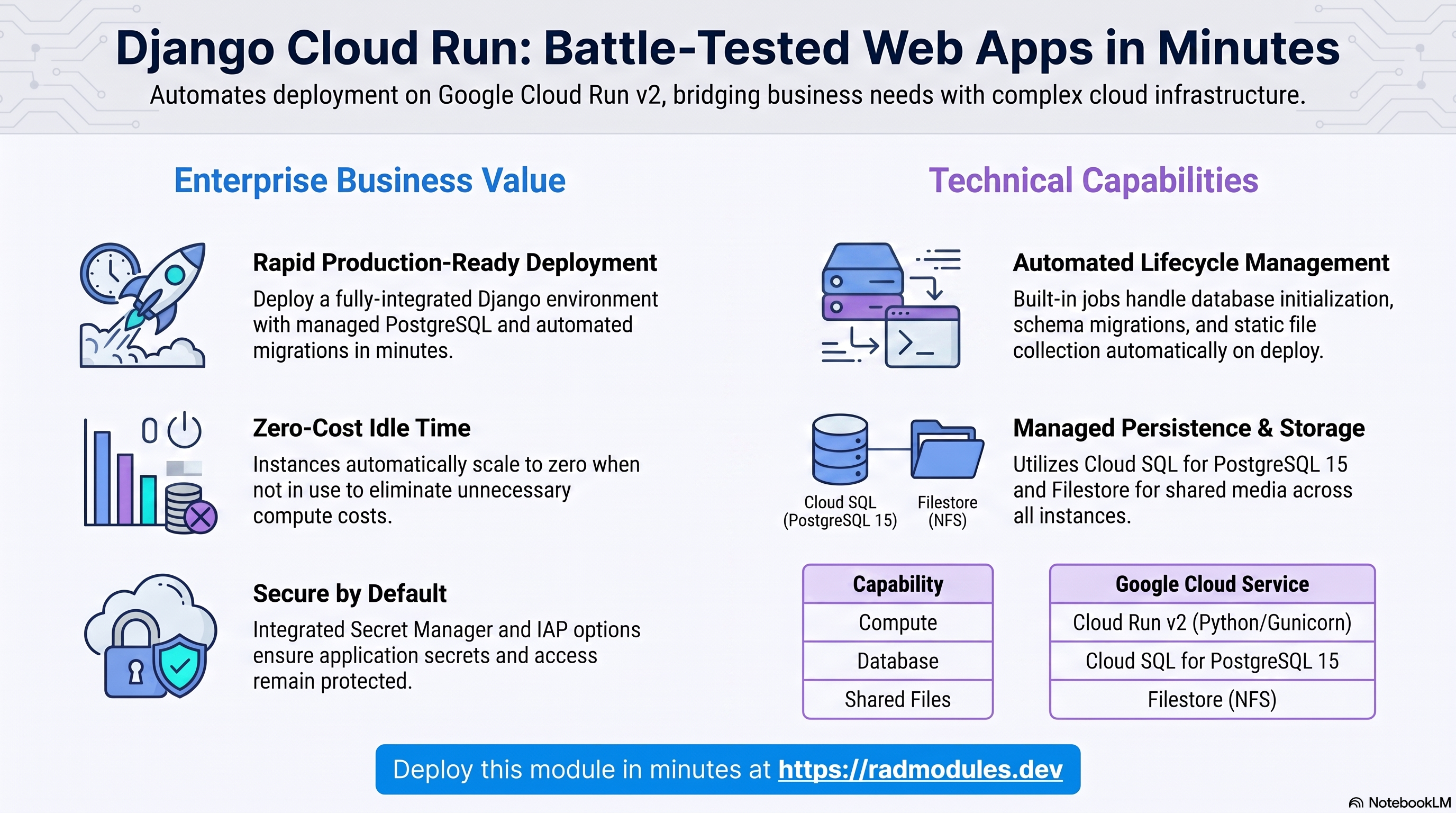
Django is a battle-tested Python web framework that encourages rapid development and clean, pragmatic design, powering some of the world's most demanding web applications. This module deploys Django on Cloud Run v2 on top of the App_CloudRun foundation, which provisions and manages the shared Google Cloud infrastructure.
This guide focuses on the cloud services Django uses and how to explore and operate them from the Google Cloud Console and the command line. For the mechanics that are common to every Cloud Run application — Workload Identity, ingress, autoscaling, CI/CD, Cloud Armor, IAP, Binary Authorization, VPC Service Controls, backups, and the deployment lifecycle — refer to the App_CloudRun foundation guide rather than repeating them here.
What Django costs on RAD, and how that compares
Django on RAD's Cloud Run module costs about US$81.23 a month. A self-managed server is cheaper in cash, but then you run the database, backups, security patches and upgrades yourself. GKE Autopilot suits Django that must stay up continuously or scale across pods; for the lowest cost, this Cloud Run module already gives you the cheaper option — see the GKE guide if you need the other one. Figures are as at 8 October 2026; sources are listed at the end of this section.
If you only need it occasionally — studying, a demo, a seasonal business — a RAD-managed project can be deleted and restored within 30 days for a handful of credits, so that US$81.23 becomes a few dollars a month instead. See Pause it for free, below.
What you pay on RAD
| In a Google Cloud project you own | In a project RAD manages for you | |
|---|---|---|
| Module fee, once per deployment | 110 credits (US$11 at the top-up price) | 99 credits (10% lower) |
| Build time | A few credits per build | The same |
| Google Cloud running cost | Billed by Google to your own billing account, about US$81.23 a month for the default configuration (table below) | Metered hourly in credits; RAD publishes 32 credits a day, about 960 a month (about US$96 at the top-up price) |
| Who owns what | You own the project and its billing; RAD deploys and updates it | RAD owns the project, with guardrails, quotas and budget alerts; you get console access, and a minimum purchased balance is held in reserve |
10 credits cost US$1 on a one-off top-up, and less on a monthly plan. In a project RAD manages, the database, file server and network are shared by every application in the project, so a second application does not add a second database.
Default running cost in your own project (us-central1, Google list prices):
| Resource (module default) | Per month |
|---|---|
| Cloud Run, 1x vCPU / 0.5 GiB (scaleToZero) | US$10.78 |
| Cloud SQL for PostgreSQL, 1 vCPU / 3.75 GB, zonal, 10 GB SSD | US$51.02 |
| NFS/cache file server (small VM) | US$13.43 |
| Cloud NAT and networking | US$5 |
| Cloud Storage (add-ons, backups) | US$1 |
| Total | about US$81.23 |
How it compares
- Django is a framework, not a packaged product, so there is no commercial "Django hosting" plan to compare against — the honest comparison is a bare server: a Hetzner CPX22 or DigitalOcean 2 vCPU/4 GB droplet runs about US$24 a month, and a GCP Compute Engine e2-standard-2 (2 vCPU/8 GB) about US$49 — plus your own time for the database, backups, security patches and OS upgrades, which RAD's managed Cloud SQL, Secret Manager and monitoring cover for you.
- What you are really pricing is how much of the application layer is custom. For a thin API or admin tool, a small VPS may be enough; for anything with real data integrity requirements, a managed database is worth more than the price difference suggests.
Pause it for free: delete a RAD-managed project, restore it when you need it
If Django runs in a project RAD manages for you, you have a second option that goes well beyond scaling to zero: delete the whole project, and restore it within 30 days for close to nothing. This suits Django you only need occasionally — studying, a demo, a seasonal business — far better than running it continuously.
- How it works. Deleting a RAD-managed project unlinks its billing first, then asks Google to delete the project. Google does not remove the project immediately: it keeps it, recoverable, for 30 days. Because billing is already unlinked, nothing is charged while it waits. Unlike deleting one module, this does not tear down Cloud SQL, the NFS VM or Cloud Run one by one — the whole project, and everything in it, simply stops.
- Restoring costs a handful of credits, not a rebuild. Within 30 days, the project's owner can restore it. RAD asks Google to undelete the project and reattaches its billing account, then asks you to run Update on each deployment to confirm everything came back. Because nothing was individually destroyed, that Update finds the same resources already there — it is a check, not a rebuild, and an Update never charges the module fee again. That costs a handful of credits (under US$1) in total for a typical Django-sized deployment chain, against the 104 credits (US$10.35) a full redeploy costs.
- So a month of occasional use can cost a few dollars, not US$81.23. Deploy Django, use it for a while, delete the project. Restore it next time you want it, confirm with Update, and delete it again when you're done. You pay only for the module fee once, the builds, and whatever hours Django was actually live.
- What this needs. You must own the project (not a bring-your-own one RAD only manages billing for), and you restore it yourself within the 30 days — after that, Google deletes it for good. Restoring is admitted like creating a new project: your purchased credit balance must still clear the tier's floor (100 credits for the sandbox tier most study and demo use fits). Google says most services are fully working again within 36 hours of a restore.
- One real gap: nightly backups do not survive. Backups are written to a bucket inside the project, and that bucket is not protected by Cloud Storage's soft-delete, so it is very likely gone as soon as you delete the project — even though the project itself is recoverable for 30 days. If you have customised the data and want to keep it, copy a backup out (to Google Drive, or a bucket outside the project) before you delete, the same as the redeploy workflow below. For a default installation with nothing irreplaceable in it, this does not matter.
Pay only while you use it, the other way: delete and redeploy
Cloud Run already scales to zero between requests. The option above only applies to a RAD-managed project; in your own project, or once the 30-day window has passed, the way to stop paying is to delete the deployment and deploy it again when you need it.
- What a redeploy costs. The module fee again plus the builds: about 114 credits (US$11.45), and about an hour, because RAD recreates the project and shared services before Django. Deleting saves money once Django would otherwise sit unused for about 4 days or more in your own project (about US$2.71 a day), or about 3 days or more in a RAD-managed one (32 credits a day).
- Delete everything Django uses. Most of the running cost is the database and the NFS/cache VM. They stop only when nothing else in the project uses them, so deleting it while something else shares the project saves only Django's own compute part.
- Keep your data first. The nightly database backups are written to a bucket inside the deployment, and that bucket is deleted with it. Before deleting, copy the latest backup to Google Drive, or to a bucket you keep.
- Note your settings. RAD does not recreate a deleted deployment for you; you enter the settings again when you deploy.
Lab sessions and Managed Environments
- Lab sessions, for training. A trainer runs a session for a class. Each participant gets Django in their own Google Cloud project for 15 minutes to 24 hours, within an allowance the trainer sets. Either the trainer funds every place, or each participant pays for their own. Everything is deleted when the session ends and unused credits go back to the trainer.
- Managed Environments, for consultancies. A partner runs Django for a client from a ring-fenced wallet it funds, and settles with the client directly. If the wallet runs low, billing pauses and the data is kept, so nobody receives an unexpected charge. At the end the partner hands the project over and the deployments become the client's own.
Credits can be bought in more than 20 currencies, including XAF, XOF, NGN, GHS, KES and ZAR, by card, bank transfer or mobile money.
Sources (8 October 2026): Google Cloud list prices from the Cloud Billing Catalog API; RAD's own fees and daily-credit estimates from radmodules.dev/pricing; Delete and restore projects for the pause/restore mechanics and window.
1. Overview
Django runs as a Python/Gunicorn container on Cloud Run v2. The deployment wires together a focused set of Google Cloud services:
| Capability | Google Cloud service | Notes |
|---|---|---|
| Compute | Cloud Run v2 | Python/Gunicorn container, 1 vCPU / 512 MiB by default; autoscaled to zero |
| Database | Cloud SQL for PostgreSQL 15 | Required — Django's DB_ENGINE is fixed to django.db.backends.postgresql |
| Shared files | Filestore (NFS) | Shared media across all container instances (requires gen2 execution environment) |
| Object storage | Cloud Storage | A dedicated media bucket provisioned by Django_Common |
| Secrets | Secret Manager | Auto-generated Django SECRET_KEY and database password |
| Cache (optional) | Redis / Cloud Memorystore | Disabled by default; enable for session storage and caching |
| Ingress | Cloud Load Balancing | External HTTPS load balancer with optional custom domain + managed certificate |
Sensible defaults worth knowing up front:
- PostgreSQL 15 is fixed.
Django_Commonhard-wiresDB_ENGINEto PostgreSQL; MySQL andNONEare not supported through this module. - The Django
SECRET_KEYis auto-generated and stored in Secret Manager; it is injected at runtime and never set in plain text. - Four PostgreSQL extensions are installed automatically (
pg_trgm,unaccent,hstore,citext) by thedb-initjob, so you do not need to configure them. - Two initialization jobs run by default —
db-init(creates the database and user) anddb-migrate(runsmanage.py migrateandcollectstatic). On Cloud Run these run as Cloud Run Jobs triggered on apply. - NFS is enabled by default. All container instances share the same Filestore
volume for uploaded media files. NFS mounts require
execution_environment = "gen2"(set automatically). - Redis is disabled by default. Enable with
enable_redis = trueand point at a Cloud Memorystore instance for production session storage and caching. - Scale to zero by default.
min_instance_countdefaults to0; set to1for production to eliminate cold starts.
2. Google Cloud Services & How to Explore Them
All commands assume PROJECT, REGION, and SERVICE are set. The service name and
other identifiers are reported in the deployment Outputs.
A. Cloud Run v2 — the Django service
Django runs as a Cloud Run service scaled automatically between min_instance_count
and max_instance_count. Each instance runs a Cloud SQL Auth Proxy sidecar and,
when NFS is enabled, mounts the Filestore share.
- Console: Cloud Run → select the service to see revisions, traffic splits, logs, and metrics.
- CLI:
gcloud run services describe "$SERVICE" --region "$REGION" --project "$PROJECT"
gcloud run services list --region "$REGION" --project "$PROJECT"
# Stream live logs:
gcloud logging read 'resource.type="cloud_run_revision" AND resource.labels.service_name="'"$SERVICE"'"' \
  --project "$PROJECT" --limit 50
See App_CloudRun for revision traffic splits, min/max instances, concurrency, and execution environment configuration.
B. Cloud SQL for PostgreSQL 15
Django stores all application data in a managed Cloud SQL for PostgreSQL 15 instance.
Container instances reach it through the Cloud SQL Auth Proxy over a local Unix
socket, so no public IP is exposed. On first deploy the db-init Cloud Run Job
creates the application database and user, installs the required extensions, and
grants privileges. The db-migrate job then runs manage.py migrate and
manage.py collectstatic.
- Console: SQL → select the instance for connections, backups, flags, and metrics.
- CLI:
gcloud sql instances list --project "$PROJECT"
gcloud sql instances describe <instance-name> --project "$PROJECT"
# Open an interactive shell to inspect schema/data:
gcloud sql connect <instance-name> --user=<db-user> --project "$PROJECT"
# List the initialization jobs:
gcloud run jobs list --region "$REGION" --project "$PROJECT"
The instance name, database name, user, and the Secret Manager secret holding the password are all surfaced in the Outputs. For the connection model, automated backups, and password rotation, see App_CloudRun.
C. Filestore (NFS) and Cloud Storage
Uploaded media is written to a Filestore (NFS) share mounted into every container
instance so all replicas see the same files. A dedicated Cloud Storage media
bucket is also provisioned automatically by Django_Common; the workload service
account is granted access. NFS mounts on Cloud Run require the gen2 execution
environment, which this module sets by default.
- Console: Filestore → Instances for the NFS share; Cloud Storage → Buckets for the media bucket.
- CLI:
gcloud filestore instances list --project "$PROJECT"
gcloud storage buckets list --project "$PROJECT"
gcloud storage ls gs://<media-bucket>/          # bucket name is in the Outputs
See App_CloudRun for NFS provisioning, GCS Fuse volumes, and CMEK options.
D. Redis cache
Redis is disabled by default. When enable_redis = true, Django receives
REDIS_HOST and REDIS_PORT as environment variables. Configure settings.py to
use these for CACHES and SESSION_ENGINE. The module does not provision a Redis
instance — use a Cloud Memorystore instance and set redis_host to its private IP.
- Console: Memorystore → Redis (if using a managed instance).
- CLI:
redis-cli -h <redis-host> ping        # from a host with network access
# Confirm REDIS_HOST and REDIS_PORT are in the service environment:
gcloud run services describe "$SERVICE" --region "$REGION" --project "$PROJECT" \
  --format="json" | jq '.spec.template.spec.containers[0].env[]|select(.name|startswith("REDIS"))'
E. Secret Manager
The Django SECRET_KEY and the database password are stored as Secret Manager
secrets and injected into container instances at runtime; plaintext never appears in
configuration. The superuser password (if you create one via DJANGO_SUPERUSER_PASSWORD)
should also be stored here.
- Console: Security → Secret Manager.
- CLI:
gcloud secrets list --project "$PROJECT"
gcloud secrets versions access latest --secret=<secret-name> --project "$PROJECT"
# The database password secret name is in the Outputs:
gcloud secrets versions access latest --secret=<database_password_secret> --project "$PROJECT"
See App_CloudRun for the secret mounting model, volume mounts versus env-var references, and rotation.
F. Networking & ingress
By default the service is exposed directly at its run.app HTTPS URL
(ingress_settings = "all"). Ingress can be restricted to internal or
internal-and-cloud-load-balancing via ingress_settings, and VPC egress can be
controlled via vpc_egress_setting. Hostnames for the load-balanced path are
configured via application_domains.
- Console: Network services → Load balancing; Cloud Run → service → Networking tab.
- CLI:
gcloud run services describe "$SERVICE" --region "$REGION" --project "$PROJECT" \
  --format="value(status.url)"
gcloud compute addresses list --project "$PROJECT"
See App_CloudRun for custom domains, Cloud CDN, static IP, and VPC egress details.
G. Cloud Logging & Monitoring
Container stdout/stderr flow to Cloud Logging; Cloud Run and Cloud SQL metrics flow to Cloud Monitoring. Optional uptime checks and alert policies are available.
- Console: Logging → Logs Explorer; Monitoring → Dashboards / Alerting.
- CLI:
gcloud logging read \
  'resource.type="cloud_run_revision" AND resource.labels.service_name="'"$SERVICE"'"' \
  --project "$PROJECT" --limit 50
3. Django Application Behaviour
- First-deploy database setup. A
db-initCloud Run Job creates the PostgreSQL database and user, grants privileges, and installs the four required extensions (pg_trgm,unaccent,hstore,citext) using theROOT_PASSWORDsuperuser secret. The job is idempotent and safe to re-run. - Migrations on first deploy. A
db-migrateCloud Run Job runsmanage.py migrateandmanage.py collectstatic --noinput --clearafterdb-initcompletes. Both jobs are triggered automatically on apply (execute_on_apply = true). Overrideinitialization_jobswith a non-empty list to replace them with custom jobs. SECRET_KEYmanagement. A 50-character random key is generated byDjango_Commonand stored in Secret Manager. It is injected asSECRET_KEY. Do not setSECRET_KEYinenvironment_variables.- Superuser creation. If
DJANGO_SUPERUSER_USERNAME,DJANGO_SUPERUSER_EMAIL, andDJANGO_SUPERUSER_PASSWORDare present as environment variables when the container starts,entrypoint.shcreates a Django superuser on first boot. Usesecret_environment_variablesfor the password:# Retrieve the superuser password from Secret Manager:
gcloud secrets versions access latest --secret=<superuser-secret> --project "$PROJECT" - Health probes. The startup probe targets
GET /healthzon port 8080 with a 60-second initial delay. The liveness probe also targetsGET /healthzwith a 30-second initial delay. Implement a lightweight/healthz/view that returns HTTP 200 with no redirects. Note that Cloud Run health probe traffic arrives over HTTP; avoid settingSECURE_SSL_REDIRECT = Trueinsettings.pyor the probe will receive a 301 redirect and the service will never become healthy. - Scheduled tasks. Django management commands (e.g.,
clearsessions) can be scheduled as Cloud Run Jobs via thecron_jobsvariable:gcloud run jobs list --region "$REGION" --project "$PROJECT"
gcloud run jobs execute <job-name> --region "$REGION" --project "$PROJECT" - gen2 execution environment. NFS mounts require Cloud Run gen2 containers.
This is set automatically when
enable_nfs = true. If you disable NFS you may overrideexecution_environmentto"gen1", but gen2 is strongly recommended.
4. Configuration Variables
Variables are grouped exactly as they appear on the deployment platform. Only settings specific to or notable for Django are listed; every other input is inherited from App_CloudRun with its standard behaviour and defaults.
Group 1 — Project & Identity
| Variable | Default | Description |
|---|---|---|
project_id | (required) | Target Google Cloud project. |
region | us-central1 | Region for the Cloud Run service and regional resources. |
Group 2 — Deployment Environment
| Variable | Default | Description |
|---|---|---|
tenant_id | demo | Short suffix that makes resource names unique per environment. |
support_users | [] | Emails granted project access and monitoring alerts. |
resource_labels | {} | Labels applied to all resources for cost/ownership tracking. |
Group 3 — Application Identity
| Variable | Default | Description |
|---|---|---|
application_name | django | Base name for resources. Do not change after first deploy. |
application_display_name | Django Application | Friendly name shown in the Console. |
application_description | Django Application - High-level Python Web framework | Service description annotation. |
application_version | latest | Image version tag; increment to roll out a new revision. Pin to a specific tag in production. |
Group 4 — Runtime & Scaling
| Variable | Default | Description |
|---|---|---|
deploy_application | true | Set false to provision infrastructure only. |
container_image_source | custom | custom builds via Cloud Build; prebuilt deploys an existing image URI. |
container_image | us-docker.pkg.dev/cloudrun/container/hello | Override container image URI. |
container_resources | { cpu_limit = "1000m", memory_limit = "512Mi" } | CPU and memory limits per instance. |
min_instance_count | 0 | Minimum warm instances. Set ≥ 1 to eliminate cold starts in production. |
max_instance_count | 1 | Maximum concurrently active instances. |
container_port | 8080 | Django/Gunicorn listens on port 8080. |
enable_cloudsql_volume | true | Cloud SQL Auth Proxy sidecar for socket connections. |
execution_environment | gen2 | Required for NFS mounts. Do not change unless NFS is disabled. |
Group 5 — Traffic Management & IAP
| Variable | Default | Description |
|---|---|---|
ingress_settings | all | Cloud Run ingress: all, internal, or internal-and-cloud-load-balancing. |
vpc_egress_setting | PRIVATE_RANGES_ONLY | Egress through the serverless VPC connector. |
enable_iap | false | Require Google sign-in in front of Django. |
iap_authorized_users / iap_authorized_groups | [] | Who may access when IAP is enabled. |
Group 6 — Environment Variables & Secrets
| Variable | Default | Description |
|---|---|---|
environment_variables | {} | Extra non-secret settings. Do not include SECRET_KEY or DB_* here. |
secret_environment_variables | {} | Map of env var → Secret Manager secret name (e.g., DJANGO_SUPERUSER_PASSWORD). |
secret_propagation_delay | 30 | Seconds to wait after secret creation before proceeding. |
secret_rotation_period | 2592000s | Secret Manager rotation notification frequency. |
Group 7 — Backup & Maintenance
| Variable | Default | Description |
|---|---|---|
backup_schedule | 0 2 * * * | Automated backup cron (UTC). |
backup_retention_days | 7 | Retention; raise to 30–90 for production/compliance. |
enable_backup_import / backup_source / backup_uri | restore options | Restore from a backup on deploy. Set enable_backup_import = false after a successful import. |
Group 8 — CI/CD & GitHub Integration
Standard App_CloudRun Cloud Build / Cloud Deploy integration — see
App_CloudRun. Key inputs: enable_cicd_trigger,
github_repository_url, github_token, enable_cloud_deploy.
Group 9 — Custom SQL Scripts
enable_custom_sql_scripts, custom_sql_scripts_bucket, custom_sql_scripts_path,
custom_sql_scripts_use_root — run SQL from a GCS bucket after provisioning. See
App_CloudRun.
Group 10 — Cloud Armor & CDN
| Variable | Default | Description |
|---|---|---|
enable_cloud_armor | false | Attach a Cloud Armor (WAF) policy to the backend. |
admin_ip_ranges | [] | CIDRs allowed privileged access. |
enable_cdn | false | Enable Cloud CDN on the load balancer. |
application_domains | [] | Hostnames to serve (also used for custom domain). |
Group 11 — Filesystem (NFS) & Cloud Storage
| Variable | Default | Description |
|---|---|---|
enable_nfs | true | Shared Filestore volume for Django media (keep enabled for multi-instance). |
nfs_mount_path | /mnt/nfs | Mount path inside the container. Must match MEDIA_ROOT in settings.py. |
create_cloud_storage | true | Provision the additional data bucket. The media bucket is always provisioned by Django_Common. |
storage_buckets | [{ name_suffix = "data" }] | Additional buckets beyond the auto-provisioned media bucket. |
gcs_volumes | [] | GCS Fuse mounts. |
Group 12 — Database Backend
| Variable | Default | Description |
|---|---|---|
database_type | POSTGRES_15 | PostgreSQL 15 required. Django does not support MySQL through this module. |
application_database_name | django_db | Database name. Immutable after first deploy. |
application_database_user | django_user | Application user. Immutable after first deploy. |
database_password_length | 32 | Generated password length (16–64). |
db_user_env_var_name / db_name_env_var_name | "" | Override the env var name used to inject the DB user/name. |
enable_auto_password_rotation | false | Zero-downtime DB password rotation. |
The four required extensions (pg_trgm, unaccent, hstore, citext) are installed
automatically by the built-in db-init job — no variable is needed for them.
Group 13 — Jobs & Scheduled Tasks
| Variable | Default | Description |
|---|---|---|
initialization_jobs | (built-in db-init) | By default, one db-init Cloud Run Job is defined. The db-migrate job is always added by Django_Common. Provide a non-empty list to replace the default db-init with custom jobs. |
cron_jobs | [] | Scheduled Cloud Run Jobs (e.g., clearsessions, cleartokens). |
Group 14 — Observability & Health
| Variable | Default | Description |
|---|---|---|
startup_probe | HTTP GET /healthz, 60s initial delay | Startup probe passed to Django_Common. Increase delay for large migration sets. Do not use a redirect path. |
liveness_probe | HTTP GET /healthz, 30s initial delay | Liveness probe. Use a lightweight endpoint that returns 200 with no body. |
startup_probe_config | enabled, HTTP /healthz | App_CloudRun-level infrastructure startup probe. |
health_check_config | enabled, HTTP /healthz | App_CloudRun-level infrastructure health check. |
uptime_check_config | disabled (enabled = false, path /) | Optional Cloud Monitoring uptime check. |
Group 21 — Redis Cache
| Variable | Default | Description |
|---|---|---|
enable_redis | false | Enable Redis for session storage and caching. |
redis_host | "" | Redis host IP or hostname. |
redis_port | 6379 | Redis port. |
redis_auth | "" | Optional Redis auth password (sensitive). |
Group 22 — VPC Service Controls & Audit Logging
| Variable | Default | Description |
|---|---|---|
enable_vpc_sc | false | Enforce a VPC-SC perimeter (requires organization_id). |
vpc_cidr_ranges / vpc_sc_dry_run | (set) | Access level CIDRs / dry-run mode. |
enable_audit_logging | false | Detailed Cloud Audit Logs. |
5. Outputs
These values are returned on a successful deployment and are the quickest way to locate and explore the running resources.
| Output | Description |
|---|---|
service_name | Cloud Run service name. |
service_url | HTTPS URL to reach Django. |
service_location | Region the service is deployed in. |
stage_services | Map of Cloud Deploy stage service names and URLs. |
load_balancer_ip / load_balancer_url | External IP and HTTPS URL (when a static IP is reserved). |
database_instance_name | Cloud SQL instance name. |
database_name | Application database name. |
database_user | Application database user. |
database_password_secret | Secret Manager secret holding the DB password. |
database_host / database_port | DB endpoint (sensitive) / port. |
storage_buckets | Created Cloud Storage buckets. |
network_name / network_exists / regions | VPC network, presence, available regions. |
container_image / container_registry | Deployed image and Artifact Registry repo. |
monitoring_enabled / monitoring_notification_channels | Monitoring status and channels. |
initialization_jobs | Names of the setup Cloud Run Jobs. |
deployment_id / tenant_id / resource_prefix | Naming identifiers. |
project_id / project_number | Project identifiers. |
cicd_enabled / cicd_configuration | CI/CD status and details (repo, trigger, registry). |
github_repository_url / github_repository_owner / github_repository_name | CI/CD repo details. |
artifact_registry_repository / cloudbuild_trigger_name / cloudbuild_trigger_id | Registry and build trigger. |
uptime_check_names | Names of provisioned Cloud Monitoring uptime checks. |
vpc_sc_enabled / vpc_sc_perimeter_name / vpc_sc_dry_run_mode | VPC-SC status. |
audit_logging_enabled / artifact_registry_cmek_enabled | Audit logging and CMEK status. |
6. Configuration Pitfalls & Sensible Defaults
Risk: Critical (data loss / outage / security) — High (service degraded) — Medium (cost or partial degradation) — Low (minor).
| Setting | Sensible value | Risk | Consequence if wrong |
|---|---|---|---|
database_type | POSTGRES_15 | Critical | Django requires PostgreSQL; MySQL or NONE will fail the db-init job. |
application_name / tenant_id | set once | Critical | Embedded in resource names; changing recreates all named resources and destroys data. |
application_database_name / _user | set once | Critical | Immutable after first deploy; renaming recreates the DB/user and destroys data. |
startup_probe path | /healthz (no redirect) | Critical | Cloud Run probe traffic is plain HTTP; a redirect returns 301, Cloud Run never sees 200, service never starts. |
SECURE_SSL_REDIRECT in settings.py | False or exempt /healthz | Critical | True redirects every HTTP request including the startup probe; service stuck in STARTING. |
enable_backup_import | false after restore | High | Leaving true re-runs the import on every apply, overwriting live data with stale backup. |
enable_nfs | true (default) | High | Disabling with max_instance_count > 1 means each instance has isolated ephemeral storage; uploads are lost on instance teardown. |
execution_environment | gen2 (default when NFS enabled) | High | gen1 does not support NFS volume mounts; service fails to start. |
nfs_mount_path | /mnt/nfs — must match MEDIA_ROOT | High | Mismatch causes Django to write media to ephemeral storage; files lost on instance teardown. |
container_resources memory | ≥ 512Mi; raise for ORM-heavy workloads | High | Too little memory: instance exits with OOM (exit 137) on large querysets or file processing. |
min_instance_count | 1 for production | Medium | 0 causes cold starts (>60 s) on first request after idle; cron jobs may find no warm instance. |
application_version | pinned tag, not latest | Medium | latest makes rollback ambiguous; Cloud Run cannot tell two latest pulls apart. |
enable_redis | true when using Redis-backed sessions | Medium | Left false with Redis-configured settings.py: ConnectionRefusedError on every cache/session access. |
ingress_settings | internal-and-cloud-load-balancing for load-balanced private services | Medium | all allows direct invocation of the Cloud Run endpoint URL bypassing Cloud Armor/IAP. |
enable_iap / enable_cloud_armor | enable for admin-facing | Medium | Django admin UI is otherwise publicly reachable at the service URL. |
backup_retention_days | 7 (raise for prod) | Medium | Too short for compliance retention. |
For the foundation behaviour referenced throughout — IAM and Workload Identity, autoscaling, ingress and certificates, CI/CD, Cloud Armor, IAP, Binary Authorization, VPC-SC, backups, and image mirroring — see App_CloudRun. Django-specific application configuration shared with the GKE variant is described in Django_Common.
Related guides
- Hands-on lab: Django on Cloud Run — deploy it step by step, with the console screens and commands at each stage.
- Django on GKE Autopilot — the same application on Kubernetes, for when you need the other deployment target.
- Django Common — Shared Application Configuration — the configuration shared by both deployment targets.
- Deployed alongside CloudBeaver on Google Cloud Run, Gitea on Google Cloud Run, GlitchTip on Google Cloud Run in the Custom Application Starter solution.
Need RAD to do something it does not do yet? Request it on the roadmap, or vote on what is already there.