Headscale on GKE Autopilot
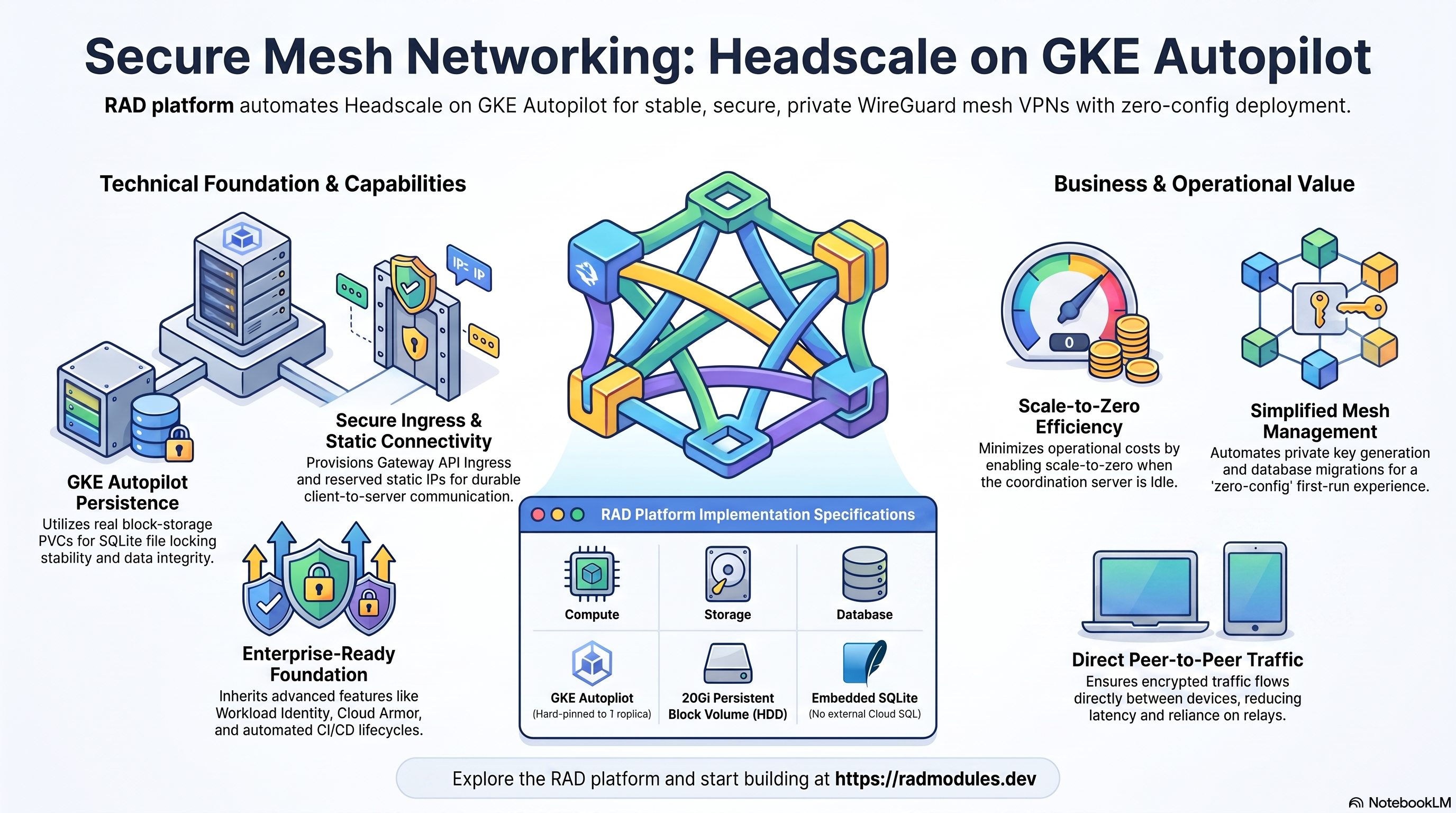
Headscale is an open-source, self-hosted implementation of the Tailscale coordination server — a control plane for a private WireGuard mesh VPN, compatible with the official Tailscale clients. Headscale is not a VPN gateway or relay itself: it authenticates nodes, distributes each peer's public key and IP allocation, and keeps the mesh's network map in sync. Actual encrypted traffic between devices flows directly, peer-to-peer, over WireGuard (or via Tailscale's own public DERP relay infrastructure). This module deploys Headscale on GKE Autopilot on top of the App_GKE foundation, which provisions and manages the shared Google Cloud and Kubernetes infrastructure.
This guide focuses on the cloud services Headscale uses and how to explore and operate them from the Google Cloud Console and the command line. For the mechanics that are common to every GKE application — Workload Identity, ingress, autoscaling, CI/CD, Cloud Armor, IAP, Binary Authorization, VPC Service Controls, backups, and the deployment lifecycle — refer to the App_GKE foundation guide rather than repeating them here.
What Headscale costs on RAD, and how that compares
Running Headscale on GKE Autopilot pod in your own Google Cloud project costs about $42.08/month in Google Cloud charges, on top of a one-off 75-credit RAD module fee charged once at deploy time. Headscale is an independent, open-source reimplementation of a private WireGuard coordination server, compatible with official Tailscale clients — it is not a hosted version of any commercial product, so there's no SaaS price to quote against it. In a RAD-managed project the module fee drops to 67.5 credits (10% lower) and the running cost is metered hourly in credits instead of billed directly by Google — see Pause it for free below for the one RAD-managed advantage a self-hosted VPS cannot match — or see the Cloud Run guide for the lower-cost option.
What you pay on RAD
| Own project | RAD-managed project | |
|---|---|---|
| Module fee (one-off) | 75 credits | 67.5 credits (10% lower) |
| Build time | ~3-6 credits per build, either way | ~3-6 credits per build, either way |
| Google Cloud running cost | $42.08/month, billed by Google at list price | ~67 credits/day, metered at list price plus RAD's margin |
Default running cost in your own project
| Resource | US$/month (Google list price, us-central1) |
|---|---|
| GKE Autopilot pod, 1x vCPU / 1 GiB | $36.08 |
| Cloud NAT and networking | $5.00 |
| Cloud Storage (add-ons, backups) | $1.00 |
| GKE cluster management fee | shared across every GKE app in the project; $0 if this is your only cluster, else ~73 |
| Total | $42.08 |
The GKE cluster management fee is excluded from the total above because it is shared across every GKE app in the project — $0 if this is the only one, otherwise roughly $73/month split across however many you run.
How it compares
- A self-managed comparison: Hetzner CPX22 (2 vCPU/4GB) runs about $24/mo, a DigitalOcean 2 vCPU/4GB Droplet is the same $24/mo, and a GCP Compute Engine e2-standard-2 (2 vCPU/8GB) is about $49/mo — more than this lightweight 1 vCPU/1 GiB coordination server needs, but the smallest widely-quoted reference point.
- Headscale needs no database of its own in this deployment (it uses SQLite internally), so most of its own-project running cost above is the small NFS file server, not a managed Postgres instance.
- The admin trade-off is the same shape as every entry here: a cheaper VPS, self-patched, versus RAD's managed file server, Secret Manager and monitoring.
Pause it for free: delete a RAD-managed project, restore it when you need it
This is the headline advantage of a RAD-managed project, and it costs nothing while paused. Deleting a RAD-managed project unlinks its billing first, then asks Google to delete the project outright — Google's own 30-day recoverable soft delete. Unlike deleting one module, this does not tear down Cloud SQL, any VM, or the compute resource one by one: the whole project simply stops, and nothing is charged while it waits, because billing is already unlinked.
Restoring, within 30 days and only by the project's owner, asks Google to undelete the project and reattaches its billing account, then asks you to run Update on each deployment to confirm everything came back. Because nothing was individually destroyed, that Update finds the same resources already there — it is a check, not a rebuild, and an Update never charges the module fee again. This costs only a handful of credits (under US$1) in total for a typical 2-3-deployment chain.
What this needs: you must own the project (not one RAD only manages billing for), you must restore it yourself within 30 days — after that Google deletes it for good — and restoring is admitted like creating a new project, so your purchased credit balance must still clear the tier's floor (100 credits for the sandbox tier most study/demo use fits). Google says most services are fully working again within 36 hours of a restore.
One real gap: nightly backups are written to a bucket inside the project, and that bucket has Cloud Storage's soft-delete explicitly turned off, so it is very likely gone as soon as you delete the project — even though the project itself is recoverable for 30 days. If you've customised Headscale and want to keep that work, copy a backup out (to Google Drive, or a bucket outside the project) before deleting. For a default install with nothing irreplaceable in it, this does not matter.
Pay only while you use it, the other way: delete and redeploy
In your own project, or once 30 days have passed on a RAD-managed one, there is no free pause — deleting removes the resources for good, and bringing Headscale back means redeploying from scratch. That costs about 78-81 credits (the 75-credit module fee plus a build).
Deleting only saves money once Headscale would otherwise sit unused long enough to clear that redeploy cost against its own running cost — for Headscale, that's about 6 days or more. Most of that running cost is usually the database (and, where this module uses one, the shared file-server VM or GKE cluster) — those stop only once nothing else in the project uses them, so deleting this app while something else shares the project saves only its own compute share.
Keep data first: nightly backups go to a bucket inside the deployment and are deleted with it, so copy the latest backup out before deleting if you want to keep it.
Lab sessions and Managed Environments
Lab sessions, for training: a trainer runs a session for a class. Each participant gets the app in their own Google Cloud project for 15 minutes to 24 hours, within an allowance the trainer sets. Either the trainer funds every place, or each participant pays for their own. Everything is deleted when the session ends and unused credits go back to the trainer.
Managed Environments, for consultancies: a partner runs the app for a client from a ring-fenced wallet it funds, and settles with the client directly. If the wallet runs low, billing pauses and the data is kept, so nobody receives an unexpected charge. At the end the partner hands the project over and the deployments become the client's own.
Credits can be bought in more than 20 currencies, including XAF, XOF, NGN, GHS, KES and ZAR, by card, bank transfer or mobile money.
Sources (8 October 2026): Google Cloud Billing Catalog API list prices; radmodules.dev/pricing for RAD's own fees and daily-credit estimates; Google's project delete/restore documentation for the pause/restore claims.
1. Overview
Headscale runs as a single Go binary pod on GKE Autopilot, built from a
custom, ko-based upstream image. The deployment wires together a focused
set of Google Cloud services:
| Capability | Google Cloud service | Notes |
|---|---|---|
| Compute | GKE Autopilot, StatefulSet | Go workload, 1 vCPU / 1 GiB by default; hard-pinned to a single replica |
| Database | Embedded SQLite | No Cloud SQL instance — database_type = "NONE" |
| Persistence | Real block-storage PVC (default) | stateful_pvc_enabled = true by default — /var/lib/headscale on pd-standard HDD, not GCS Fuse |
| Secrets | Secret Manager | None — Headscale has no application-level secrets in this module |
| Ingress | Cloud Load Balancing / Gateway API | External static IP + custom domain by default (reserve_static_ip = true, enable_custom_domain = true) |
Sensible defaults worth knowing up front:
- SQLite is the only supported database. There is no external Cloud SQL
instance; all state (node registry, pre-auth keys, the Noise-protocol
private key) lives in a single SQLite file under
/var/lib/headscale. - StatefulSet + real block PVC is the default layout, not an opt-in.
stateful_pvc_enabled = trueby default runs Headscale as a StatefulSet with a per-pod PVC — this is the platform variant that actually solves the SQLite/file-locking problem Cloud Run cannot.stateful_pvc_storage_classdefaults tostandard(HDDpd-standard, not SSD) since Headscale's files are small with no high-IOPS need. max_instance_countis hardcoded to1downstream, not just defaulted.Headscale_Commonsetsconfig.max_instance_count = 1as a literal value regardless of what this module's variable holds. Headscale has no active-active support.- Scale-to-zero is enabled by default (
min_instance_count = 0). - A stable, public entry point matters more here than for most apps.
reserve_static_ip = trueandenable_custom_domain = trueare both defaults — every device registered against this server needs a durable URL, not just a browser session. - MagicDNS is off by default. It requires
dns.base_domainset and genuinely different fromserver_url's domain. - No default initialization job. Headscale's SQLite file is created automatically on first boot.
2. Google Cloud Services & How to Explore Them
All commands assume you have run
gcloud container clusters get-credentials <cluster> --region <region> --project <project>
and that PROJECT, REGION, and NAMESPACE are set. The namespace and other
identifiers are reported in the deployment Outputs.
A. GKE Autopilot — the Headscale StatefulSet
Headscale runs as a single-replica StatefulSet by default (workload_type
auto-resolves to StatefulSet when stateful_pvc_enabled = true). Because
max_instance_count is hardcoded to 1, there is no horizontal scaling to
observe here.
- Console: Kubernetes Engine → Workloads → select the Headscale workload for pods, revisions, and events.
- CLI:
kubectl get statefulset,pods,pvc -n "$NAMESPACE"
kubectl logs -n "$NAMESPACE" statefulset/<service-name> --tail=100
See App_GKE for how Autopilot and the workload type (Deployment vs StatefulSet) are managed.
B. Persistent Volume — the SQLite storage PVC
With stateful_pvc_enabled = true (the default), a real block-storage PVC is
mounted at /var/lib/headscale, holding db.sqlite (+ -wal/-shm sidecars
in WAL mode), noise_private.key, and the legacy WireGuard key. This gives
SQLite's WAL mode genuine POSIX file locking — confirmed live to be
completely free of the gcsfuse write errors observed on the Cloud Run
variant.
- Console: Kubernetes Engine → Storage → Persistent Volume Claims.
- CLI:
kubectl get pvc -n "$NAMESPACE"
kubectl describe pvc -n "$NAMESPACE" <pvc-name>
See App_GKE for the StatefulSet PVC mechanics and storage class options.
C. Networking & ingress
By default the workload gets a reserved static external IP and a Gateway API Ingress for a custom hostname — important here because every registered Tailscale client device needs a durable URL to reach the coordination server.
- Console: Network services → Load balancing; VPC network → IP addresses.
- CLI:
kubectl get gateway,httproute,svc -n "$NAMESPACE"
gcloud compute addresses list --project "$PROJECT"
See App_GKE for custom domains, Cloud CDN, and static IP details.
D. Cloud Logging & Monitoring
Pod stdout/stderr flow to Cloud Logging. On boot, a healthy pod logs private-key generation, "database opened successfully", and "listening and serving HTTP". GKE metrics flow to Cloud Monitoring.
- Console: Logging → Logs Explorer; Monitoring → Dashboards / Alerting.
- CLI:
gcloud logging read 'resource.type="k8s_container" AND resource.labels.namespace_name="'"$NAMESPACE"'"' \
  --project "$PROJECT" --limit 50
3. Headscale Application Behaviour
- SQLite auto-initializes on boot. No separate database-setup job — on
first start Headscale creates
db.sqliteunder/var/lib/headscaleand applies its own internal schema migrations automatically. - Private key auto-generation. On first boot Headscale generates its
Noise-protocol private key at
noise_private.keyif it does not already exist. Losing this key (or the PVC) forces every previously-registered client node to re-register. - Health endpoint.
/healthis a real, unauthenticated endpoint — confirmed live returning HTTP 200 alongside "listening and serving HTTP" in the application logs. Both the startup and liveness probes target it by default. - First-run setup is a manual, post-deploy step — GKE's shell access makes
this straightforward. Headscale ships with no web-based signup flow.
Create the first user and a pre-auth key by exec'ing directly into the
running pod:
See the hands-on lab for the full walkthrough.
POD=$(kubectl get pods -n "$NAMESPACE" -l app=<service-name> -o jsonpath='{.items[0].metadata.name}')

# Create the first user/namespace:
kubectl exec -n "$NAMESPACE" "$POD" -- /ko-app/headscale users create myuser

# Issue a pre-auth key for that user (valid 1 hour, reusable):
kubectl exec -n "$NAMESPACE" "$POD" -- /ko-app/headscale preauthkeys create \
--user myuser --reusable --expiration 1h - Connecting a real Tailscale client. Once a pre-auth key exists:
tailscale up --login-server=<server_url> --authkey=<preauthkey> - Inspecting registered nodes:
kubectl exec -n "$NAMESPACE" "$POD" -- /ko-app/headscale nodes list
4. Configuration Variables
Variables are grouped exactly as they appear on the deployment platform. Only settings specific to or notable for Headscale are listed; every other input is inherited from App_GKE with its standard behaviour and defaults.
Group 1 — Project & Identity
| Variable | Default | Description |
|---|---|---|
project_id | (required) | Target Google Cloud project. |
region | us-central1 | Region for the workload and regional resources. |
Group 3 — Application Identity
| Variable | Default | Description |
|---|---|---|
application_name | headscale | Base name for resources. Do not change after first deploy. |
application_version | latest | "latest" resolves to the pinned upstream build HEADSCALE_VERSION=0.26.1. |
server_url | "" | Public URL of the control plane, baked into every client's registration. Defaults to the internal cluster URL, or the reserved static IP / custom domain when configured. |
Group 4 — Runtime & Scaling
| Variable | Default | Description |
|---|---|---|
min_instance_count | 0 | Scale-to-zero. |
max_instance_count | 1 | Hardcoded to 1 downstream regardless of this value — see Pitfalls. |
cpu_limit / memory_limit | 1000m / 1Gi | Per-pod resource limits. |
container_port | 8080 (declared, not forwarded) | Fixed at 8080 via Headscale_Common regardless of this variable's value. |
Group 6 — GKE Backend Configuration
| Variable | Default | Description |
|---|---|---|
workload_type | null (auto-resolves to StatefulSet) | Because stateful_pvc_enabled = true by default. |
service_type | LoadBalancer | Public reachability comes from the Gateway (enable_custom_domain), not this Service type — this is not the same fleet-wide "should be LoadBalancer" bug seen on browser-facing apps elsewhere in this catalog, since the actual client-facing entry point is the Gateway/static-IP path. |
Group 7 — StatefulSet
| Variable | Default | Description |
|---|---|---|
stateful_pvc_enabled | true | The default, and the reason this platform variant doesn't share Cloud Run's SQLite/gcsfuse risk — see Pitfalls. |
stateful_pvc_mount_path | /var/lib/headscale | Must not be changed — this is where Headscale stores its SQLite DB and keys. |
stateful_pvc_storage_class | standard (HDD) | Deliberately not SSD — small files, no high-IOPS need, and HDD draws from the much larger DISKS_TOTAL_GB quota. |
stateful_pvc_size | 20Gi | Per-pod PVC size. |
Group 12 — Database (forwarded for compatibility)
| Variable | Default | Description |
|---|---|---|
database_type | NONE | Fixed by Headscale_Common — no Cloud SQL instance is ever created. |
Group 19 — Custom Domain & Networking
| Variable | Default | Description |
|---|---|---|
enable_custom_domain | true | Provisions the Gateway API Ingress — the actual public entry point. |
reserve_static_ip | true | A stable server URL matters for every registered client device. |
Group 20 — Identity-Aware Proxy
| Variable | Default | Description |
|---|---|---|
enable_iap | false | Never enable for normal use — IAP requires a Google identity, which the tailscale CLI cannot present, blocking client registration. |
Group 22 — Observability & Health
| Variable | Default | Description |
|---|---|---|
startup_probe | HTTP /health, 15s delay, threshold 10 | Real, unauthenticated Headscale endpoint. |
liveness_probe | HTTP /health, 30s delay, threshold 3 | Same endpoint. |
5. GCP Service Exploration Reference
See §2 above — GKE Autopilot/StatefulSet, the persistent volume, networking,
and logging/monitoring are the full set of services this module touches
directly (beyond the shared VPC/IAM/Artifact Registry infrastructure common
to every App_GKE deployment).
6. Outputs
These values are returned on a successful deployment and are the quickest way to locate and explore the running resources.
| Output | Description |
|---|---|
service_name | Kubernetes Service name. |
namespace | Namespace the workload runs in. |
service_cluster_ip | In-cluster ClusterIP. |
service_external_ip | External LoadBalancer/reserved IP. |
api_url | URL to reach Headscale — this is what server_url predicts and what clients register against. |
storage_buckets | Created Cloud Storage buckets (the storage bucket — unused as a mount when stateful_pvc_enabled = true, the default). |
statefulset_name | Name of the StatefulSet (present with the default workload_type = "StatefulSet"). |
network_name / network_exists / regions | VPC network, presence, available regions. |
container_image / container_registry | Deployed image and Artifact Registry repo. |
monitoring_enabled / monitoring_notification_channels | Monitoring status and channels. |
initialization_jobs | Names of any custom setup jobs (empty by default). |
deployment_id / tenant_id / resource_prefix | Naming identifiers. |
project_id / project_number | Project identifiers. |
cicd_enabled / cicd_configuration | CI/CD status and details. |
github_repository_url / github_repository_owner / github_repository_name | CI/CD GitHub details. |
artifact_registry_repository / cloudbuild_trigger_name / cloudbuild_trigger_id | Registry and build trigger. |
kubernetes_ready | Whether the cluster/workload is ready. False on the first apply of a brand-new inline cluster — re-apply to finish. |
vpc_sc_enabled / vpc_sc_perimeter_name / vpc_sc_dry_run_mode | VPC-SC status. |
audit_logging_enabled / artifact_registry_cmek_enabled | Audit logging and CMEK status. |
7. Pitfalls & Gotchas
Risk: Critical (data loss / outage / security) — High (service degraded) — Medium (cost or partial degradation) — Low (minor).
Inherited plan-time validation. This module passes its configuration through the App_GKE foundation engine, which validates values and combinations at plan time — see App_GKE for the general validation behaviour, plus the module-specific Validation Guards section of
modules/Headscale_GKE/README.md.
| Setting | Sensible value | Risk | Consequence if wrong |
|---|---|---|---|
stateful_pvc_enabled | Keep true (the default) | Critical if overridden to false | This is the setting that gives Headscale's SQLite database real POSIX file locking. Setting it false falls back to the same GCS-Fuse-backed volume as Headscale_CloudRun, reintroducing the confirmed-live SQLite/gcsfuse write-error risk (BufferedWriteHandler.OutOfOrderError) that this platform variant exists specifically to avoid. Only disable this if you have a strong independent reason. |
stateful_pvc_storage_class | standard (HDD, the default) | Medium (cost/quota) | Switching to standard-rwo/premium-rwo (SSD) draws from the much tighter SSD_TOTAL_GB regional quota for no real benefit — Headscale's files are small with no high-IOPS need. |
max_instance_count | Leave at 1 (it's hardcoded anyway) | High | The variable is declared but never actually read by Headscale_Common — config.max_instance_count is a literal 1. Setting it higher gives a false impression that horizontal scaling is available. |
server_url | Set once, before registering clients | Critical | Baked into every client's registration. Changing it after clients have registered requires re-registering every node. |
enable_iap | false | Critical | IAP requires a Google identity for every request. The tailscale CLI cannot present one, so enabling IAP blocks all client registration and mesh sync traffic. |
| Deleting the PVC/StatefulSet | Never delete while nodes are registered | Critical | The Noise-protocol private key and the entire node registry live on the PVC. Losing it forces every client to re-register from scratch. Recall the catalog-wide rule: scaling to zero does not release the PVC — only deleting it does. |
MagicDNS (dns.magic_dns) | Leave false unless you also set a genuine dns.base_domain | Medium | Enabling MagicDNS without a valid, distinct base_domain from server_url's domain produces broken DNS resolution for clients. |
reserve_static_ip / enable_custom_domain | Keep true (the defaults) | Medium | Without a stable URL, an ephemeral or internal-DNS address can change under a redeploy, silently breaking every registered client's ability to reach the coordination server. |
For the foundation behaviour referenced throughout — IAM and Workload Identity, autoscaling, ingress and certificates, CI/CD, Cloud Armor, IAP, Binary Authorization, VPC-SC, backups, and image mirroring — see App_GKE. Headscale-specific application configuration shared with the Cloud Run variant is described in Headscale_Common.
Related guides
- Hands-on lab: Headscale on GKE Autopilot — deploy it step by step, with the console screens and commands at each stage.
- Headscale on Google Cloud Run — the same application on Cloud Run, for when you need the other deployment target.
- Headscale Common — Shared Application Configuration — the configuration shared by both deployment targets.
- Deployed alongside TechnitiumDNS on GKE Autopilot, AdGuard Home on GKE Autopilot, Gatus on GKE Autopilot in the Zero-trust Network & DNS solution.
Need RAD to do something it does not do yet? Request it on the roadmap, or vote on what is already there.