TechnitiumDNS on Google Cloud Run
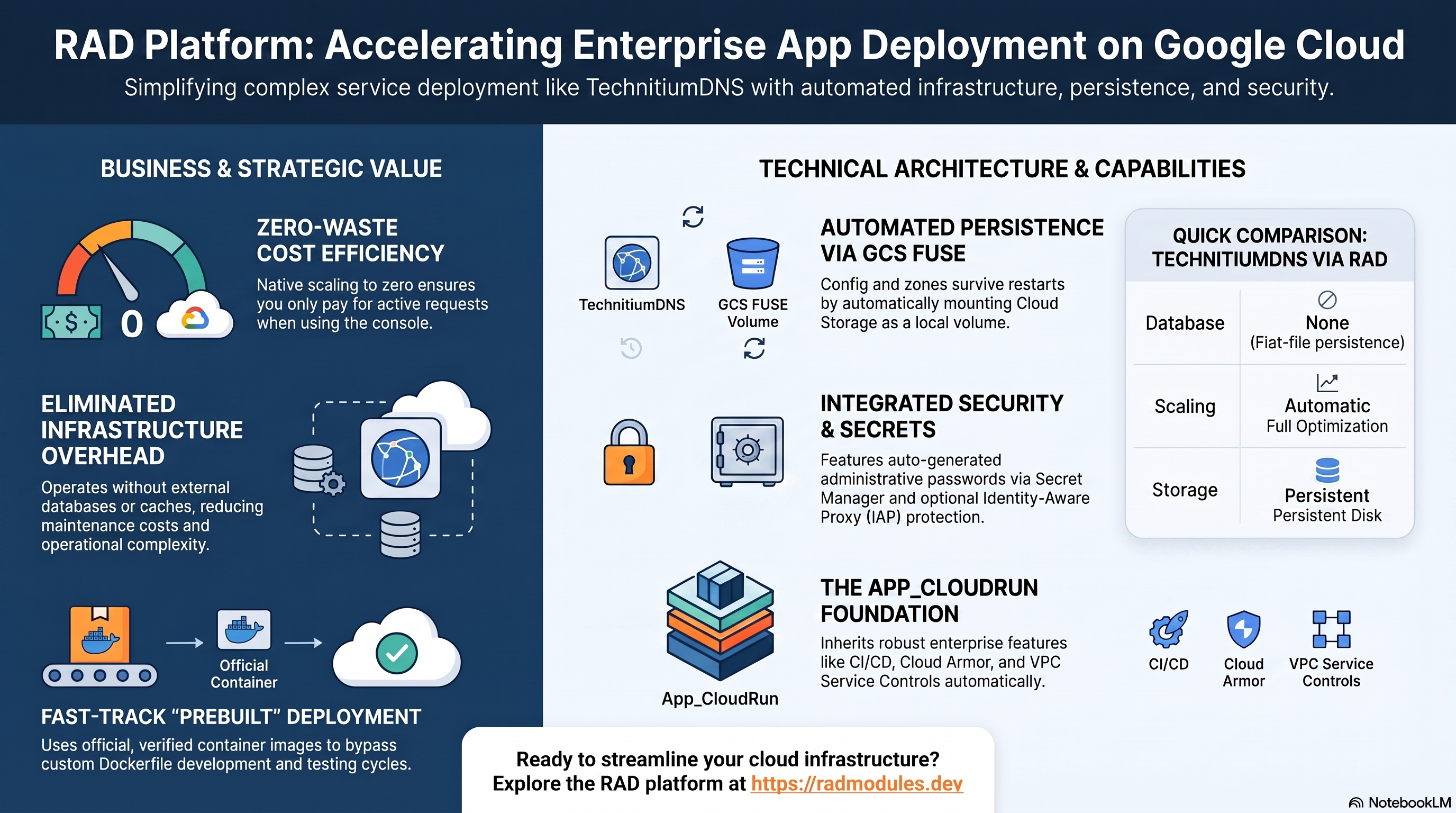
⚠️ Scoping disclosure: this module deploys Technitium's web admin console + REST API only (port 5380/HTTP). Technitium's core DNS resolver function (port 53/udp+tcp) cannot be exposed through Cloud Run's HTTP(S)-only ingress. No client anywhere can query this deployment as a DNS resolver. See §1 and §7 below for the full explanation.
Technitium DNS Server is a self-hosted, open-source, cross-platform authoritative and recursive DNS
server (.NET) with a full-featured web admin console and REST API for managing zones, records,
DNS-based ad/tracker blocking, conditional forwarding, and DNS-over-HTTPS/TLS. This module deploys the
official technitium/dns-server image on Cloud Run v2, unmodified, on top of the
App_CloudRun foundation, which provisions and manages the shared Google Cloud
infrastructure.
This guide focuses on the cloud services TechnitiumDNS uses and how to explore and operate them from the Google Cloud Console and the command line. For the mechanics common to every Cloud Run application — service identity, ingress and load balancing, scaling and concurrency, CI/CD, Cloud Armor, IAP, Binary Authorization, VPC Service Controls, backups, and the deployment lifecycle — refer to the App_CloudRun foundation guide rather than repeating them here.
What TechnitiumDNS costs on RAD, and how that compares
TechnitiumDNS on RAD's Cloud Run module costs about US$16.78 a month in a Google Cloud project you own, with the module fee charged once in RAD credits. This is one of the lightest modules on the platform — no database, a small container, and (per the scoping disclosure above) only the web admin console and REST API, not a reachable DNS resolver. For the lowest running cost this stays on Cloud Run; GKE Autopilot is only worth it if it needs to sit beside other Kubernetes workloads — see the GKE guide for that option, at about US$24.04 a month instead. If you only need it occasionally — testing zone configuration, a short-lived evaluation — a RAD-managed project can be deleted and restored within 30 days for a handful of credits (under US$1) instead of paying for it to sit idle. See Pause it for free, below. Figures are as at 8 October 2026; sources are listed at the end of this section.
What you pay on RAD
| In a Google Cloud project you own | In a project RAD manages for you | |
|---|---|---|
| Module fee, once per deployment | 40 credits (US$4 at the top-up price) | 36 credits (10% lower) |
| Build time | About 3-6 credits per build | The same |
| Google Cloud running cost | Billed by Google to your own billing account, about US$16.78 a month for the default configuration (table below) | Metered hourly in credits; RAD publishes 3 credits a day, about 90 a month |
| Who owns what | You own the project and its billing; RAD deploys and updates it | RAD owns the project, with guardrails, quotas and budget alerts; you get console access, and a minimum purchased balance is held in reserve |
10 credits cost US$1 on a one-off top-up, and less on a monthly plan. In a project RAD manages, the network is shared by every application in the project, so a second application does not add a second set of it.
Default running cost in your own project (us-central1, Google list prices):
| Resource (module default) | Per month |
|---|---|
| Cloud Run, 1x vCPU / 0.5 GiB (scaleToZero) | US$10.78 |
| Cloud NAT and networking | US$5.00 |
| Cloud Storage (add-ons, backups) | US$1.00 |
| Total | US$16.78 |
How it compares
- TechnitiumDNS has no commercial hosted SaaS of its own for this admin console/API surface — it is distributed only as self-hosted, Docker-first open-source software for an administrator to run themselves.
- A self-managed comparison: Hetzner CPX22 (2 vCPU/4GB) runs about $24/month, a DigitalOcean 2 vCPU/4GB Droplet is the same $24/month, and a GCP Compute Engine e2-standard-2 (2 vCPU/8GB) is about $49/month — all considerably more machine than this module's 1 vCPU / 0.5 GiB footprint needs; a $5-6/month shared-vCPU micro instance would run it comfortably, plus the admin's own time for patching and TLS that RAD's managed Secret Manager and monitoring cover for you.
- With no database and no persistent state beyond its own configuration, this is close to the floor of what any Cloud Run deployment on RAD costs — almost the whole bill is the container itself.
Pause it for free: delete a RAD-managed project, restore it when you need it
If TechnitiumDNS runs in a project RAD manages for you, deleting the whole project unlinks its billing first, then asks Google to delete the project outright — Google's own 30-day recoverable soft delete. Unlike deleting one module, this does not tear down the compute resource one by one: the whole project simply stops, and nothing is charged while it waits, because billing is already unlinked.
Restoring, within 30 days and only by the project's owner, asks Google to undelete the project and reattaches its billing account, then asks you to run Update on each deployment to confirm everything came back. Because nothing was individually destroyed, that Update finds the same resources already there — it is a check, not a rebuild, and an Update never charges the module fee again. This costs only a handful of credits (under US$1) in total for a typical 2-3-deployment chain.
What this needs: you must own the project (not one RAD only manages billing for), you must restore it yourself within 30 days — after that Google deletes it for good — and restoring is admitted like creating a new project, so your purchased credit balance must still clear the tier's floor (100 credits for the sandbox tier most study/demo use fits). Google says most services are fully working again within 36 hours of a restore.
One real gap: nightly backups are written to a bucket inside the project, and that bucket has Cloud Storage's soft-delete explicitly turned off, so it is very likely gone as soon as you delete the project — even though the project itself is recoverable for 30 days. If you have custom zone configuration you want to keep, copy a backup out (to Google Drive, or a bucket outside the project) before deleting. For a default install with nothing irreplaceable in it, this does not matter.
Pay only while you use it, the other way: delete and redeploy
In your own project, or once the 30-day restore window has passed, the alternative is to delete TechnitiumDNS outright and redeploy it later. A redeploy costs the module fee again, plus the builds — roughly 45 credits (about US$4.50) in your own project, or 41 credits in a RAD-managed one.
Deleting saves money only once TechnitiumDNS would otherwise sit unused long enough to clear that redeploy cost against its own daily running cost — against the own-project total above (about US$0.56 a day), that works out to about 9 days or more, or about 14 days or more in a RAD-managed one (3 credits a day). There's no database here, so deleting this app frees its entire running cost rather than just a share of it.
Keep data first: anything TechnitiumDNS writes to a backup bucket inside the deployment is deleted with it, so copy anything you want to keep out before deleting.
Lab sessions and Managed Environments
- Lab sessions, for training: a trainer runs a session for a class. Each participant gets the app in their own Google Cloud project for 15 minutes to 24 hours, within an allowance the trainer sets. Either the trainer funds every place, or each participant pays for their own. Everything is deleted when the session ends and unused credits go back to the trainer.
- Managed Environments, for consultancies: a partner runs the app for a client from a ring-fenced wallet it funds, and settles with the client directly. If the wallet runs low, billing pauses and the data is kept, so nobody receives an unexpected charge. At the end the partner hands the project over and the deployments become the client's own.
- Credits can be bought in more than 20 currencies, including XAF, XOF, NGN, GHS, KES and ZAR, by card, bank transfer or mobile money.
Sources (8 October 2026): Google Cloud Billing Catalog API list prices; radmodules.dev/pricing for RAD's own fees and daily-credit estimates; Delete and restore projects for the pause/restore mechanics. No currently-verified commercial hosted SaaS exists for this TechnitiumDNS surface, so no competitor price is named.
1. Overview
TechnitiumDNS runs as a single prebuilt container on Cloud Run v2. The deployment wires together a deliberately small set of Google Cloud services — TechnitiumDNS has no database or cache dependency of its own:
| Capability | Google Cloud service | Notes |
|---|---|---|
| Compute | Cloud Run v2 | Single prebuilt container, 500m vCPU / 512 MiB by default; request-based billing, scales to zero |
| Database | None | database_type = "NONE"; zones/settings/logs are local flat files, no Cloud SQL provisioned |
| Persistence | Cloud Storage (GCS FUSE) | Config bucket mounted at /etc/dns; survives restarts and redeploys |
| Object storage | Cloud Storage | One auto-created "config" bucket (also the persistence layer above) |
| Cache / queue | None | No Redis; TechnitiumDNS needs no external cache |
| Secrets | Secret Manager | One auto-generated secret: DNS_SERVER_ADMIN_PASSWORD |
| Ingress | Cloud Run URL / Cloud Load Balancing | Default run.app URL for the web console only — port 53 is never exposed |
Sensible defaults worth knowing up front:
- No database is provisioned.
database_type = "NONE"— TechnitiumDNS keeps zones, settings, and logs as local flat files under/etc/dns. The database-related variables exist for completeness but are inert. - Persistent by default. A GCS FUSE volume is mounted at
/etc/dnsautomatically — config, zones, and logs survive restarts and redeploys with no extra configuration. - Prebuilt image, no custom Dockerfile.
container_image_source = "prebuilt"deploystechnitium/dns-serveras-is — verified locally to boot cleanly and honourDNS_SERVER_ADMIN_PASSWORD/DNS_SERVER_DOMAINon first start. - Scales to zero by default (
min_instance_count = 0,cpu_always_allocated = false) — the admin console is a plain request/response app with no background scheduler or WebSocket stream. - The health endpoint is
/, the console's unauthenticated root page, which returns HTTP 200 with the full console HTML as soon as the server binds its port. - One auto-generated secret.
DNS_SERVER_ADMIN_PASSWORDbootstraps the initialadminaccount on the very first boot only; later restarts ignore it (the persistedauth.configwins). - No DNS resolver. See §7 below — this is the single most important thing to understand before deploying this module.
2. Google Cloud Services & How to Explore Them
All commands assume PROJECT and REGION are set. Service and resource names are
reported in the deployment Outputs.
A. Cloud Run — the TechnitiumDNS console service
TechnitiumDNS runs as a Cloud Run v2 service. Each deployment creates an immutable revision; traffic can be split across revisions for safe rollouts.
- Console: Cloud Run → select the service for revisions, traffic, logs, and metrics.
- CLI:
gcloud run services list --project "$PROJECT" --region "$REGION"
gcloud run services describe <service-name> --project "$PROJECT" --region "$REGION"
gcloud run revisions list --service <service-name> --project "$PROJECT" --region "$REGION"
See App_CloudRun for scaling, concurrency, execution environment, and traffic splitting.
B. Persistence — the config Cloud Storage bucket
TechnitiumDNS has no Cloud SQL instance. All zones, settings, the auth database, and logs live under
/etc/dns, backed by a GCS FUSE-mounted Cloud Storage bucket created for this deployment.
- Console: Cloud Storage → Buckets → find the bucket named
gcs-<service-name>-config. - CLI:
gcloud storage buckets list --project "$PROJECT" --filter="name~-config"
gcloud storage ls "gs://<bucket-name>/"
See App_CloudRun for the GCS FUSE volume mount model.
C. Secret Manager
TechnitiumDNS generates exactly one secret at deploy time: the initial admin password.
- Console: Security → Secret Manager.
- CLI:
gcloud secrets list --project "$PROJECT" --filter="name~admin-password"
gcloud secrets versions access latest --secret=<secret-name> --project "$PROJECT"
See App_CloudRun for injection and rotation details.
D. Networking & ingress
The service is reachable at its run.app URL by default — this is the web console URL, not a DNS
endpoint. An external HTTPS load balancer with a custom domain, Cloud CDN, and Cloud Armor can be layered
on for the console; none of this exposes DNS resolution (port 53).
- Console: Cloud Run (service URL); Network services → Load balancing.
- CLI:
gcloud run services describe <service-name> --region "$REGION" --format='value(status.url)'
gcloud compute addresses list --project "$PROJECT"
See App_CloudRun.
E. Cloud Logging & Monitoring
Container logs flow to Cloud Logging; Cloud Run metrics flow to Cloud Monitoring, with optional uptime checks and alert policies.
- Console: Logging → Logs Explorer; Monitoring → Dashboards / Alerting.
- CLI:
gcloud run services logs read <service-name> --project "$PROJECT" --region "$REGION" --limit 50
3. TechnitiumDNS Application Behaviour
- No first-deploy database setup. TechnitiumDNS has no external database and no migration step. It
reads/writes local flat files under
/etc/dnsfrom the moment it boots. - First-boot admin bootstrap.
DNS_SERVER_ADMIN_PASSWORDis applied only when/etc/dns/auth.configdoes not yet exist (a genuinely fresh deployment). On every later restart or redeploy, the persistedauth.configon the GCS-mounted volume wins and the injected password is ignored. - Health path. Startup and liveness probes target
/, which returns HTTP 200 with the full console HTML as soon as the server binds port 5380. Verify:SERVICE_URL=$(gcloud run services describe <service-name> \
--project "$PROJECT" --region "$REGION" --format='value(status.url)')
curl -s -o /dev/null -w '%{http_code} %{size_download}\n' "$SERVICE_URL/" # expect 200 and a large body - Log in. Open
$SERVICE_URLin a browser, sign in asadminwith the Secret-Manager-stored password, and change it immediately from the console's own user-management page (Technitium does not re-readDNS_SERVER_ADMIN_PASSWORDafter first boot, so changing it there is the only way to rotate it going forward). - REST API. All console actions are also available over the REST API
(
$SERVICE_URL/api/...) using a session token obtained via/api/user/login. See Technitium's API docs. - No DNS resolution from this deployment. See §7 below.
4. Configuration Variables
Variables are grouped exactly as they appear on the deployment platform. Only settings specific to or notable for TechnitiumDNS are listed; every other input is inherited from App_CloudRun with its standard behaviour.
Group 1 — Project & Identity
| Variable | Default | Description |
|---|---|---|
project_id | (required) | Target Google Cloud project. |
region | us-central1 | Region for the service and regional resources. |
Group 2 / 3 — Deployment Environment & Application Identity
| Variable | Default | Description |
|---|---|---|
tenant_id | demo | Short suffix that makes resource names unique per environment. |
application_name | technitiumdns | Base name for the service, registry repo, and secrets. Do not change after first deploy. |
application_display_name | TechnitiumDNS | Human-readable name shown in the Console. |
application_version | latest | TechnitiumDNS image version tag (e.g. latest, 13.5.1). |
Group 4 — Runtime & Scaling
| Variable | Default | Description |
|---|---|---|
deploy_application | true | Set false to provision supporting infrastructure only. |
container_image_source | prebuilt | Deploys the official image as-is; custom accepted for forward-compatibility but no Dockerfile ships. |
cpu_limit | "1000m" | CPU per instance. |
memory_limit | 512Mi | Memory per instance (gen2 floor is 512Mi). |
min_instance_count | 0 | Scales to zero when idle. |
max_instance_count | 1 | Maximum instances. |
container_port | 5380 | The web console's default port. |
cpu_always_allocated | false | Request-based billing — no background work to keep warm for. |
enable_cloudsql_volume | false | Off — TechnitiumDNS has no database. |
enable_image_mirroring | true | Mirror the TechnitiumDNS image into Artifact Registry. |
Group 5 — Access & Networking
| Variable | Default | Description |
|---|---|---|
ingress_settings | all | Public console access by default. |
enable_iap | false | Require Google sign-in. Strongly recommended — the console otherwise relies solely on its own admin password. |
Group 6 — Environment Variables & Secrets
| Variable | Default | Description |
|---|---|---|
environment_variables | {} | Extra DNS_SERVER_* settings (e.g. DNS_SERVER_FORWARDERS, DNS_SERVER_DOMAIN). |
secret_environment_variables | {} | Map of env var → Secret Manager secret name (additional secrets; DNS_SERVER_ADMIN_PASSWORD is already wired). |
Group 11 — Storage & Filesystem
| Variable | Default | Description |
|---|---|---|
gcs_volumes | [] | Additional GCS buckets to mount; the config bucket at /etc/dns is auto-added. |
storage_buckets | [] | Additional buckets beyond the auto-created config bucket. |
enable_nfs | false | Not needed by default — the GCS volume at /etc/dns already persists state. |
Group 12 — Database Backend
| Variable | Default | Description |
|---|---|---|
database_type | NONE | TechnitiumDNS has no external database; leave NONE. |
application_database_name / application_database_user | technitiumdns | Inert — no database is provisioned. |
Group 13 — Jobs & Scheduled Tasks
| Variable | Default | Description |
|---|---|---|
initialization_jobs | [] | TechnitiumDNS needs no init job; leave empty. |
cron_jobs | [] | Optional scheduled Cloud Run jobs. |
Group 14 — Observability & Health
| Variable | Default | Description |
|---|---|---|
startup_probe | HTTP / 20s delay | Startup probe targeting the console's public root page. |
liveness_probe | HTTP / 30s delay | Liveness probe. |
uptime_check_config | { enabled=false, path="/" } | Optional Cloud Monitoring uptime check. |
Group 16 — Redis Cache
| Variable | Default | Description |
|---|---|---|
enable_redis | false | Not required — TechnitiumDNS has no Redis dependency. |
All other inputs follow standard App_CloudRun behaviour.
5. Outputs
Returned on a successful deployment — the quickest way to locate and explore the running resources.
| Output | Description |
|---|---|
service_name | Cloud Run service name. |
service_url | Default run.app URL of the web console (not a DNS endpoint). |
service_location | Region the service runs in. |
stage_services | Stage-specific service URLs (Cloud Deploy). |
load_balancer_ip / load_balancer_url | External HTTPS load balancer IP / URL (when enabled). |
database_instance_name / database_name / database_user | Database identifiers — empty for the default NONE engine. |
database_password_secret / database_host / database_port | Database endpoint fields — unused for NONE. |
storage_buckets | Created Cloud Storage buckets (the config bucket). |
network_name / network_exists / regions | VPC network, presence, regions. |
container_image / container_registry | Deployed image and Artifact Registry repo. |
monitoring_enabled / monitoring_notification_channels / uptime_check_names | Monitoring status, channels, uptime checks. |
initialization_jobs | Names of any setup jobs (none by default). |
deployment_id / tenant_id / resource_prefix | Naming identifiers. |
project_id / project_number | Project identifiers. |
cicd_enabled / github_repository_url / github_repository_owner / github_repository_name / cicd_configuration | CI/CD status and details. |
artifact_registry_repository / cloudbuild_trigger_name / cloudbuild_trigger_id | Registry and build trigger. |
vpc_sc_enabled / vpc_sc_perimeter_name / vpc_sc_dry_run_mode | VPC-SC status. |
audit_logging_enabled / artifact_registry_cmek_enabled | Audit logging and CMEK status. |
6. Configuration Pitfalls & Sensible Defaults
Risk: Critical (data loss / outage / security) — High (service degraded) — Medium (cost or partial degradation) — Low (minor).
Inherited plan-time validation. This module passes its configuration through the App_CloudRun foundation engine, which validates values and combinations at plan time. Invalid configuration fails the plan with a clear, named error before any resource is created.
| Setting | Sensible value | Risk | Consequence if wrong |
|---|---|---|---|
| Expecting this to be a DNS resolver | Do not point client DNS settings at this deployment | Critical | Port 53/udp+tcp is never exposed by Cloud Run's HTTP(S)-only ingress — DNS queries against this deployment simply fail; only the web console/API is reachable. |
enable_iap | true for anything beyond a quick test | Critical | Without IAP, the console is protected only by its own admin password over the public internet — a single leaked/weak credential grants full DNS-management access. |
DNS_SERVER_ADMIN_PASSWORD rotation | Change the password from the console after first login | High | Technitium never re-reads the env var after first boot — rotating the Secret Manager value alone does NOT change the effective console password. |
GCS volume at /etc/dns | Leave enable_gcs_storage_volume enabled (default) | Critical | Without a mounted persistent volume, Cloud Run's read-only root filesystem would prevent any config/zone change from surviving a restart or redeploy. |
ingress_settings | all for console access, internal behind IAP/VPN only if that's the intent | Medium | internal blocks all external access to the console, including the operator, unless a VPN/bastion path exists. |
min_instance_count | 0 (default) is fine for occasional admin use | Low | Cold starts add a few seconds of latency on the first request after idling; bump to 1 only if that matters. |
application_version | Pin an explicit version in production | Low | latest tracks upstream releases; pin explicitly to control upgrade timing. |
For the foundation behaviour referenced throughout — service identity, scaling and concurrency, ingress and load balancing, CI/CD, Cloud Armor, IAP, Binary Authorization, VPC-SC, backups, and image mirroring — see App_CloudRun. TechnitiumDNS-specific application configuration shared with the GKE variant is described in TechnitiumDNS_Common.
Related guides
- Hands-on lab: TechnitiumDNS on Cloud Run — deploy it step by step, with the console screens and commands at each stage.
- TechnitiumDNS on GKE Autopilot — the same application on Kubernetes, for when you need the other deployment target.
- TechnitiumDNS Common — Shared Application Configuration — the configuration shared by both deployment targets.
Need RAD to do something it does not do yet? Request it on the roadmap, or vote on what is already there.