Certification track: Professional Cloud Security Engineer (PSE)
Vaultwarden on Google Cloud Run
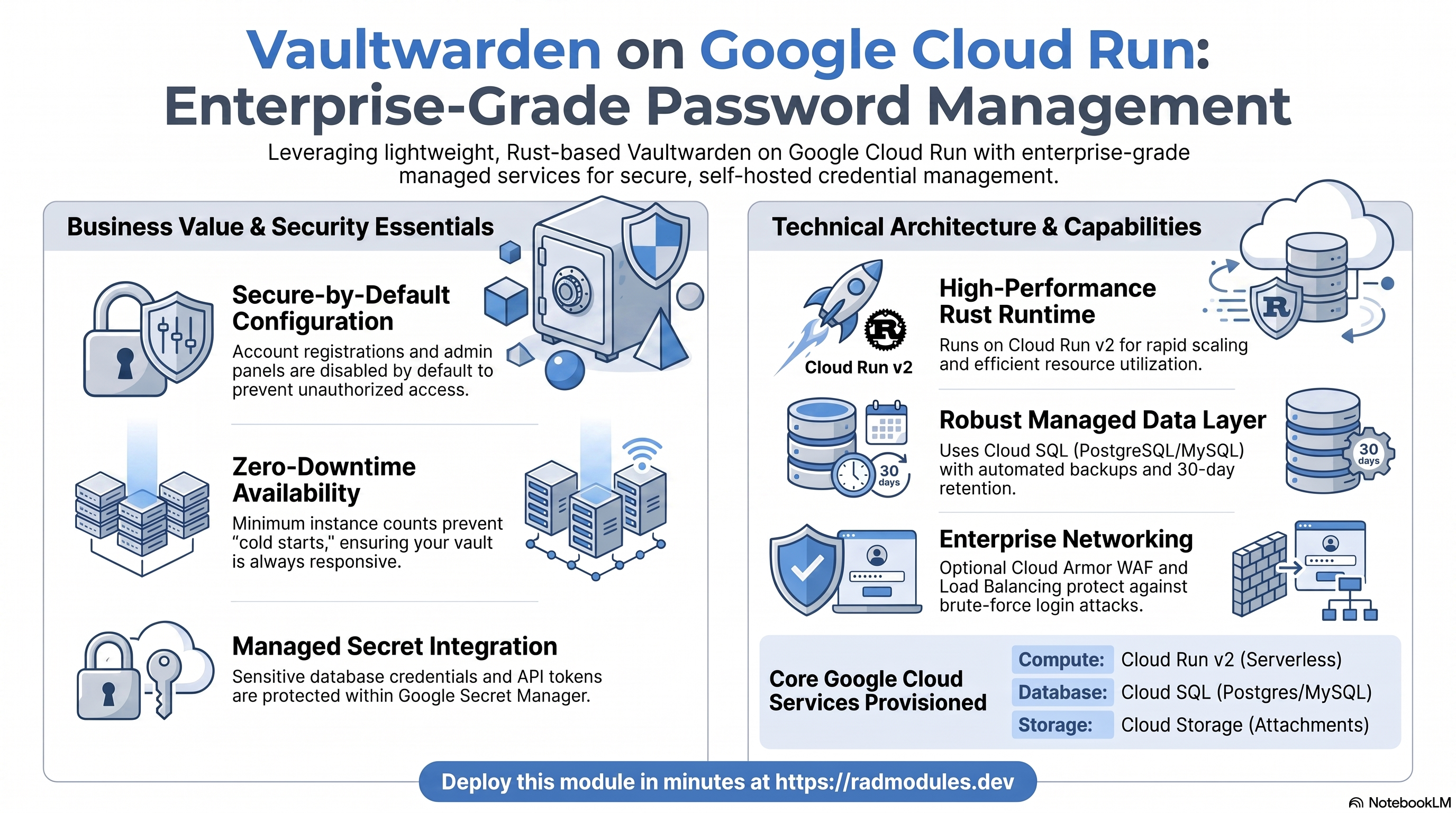
Vaultwarden is a lightweight, self-hosted Bitwarden-compatible password manager written in Rust. This module deploys Vaultwarden on Cloud Run v2 on top of the App_CloudRun foundation, which provisions and manages the shared Google Cloud infrastructure.
This guide focuses on the cloud services Vaultwarden uses and how to explore and operate them from the Google Cloud Console and the command line. For the mechanics common to every Cloud Run application — service identity, ingress and load balancing, scaling and concurrency, CI/CD, Cloud Armor, IAP, Binary Authorization, VPC Service Controls, backups, and the deployment lifecycle — refer to the App_CloudRun foundation guide rather than repeating them here.
What Vaultwarden costs on RAD, and how that compares
Running Vaultwarden on Cloud Run in your own Google Cloud project costs about US$80.31/month in Google Cloud charges, on top of a one-off 75-credit RAD module fee (US$7.50) charged once at deploy time. Vaultwarden is a lightweight, Rust-based Bitwarden-compatible password-manager server, so every official Bitwarden client app works against it unmodified. In a RAD-managed project the module fee drops to 67.5 credits (10% lower) — see Pause it for free below — or see the GKE guide if you'd rather run it on Kubernetes.
What you pay on RAD
| Own project | RAD-managed project | |
|---|---|---|
| Module fee (one-off) | 75 credits | 67.5 credits (10% lower) |
| Build time | ~3-6 credits per build, either way | ~3-6 credits per build, either way |
| Google Cloud running cost | US$80.31/month, billed by Google at list price | ~36 credits/day (about 1080/month, US$108 at the top-up price), metered at list price plus RAD's margin |
10 credits cost US$1 on a one-off top-up, and less on a monthly plan.
Default running cost in your own project
| Resource (module default) | Per month |
|---|---|
| Cloud Run, 1x vCPU / 0.5 GiB (warm) | US$9.86 |
| Cloud SQL for PostgreSQL, 1 vCPU / 3.75 GB, zonal, 10 GB SSD | US$51.02 |
| NFS/cache file server (small VM) | US$13.43 |
| Cloud NAT and networking | US$5 |
| Cloud Storage (add-ons, backups) | US$1 |
| Total | US$80.31 |
How it compares
- Bitwarden's own hosted service, which Vaultwarden is built to be compatible with, charges per user: Teams is $4/user/month and Enterprise $6/user/month (both billed annually, business plans), with a personal Premium plan at $1.65/month — verified on Bitwarden's pricing page, 8 October 2026. A 10-person team on Bitwarden Teams is $40/month forever, growing with headcount; RAD's own-project running cost is a flat ~US$80/month regardless of how many people have vaults, and the data never leaves your own project.
- A self-managed VPS comparison, sized to Vaultwarden's lightweight 1 vCPU / 0.5 GiB default: a Hetzner CPX11 or DigitalOcean 1 vCPU/2GB Droplet runs about $6-12/month — cheaper in cash terms, plus your own time for Postgres backups and patching, which matters more here than on most apps because this is a password vault.
- Vaultwarden's own running cost crosses Bitwarden Teams' per-seat price at around 20 users; below that, Bitwarden's own hosting is the cheaper option in cash terms, and RAD's case is full control of the data rather than price.
Pause it for free: delete a RAD-managed project, restore it when you need it
This is the headline advantage of a RAD-managed project, and it costs nothing while paused. Deleting a RAD-managed project unlinks its billing first, then asks Google to delete the project outright — Google's own 30-day recoverable soft delete. Unlike deleting one module, this does not tear down Cloud SQL, any VM, or the compute resource one by one: the whole project simply stops, and nothing is charged while it waits, because billing is already unlinked.
Restoring, within 30 days and only by the project's owner, asks Google to undelete the project and reattaches its billing account, then asks you to run Update on each deployment to confirm everything came back. Because nothing was individually destroyed, that Update finds the same resources already there — it is a check, not a rebuild, and an Update never charges the module fee again. This costs only a handful of credits (under US$1) in total for a typical 2-3-deployment chain.
What this needs: you must own the project (not one RAD only manages billing for), you must restore it yourself within 30 days — after that Google deletes it for good — and restoring is admitted like creating a new project, so your purchased credit balance must still clear the tier's floor (100 credits for the sandbox tier most study/demo use fits). Google says most services are fully working again within 36 hours of a restore.
One real gap: nightly backups are written to a bucket inside the project, and that bucket has Cloud Storage's soft-delete explicitly turned off, so it is very likely gone as soon as you delete the project — even though the project itself is recoverable for 30 days. If you've customised Vaultwarden and want to keep that work, copy a backup out (to Google Drive, or a bucket outside the project) before deleting. For a default install with nothing irreplaceable in it, this does not matter.
Pay only while you use it, the other way: delete and redeploy
In your own project, or once 30 days have passed on a RAD-managed one, there is no free pause — deleting removes the resources for good, and bringing Vaultwarden back means redeploying from scratch. That costs about 78-81 credits in your own project, or about 70.5-73.5 credits in a RAD-managed one.
Deleting only saves money once Vaultwarden would otherwise sit unused long enough to clear that redeploy cost against its own running cost — about 3 days or more in your own project (about US$2.68 a day), or about 2 days or more in a RAD-managed one (36 credits a day).
Keep data first: nightly backups go to a bucket inside the deployment and are deleted with it, so copy the latest backup out before deleting if you want to keep it.
Lab sessions and Managed Environments
Lab sessions, for training: a trainer runs a session for a class. Each participant gets the app in their own Google Cloud project for 15 minutes to 24 hours, within an allowance the trainer sets. Either the trainer funds every place, or each participant pays for their own. Everything is deleted when the session ends and unused credits go back to the trainer.
Managed Environments, for consultancies: a partner runs the app for a client from a ring-fenced wallet it funds, and settles with the client directly. If the wallet runs low, billing pauses and the data is kept, so nobody receives an unexpected charge. At the end the partner hands the project over and the deployments become the client's own.
Credits can be bought in more than 20 currencies, including XAF, XOF, NGN, GHS, KES and ZAR, by card, bank transfer or mobile money.
Sources (8 October 2026): Google Cloud Billing Catalog API list prices; radmodules.dev/pricing for RAD's own fees and daily-credit estimates; Google's project delete/restore documentation for the pause/restore claims; Bitwarden pricing.
1. Overview
Vaultwarden runs as a compiled Rust binary on Cloud Run v2. The deployment wires together a focused set of Google Cloud services:
| Capability | Google Cloud service | Notes |
|---|---|---|
| Compute | Cloud Run v2 | Rust binary service, 1 vCPU / 512 Mi by default, request-based autoscaling |
| Database | Cloud SQL for PostgreSQL 15 (default) or MySQL 8.0 | Configurable engine; the init job adjusts automatically |
| Object storage | Cloud Storage | A dedicated vaultwarden-attachments bucket |
| Secrets | Secret Manager | Database password; Vaultwarden manages its own admin token internally |
| Ingress | Cloud Run URL / Cloud Load Balancing | Default run.app URL, optional external HTTPS load balancer + custom domain |
Sensible defaults worth knowing up front:
- Registrations are closed by default.
signups_allowed = falseprevents anonymous account creation. Enable only during initial admin setup, then disable. - No admin token is auto-generated. The
/adminpanel is disabled unless you provideADMIN_TOKENinenvironment_variables. This is the secure default. domainmust be set for WebAuthn and TOTP. Without the full public URL, 2FA QR codes link tolocalhostand organisation invitation emails contain broken links.- Health probes target
/alive, Vaultwarden's dedicated lightweight health endpoint. Vaultwarden starts in seconds; the startup probe uses a 30 s initial delay. cpu_limitmust be at least1000m. Cloud Run gen2 with always-allocated CPU (required for amin_instance_count ≥ 1password manager) requires at least 1 vCPU.execution_environment = "gen2"is the default and should not be changed; it is required for Unix socket connections to the Cloud SQL Auth Proxy.min_instance_count = 1keeps the vault warm. Scale-to-zero makes a password manager unavailable for several seconds; Bitwarden clients show connection errors.
2. Google Cloud Services & How to Explore Them
All commands assume PROJECT and REGION are set. Service and resource names are
reported in the deployment Outputs.
A. Cloud Run — the Vaultwarden service
Vaultwarden runs as a Cloud Run v2 service that autoscales by request load between the minimum and maximum instance counts. Each deployment creates an immutable revision; traffic can be split across revisions for safe rollouts.
- Console: Cloud Run → select the service for revisions, traffic, logs, and metrics.
- CLI:
gcloud run services list --project "$PROJECT" --region "$REGION"
gcloud run services describe <service-name> --project "$PROJECT" --region "$REGION"
gcloud run revisions list --service <service-name> --project "$PROJECT" --region "$REGION"
See App_CloudRun for scaling, concurrency, execution environment, and traffic splitting.
B. Cloud SQL — PostgreSQL 15 or MySQL 8.0
Vaultwarden stores all vault data in a managed Cloud SQL instance. The default engine
is PostgreSQL 15; set database_type = "MYSQL_8_0" to use MySQL instead. The
service connects privately through the Cloud SQL Auth Proxy over a Unix socket
(no public IP). On first deploy an initialization Job creates the application
database and user.
- Console: SQL → select the instance for connections, backups, flags, metrics.
- CLI:
gcloud sql instances list --project "$PROJECT"
gcloud sql instances describe <instance-name> --project "$PROJECT"
gcloud sql connect <instance-name> --user=<db-user> --project "$PROJECT"
The instance name, database, user, and password secret are in the Outputs. See App_CloudRun for the connection model, backups, and password rotation.
C. Cloud Storage
A dedicated Cloud Storage bucket (vaultwarden-attachments) is provisioned for
attachment files. The workload service account is granted access automatically.
- Console: Cloud Storage → Buckets.
- CLI:
gcloud storage buckets list --project "$PROJECT"
gcloud storage ls gs://<attachments-bucket>/    # bucket name is in the Outputs
See App_CloudRun for GCS Fuse mounts and CMEK options.
D. Secret Manager
The database password is stored in Secret Manager and injected into the service at
runtime. Vaultwarden manages its own internal admin token and RSA signing keys within
the /data directory — those are not stored in Secret Manager.
- Console: Security → Secret Manager.
- CLI:
gcloud secrets list --project "$PROJECT"
gcloud secrets versions access latest --secret=<secret-name> --project "$PROJECT"
See App_CloudRun for injection and rotation details.
E. Networking & ingress
The service is reachable at its run.app URL by default. An external HTTPS load
balancer with a custom domain, Cloud CDN (with caution — do not cache authenticated
API responses), and Cloud Armor can be layered on. Cloud Armor is strongly recommended
to protect the Vaultwarden login endpoint from brute-force attacks.
- Console: Cloud Run (service URL); Network services → Load balancing.
- CLI:
gcloud run services describe <service-name> --region "$REGION" --format='value(status.url)'
gcloud compute addresses list --project "$PROJECT"
See App_CloudRun.
F. Cloud Logging & Monitoring
Container logs flow to Cloud Logging; Cloud Run and Cloud SQL metrics flow to Cloud
Monitoring, with optional uptime checks (targeting /alive) and alert policies.
- Console: Logging → Logs Explorer; Monitoring → Dashboards / Alerting.
- CLI:
gcloud run services logs read <service-name> --project "$PROJECT" --region "$REGION" --limit 50
3. Vaultwarden Application Behaviour
- First-deploy database setup. An initialization Job creates the Vaultwarden
database and user before the service starts. It is idempotent. The correct job image
is selected automatically:
postgres:15-alpinefor PostgreSQL,mysql:8.0-debianfor MySQL. - No schema migrations on start. Vaultwarden manages its own internal schema evolution automatically; no migration command is needed.
- No scheduled tasks required. Unlike many web applications, Vaultwarden has no mandatory cron jobs. All vault operations are request-driven.
- Health path. Both the startup and liveness probes target
/alive, which returnsOKwhen the server is ready. The initial delay is 30 s, matching Vaultwarden's fast Rust startup. - Admin panel. The
/adminpanel is disabled unlessADMIN_TOKENis provided viaenvironment_variables. Generate a secure random token (e.g. withopenssl rand -base64 48) and inject it at runtime. - SMTP for notifications. Vaultwarden uses SMTP for account verification, 2FA
recovery codes, and emergency-access emails. Configure
SMTP_HOST,SMTP_PORT,SMTP_FROM,SMTP_USERNAME, andSMTP_PASSWORD(viasecret_environment_variables) as a complete set — partial SMTP configuration causes silent delivery failures.
4. Configuration Variables
Variables are grouped exactly as they appear on the deployment platform. Only settings specific to or notable for Vaultwarden are listed; every other input is inherited from App_CloudRun with its standard behaviour.
Group 1 — Project & Identity
| Variable | Default | Description |
|---|---|---|
project_id | (required) | Target Google Cloud project. |
region | us-central1 | Region for the service and regional resources. |
Group 2 — Deployment Environment
| Variable | Default | Description |
|---|---|---|
tenant_id | demo | Short suffix that makes resource names unique per environment. |
support_users | [] | Emails granted project access and monitoring alerts. |
resource_labels | {} | Labels applied to all resources. |
Group 3 — Application Identity & Vaultwarden Settings
| Variable | Default | Description |
|---|---|---|
application_name | vaultwarden | Base name for resources. Do not change after first deploy. |
display_name | Vaultwarden Password Manager | Friendly name shown in the Console. |
description | (set) | Service description. |
application_version | 1.32.7 | Vaultwarden image version tag. |
domain | "" | Full public URL (e.g. https://vault.example.com). Required for WebAuthn, TOTP QR codes, org invites, and attachment links. |
signups_allowed | false | Allow new user self-registration. Enable only during initial setup; disable immediately after creating admin accounts. |
web_vault_enabled | true | Serve the Vaultwarden web UI. Disable for API-only access via native clients. |
Group 4 — Runtime & Scaling
| Variable | Default | Description |
|---|---|---|
deploy_application | true | Set false to provision infrastructure only. |
container_image_source | custom | custom builds from the Dockerfile; prebuilt uses an existing image URI. |
cpu_limit | 1000m | CPU per instance. Minimum 1000m enforced by validation (Cloud Run gen2 requirement). |
memory_limit | 512Mi | Memory per instance. Vaultwarden is very lightweight at rest. |
min_instance_count | 1 | Minimum instances. Keep ≥ 1 to avoid cold-start vault unavailability. |
max_instance_count | 3 | Maximum instances (cost ceiling). |
container_port | 80 | Vaultwarden's Rocket HTTP port. Must match ROCKET_PORT. |
enable_cloudsql_volume | true | Cloud SQL Auth Proxy sidecar for Unix socket connections. Required. |
execution_environment | gen2 | Gen2 is required for Unix socket support. Do not change. |
cpu_always_allocated | false | Vaultwarden serves on request by default (request-based billing). Flip to true only if you enable Vaultwarden's WebSocket push-notification server — throttled CPU between requests otherwise breaks the persistent WS connection clients poll on. |
timeout_seconds | 300 | Maximum request duration in seconds (0–3600). |
traffic_split | [] | Split traffic across revisions for staged rollouts. |
max_revisions_to_retain | 7 | How many old revisions to keep for rollback. |
Group 5 — Access & Ingress Control
| Variable | Default | Description |
|---|---|---|
ingress_settings | all | Which networks may reach the service (all / internal / internal-and-cloud-load-balancing). |
vpc_egress_setting | PRIVATE_RANGES_ONLY | How outbound traffic is routed through the VPC connector. |
enable_iap | false | Require Google sign-in via Identity-Aware Proxy. Note: IAP may prevent native Bitwarden clients from connecting. |
iap_authorized_users / iap_authorized_groups | [] | Who may access through IAP. |
Group 6 — Environment Variables & Secrets
| Variable | Default | Description |
|---|---|---|
environment_variables | (SMTP/log defaults) | Plain-text settings. Core ROCKET_PORT, SIGNUPS_ALLOWED, WEB_VAULT_ENABLED, DATA_FOLDER, and optionally DOMAIN are injected automatically. Default includes LOG_LEVEL=warn, SHOW_PASSWORD_HINT=false, and SMTP stub values. |
secret_environment_variables | {} | Map of env var → Secret Manager secret name (e.g. { SMTP_PASSWORD = "vaultwarden-smtp-pass" }). |
secret_propagation_delay | 30 | Seconds to wait after secret creation before proceeding. |
secret_rotation_period | 2592000s | Secret Manager rotation notification cadence. |
Group 7 — Backup & Restore
| Variable | Default | Description |
|---|---|---|
backup_schedule | 0 2 * * * | Automated backup cron (UTC). |
backup_retention_days | 30 | Retention; 30-day default reflects vault recovery importance. |
enable_backup_import / backup_source / backup_uri / backup_format | restore options | Restore from a backup on deploy. |
Group 8 — CI/CD & Binary Authorization
Standard App_CloudRun Cloud Build / Cloud Deploy integration — see
App_CloudRun. Key inputs: enable_cicd_trigger,
github_repository_url, github_token, enable_cloud_deploy,
enable_binary_authorization, binauthz_evaluation_mode.
Group 9 — Custom SQL Scripts
enable_custom_sql_scripts, custom_sql_scripts_bucket, custom_sql_scripts_path,
custom_sql_scripts_use_root — run SQL from a GCS bucket after provisioning. See
App_CloudRun.
Group 10 — Load Balancer, CDN & Cloud Armor
| Variable | Default | Description |
|---|---|---|
enable_cloud_armor | false | Recommended for Vaultwarden. Provisions a Global HTTPS LB + Cloud Armor WAF to protect the login endpoint from brute-force. |
admin_ip_ranges | [] | CIDRs allowed privileged access. |
application_domains | [] | Custom hostnames. Also set domain to the full https:// URL. |
enable_cdn | false | Cloud CDN. Do not cache authenticated API responses — ensure Cache-Control: no-store headers are in place. |
max_images_to_retain / delete_untagged_images / image_retention_days | (set) | Artifact Registry cleanup policy. |
Group 11 — Storage & Filesystem
| Variable | Default | Description |
|---|---|---|
create_cloud_storage | true | Provision the attachments bucket. |
storage_buckets | [{ name_suffix = "data" }] | Additional buckets. |
enable_nfs | true | Optional Filestore NFS volume. Not required for Vaultwarden in Cloud Run (data is in Cloud SQL and GCS). |
nfs_mount_path | /data | NFS mount path inside the container. |
gcs_volumes | [] | GCS Fuse volume mounts. |
manage_storage_kms_iam / enable_artifact_registry_cmek | false | CMEK options. |
Group 12 — Database Backend
| Variable | Default | Description |
|---|---|---|
database_type | POSTGRES_15 | POSTGRES_15 (default) or MYSQL_8_0. The init job image is selected automatically. |
db_name | vaultwarden | Database name. Immutable after first deploy. |
db_user | vaultwarden | Application user. Immutable after first deploy. |
database_password_length | 32 | Generated password length (16–64). |
enable_auto_password_rotation / rotation_propagation_delay_sec | off | DB password rotation. |
db_host_env_var_name / db_user_env_var_name / db_name_env_var_name / db_port_env_var_name / service_url_env_var_name | "" | Additional env var names under which connection details are injected. |
Group 13 — Jobs & Scheduled Tasks
| Variable | Default | Description |
|---|---|---|
initialization_jobs | [] | Leave empty to use the built-in database setup job (selects the correct image for PostgreSQL or MySQL automatically). |
cron_jobs | [] | Vaultwarden has no required scheduled tasks; add custom Cloud Run Jobs here if needed. |
Group 14 — Observability & Health
| Variable | Default | Description |
|---|---|---|
startup_probe | HTTP /alive, 30 s delay, 6 failures | Vaultwarden's dedicated health path; 30 s matches fast Rust startup. |
liveness_probe | HTTP /alive, 30 s delay, 3 failures | Liveness probe. |
uptime_check_config | disabled, /alive | Cloud Monitoring uptime check. |
alert_policies | [] | Metric alert policies. |
Group 21 — Redis
| Variable | Default | Description |
|---|---|---|
enable_redis | false | Vaultwarden does not use Redis natively. Leave disabled unless adding a custom integration. |
redis_host / redis_port / redis_auth | (set) | Redis endpoint, port, and auth. |
Group 22 — VPC Service Controls & Audit Logging
| Variable | Default | Description |
|---|---|---|
enable_vpc_sc | false | Enforce a VPC-SC perimeter (requires organization_id). |
vpc_cidr_ranges / vpc_sc_dry_run | (set) | Access level CIDRs / dry-run mode. |
enable_audit_logging | false | Detailed Cloud Audit Logs. |
5. Outputs
Returned on a successful deployment — the quickest way to locate and explore the running resources.
| Output | Description |
|---|---|
service_name | Cloud Run service name. |
service_url | Default run.app URL of the service. |
service_location | Region the service runs in. |
stage_services | Stage-specific service URLs (Cloud Deploy). |
load_balancer_ip / load_balancer_url | External HTTPS load balancer IP / URL (when enabled). |
database_instance_name | Cloud SQL instance name. |
database_name / database_user | Application database name / user. |
database_password_secret | Secret Manager secret holding the DB password. |
database_host / database_port | DB endpoint / port. |
storage_buckets | Created Cloud Storage buckets. |
network_name / network_exists / regions | VPC network, presence, regions. |
container_image / container_registry | Deployed image and Artifact Registry repo. |
monitoring_enabled / monitoring_notification_channels / uptime_check_names | Monitoring status, channels, uptime checks. |
initialization_jobs | Names of the setup jobs. |
deployment_id / tenant_id / resource_prefix | Naming identifiers. |
project_id / project_number | Project identifiers. |
cicd_enabled / github_repository_url / github_repository_owner / github_repository_name / cicd_configuration | CI/CD status and details. |
artifact_registry_repository / cloudbuild_trigger_name / cloudbuild_trigger_id | Registry and build trigger. |
vpc_sc_enabled / vpc_sc_perimeter_name / vpc_sc_dry_run_mode | VPC-SC status. |
audit_logging_enabled / artifact_registry_cmek_enabled | Audit logging and CMEK status. |
6. Configuration Pitfalls & Sensible Defaults
Risk: Critical (data loss / outage / security) — High (service degraded) — Medium (cost or partial degradation) — Low (minor).
| Setting | Sensible value | Risk | Consequence if wrong |
|---|---|---|---|
signups_allowed | false | Critical | Any internet user can self-register on the vault while true. Disable immediately after creating admin accounts. |
enable_cloudsql_volume | true | Critical | Vaultwarden connects to Cloud SQL via Unix socket; disabling causes all database connections to fail at startup. |
db_name / db_user | set once | Critical | Changing after first deploy causes Vaultwarden to connect to an empty database; all credentials appear lost. |
enable_backup_import | false unless restoring | Critical | Enabling without a valid backup_uri fails the import job. |
domain | full https:// URL | High | Without it, TOTP QR codes link to localhost, org invite emails contain broken links, and attachment URLs are invalid. |
database_type | set once | High | Changing after first deploy causes Vaultwarden to see an empty database; all credentials appear lost. |
cpu_limit | 1000m or more | High | Cloud Run gen2 with always-allocated CPU rejects values below 1000m at deploy time. |
container_port | 80 | High | Must match ROCKET_PORT; a mismatch means Cloud Run health checks fail and all requests time out. |
execution_environment | gen2 | High | Gen1 does not support the Unix socket path used by the Cloud SQL Auth Proxy, causing database connection failures at startup. |
min_instance_count | 1 | High | Scale-to-zero makes a password manager unavailable for 5–15 s on cold start; Bitwarden clients show connection errors. |
cpu_always_allocated | false unless WS push enabled | Medium | Leaving false while the WebSocket push-notification server is enabled throttles CPU between requests and breaks the persistent WS connection; flip to true in that case. |
enable_cloud_armor | enable for production | Medium | Without Cloud Armor, the Vaultwarden login endpoint is open to brute-force attacks from the internet. |
enable_cdn | false or with cache controls | Medium | Caching authenticated API responses leaks vault data across users. |
backup_retention_days | 30 (raise for prod) | Medium | A password manager without adequate retention means credential loss on database failure. |
enable_iap with native clients | use with care | Medium | IAP requires browser-based OAuth; native Bitwarden clients cannot complete the IAP flow. |
smtp_* env vars | configure as a complete set | High | Partial SMTP configuration causes silent email delivery failures — 2FA recovery codes and invitation emails are never sent. |
For the foundation behaviour referenced throughout — service identity, scaling and concurrency, ingress and load balancing, CI/CD, Cloud Armor, IAP, Binary Authorization, VPC-SC, backups, and image mirroring — see App_CloudRun. Vaultwarden-specific application configuration shared with the GKE variant is described in Vaultwarden_Common.
Related guides
- Hands-on lab: Vaultwarden on Cloud Run — deploy it step by step, with the console screens and commands at each stage.
- Vaultwarden on GKE Autopilot — the same application on Kubernetes, for when you need the other deployment target.
- Vaultwarden Common — Shared Application Configuration — the configuration shared by both deployment targets.
- Deployed alongside Synapse on Google Cloud Run, Element on Google Cloud Run, Headscale on Google Cloud Run in the Secure Team Communications solution.
Need RAD to do something it does not do yet? Request it on the roadmap, or vote on what is already there.