Keycloak on Google Cloud Run
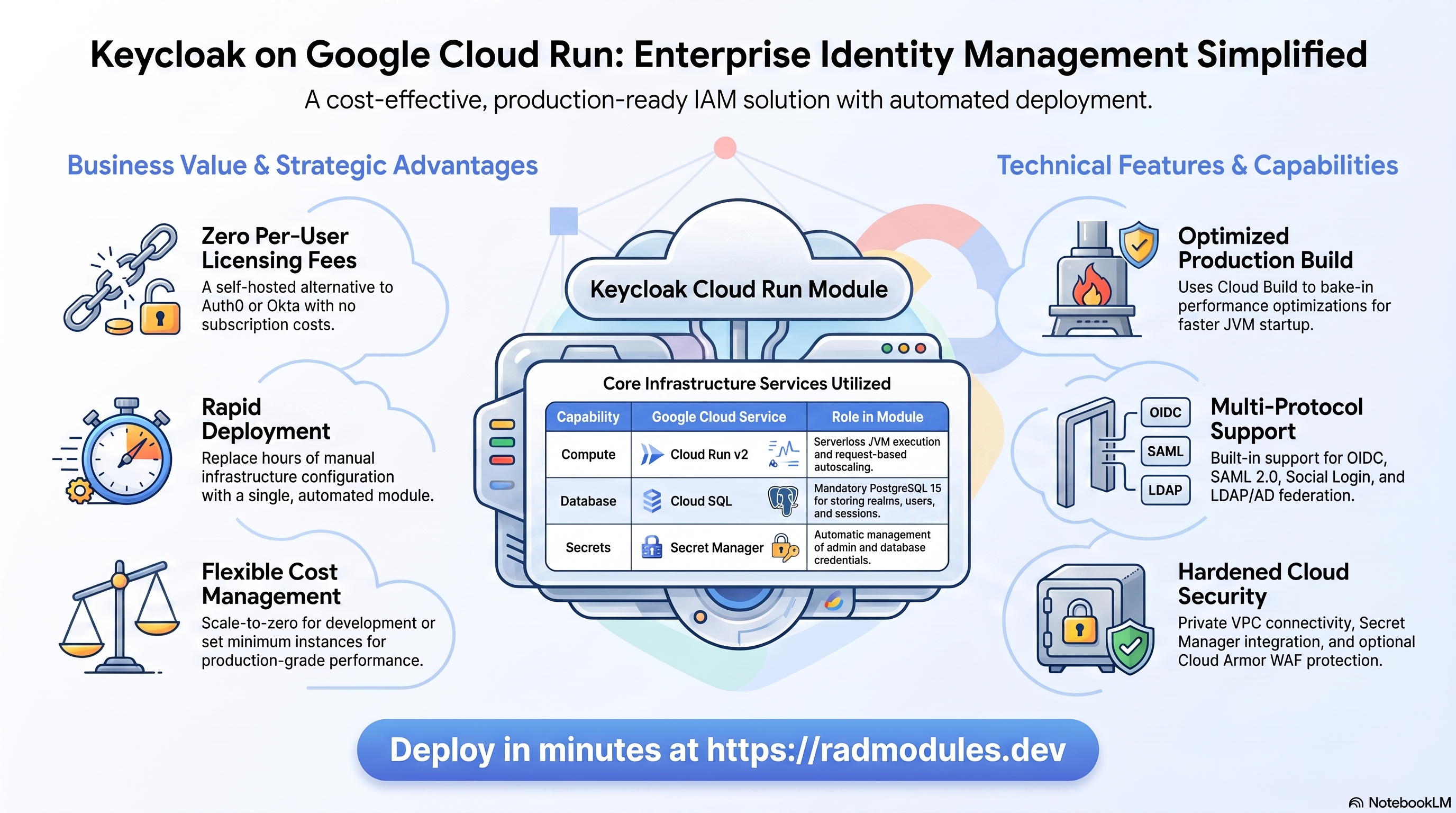
Keycloak is an open-source identity and access management platform (a CNCF project) providing single sign-on (SSO), OAuth 2.0/OIDC, SAML 2.0, social login, user federation (LDAP/Active Directory), and fine-grained authorization — a self-hosted alternative to Auth0/Okta with no per-user fees. This module deploys Keycloak on Cloud Run v2 on top of the App_CloudRun foundation, which provisions and manages the shared Google Cloud infrastructure.
This guide focuses on the cloud services Keycloak uses and how to explore and operate them from the Google Cloud Console and the command line. For the mechanics common to every Cloud Run application — service identity, ingress and load balancing, scaling and concurrency, CI/CD, Cloud Armor, IAP, Binary Authorization, VPC Service Controls, backups, and the deployment lifecycle — refer to the App_CloudRun foundation guide rather than repeating them here.
What Keycloak costs on RAD, and how that compares
Keycloak on RAD's Cloud Run module costs about US$85 a month in a Google Cloud project you own, plus a one-off 75-credit (US$7.50) module fee. Keycloak is open source under the Apache 2.0 licence with no per-user fee, so this is close to the full cost of running your own SSO/OIDC/SAML identity platform. If you only need it occasionally — a course project, a demo tenant, a short-lived environment — a RAD-managed project can be deleted and restored within 30 days for a handful of credits, so that US$85 becomes a few dollars a month instead. See Pause it for free, below.
What you pay on RAD
| In a Google Cloud project you own | In a project RAD manages for you | |
|---|---|---|
| Module fee, once per deployment | 75 credits (US$7.50 at the top-up price) | 67.5 credits (10% lower) |
| Build time | A few credits per build | The same |
| Google Cloud running cost | Billed by Google to your own billing account, about US$85 a month for the default configuration (table below) | Metered hourly in credits; RAD publishes 26 credits a day, about 780 a month (about US$78 at the top-up price, US$62 at the Scale plan's rate) |
| Who owns what | You own the project and its billing; RAD deploys and updates it | RAD owns the project, with guardrails, quotas and budget alerts; you get console access, and a minimum purchased balance is held in reserve |
10 credits cost US$1 on a one-off top-up, and less on a monthly plan. In a project RAD manages, the database, file server and network are shared by every application in the project, so a second application does not add a second database.
Default running cost in your own project (us-central1, Google list prices):
| Resource (module default) | Per month |
|---|---|
| Cloud Run, 2x vCPU / 2 GiB (scaleToZero) | US$28.37 |
| Cloud SQL for PostgreSQL, 1 vCPU / 3.75 GB, zonal, 10 GB SSD | US$51.02 |
| Cloud NAT and networking | US$5.00 |
| Cloud Storage (add-ons, backups) | US$1.00 |
| Total | about US$85 |
How it compares
- No vendor sells hosted Keycloak itself at a published price. Managed SSO SaaS (Auth0, Okta) solve the same problem but are a different product with per-monthly-active-user pricing that is not comparable to running Keycloak, so we don't quote one here.
- Sized to Keycloak's own 2 vCPU/2 GiB default, a bare VPS (Hetzner CPX22 or a DigitalOcean 2 vCPU/4 GB Droplet, about US$24/month) could run Keycloak and Postgres together for less in cash terms — but you then run the operating system, Postgres, backups, security patches and TLS yourself. RAD's figure buys managed Cloud SQL with automated backups, Secret Manager for the generated admin password, and Cloud Monitoring.
- RAD's cost doesn't grow per federated client application the way a per-MAU identity SaaS does, which matters once Keycloak is the SSO for more than a handful of apps.
- See the GKE guide for a deployment that stays available continuously and scales pods under load, instead of Cloud Run's request-based scaling.
Pause it for free: delete a RAD-managed project, restore it when you need it
If Keycloak runs in a project RAD manages for you, you have a second option that goes well beyond scaling to zero: delete the whole project, and restore it within 30 days for close to nothing. This suits Keycloak you only need occasionally — a course project, a demo, a short-lived evaluation — far better than running it continuously.
- How it works. Deleting a RAD-managed project unlinks its billing first, then asks Google to delete the project. Google does not remove the project immediately: it keeps it, recoverable, for 30 days. Because billing is already unlinked, nothing is charged while it waits. Unlike deleting one module, this does not tear down Cloud SQL or Keycloak's own compute one by one — the whole project, and everything in it, simply stops.
- Restoring costs a handful of credits, not a rebuild. Within 30 days, the project's owner can restore it. RAD asks Google to undelete the project and reattaches its billing account, then asks you to run Update on each deployment to confirm everything came back. Because nothing was individually destroyed, that Update finds the same resources already there — it is a check, not a rebuild, and an Update never charges the module fee again. For Keycloak behind a small Services_GCP and Project_GCP, that is a handful of credits (under US$1) in total, against the 80 credits a full redeploy costs.
- What this needs. You must own the project (not a bring-your-own one RAD only manages billing for), and you restore it yourself within the 30 days — after that, Google deletes it for good. Restoring is admitted like creating a new project: your purchased credit balance must still clear the tier's floor (100 credits for the sandbox tier most study and demo use fits). Google says most services are fully working again within 36 hours of a restore.
- One real gap: the backup bucket does not survive. Keycloak's nightly backups are written to a bucket inside the project, and that bucket is not protected by Cloud Storage's soft-delete, so it is very likely gone as soon as you delete the project — even though the project itself is recoverable for 30 days. If you've customised Keycloak and want to keep that work, copy a backup out (to Google Drive, or a bucket outside the project) before you delete, the same as the redeploy workflow below. For a default installation with nothing irreplaceable in it, this does not matter.
Pay only while you use it, the other way: delete and redeploy
Cloud Run already scales to zero between requests. The option above only applies to a RAD-managed project; in your own project, or once the 30-day window has passed, the way to stop paying is to delete the deployment and deploy it again when you need it.
- What a redeploy costs. The module fee again plus the builds: about 80 credits (US$8.00), because RAD recreates the project and shared services before Keycloak. Deleting saves money only once Keycloak would otherwise sit unused for about three days or more, both in your own project (about US$2.85 a day) and in a RAD-managed one (26 credits a day).
- Delete everything Keycloak uses. Most of the running cost is usually the database. It stops only when nothing else in the project uses it, so deleting Keycloak while something else shares the project saves only Keycloak's own compute part.
- Keep your data first. Nightly backups go to a bucket inside the deployment and are deleted with it, so copy the latest backup out before deleting if you want to keep it.
Lab sessions and Managed Environments
- Lab sessions, for training. A trainer runs a Keycloak session for a class. Each participant gets Keycloak in their own Google Cloud project for 15 minutes to 24 hours, within an allowance the trainer sets. Either the trainer funds every place up front, or each participant pays for their own. Everything is deleted when the session ends, and unused credits go back to the trainer.
- Managed Environments, for consultancies. A partner runs Keycloak for a client from a ring-fenced wallet it funds, and settles with the client directly. If the wallet runs low, billing pauses and the data is kept, so nobody receives an unexpected charge. At the end of the engagement the partner hands the project over, and the deployments become the client's own.
Credits can be bought in more than 20 currencies, including XAF, XOF, NGN, GHS, KES and ZAR, by card, bank transfer or mobile money.
Sources (8 October 2026): Google Cloud list prices from the Cloud Billing Catalog API; RAD fees and the 26-credit daily estimate from radmodules.dev/pricing; Delete and restore projects for the 30-day recovery window and what it says about Cloud Storage objects without soft delete. Prices change; check each source before relying on a figure.
1. Overview
Keycloak runs as a JVM (Quarkus) container on Cloud Run v2, built in production (optimized) mode via Cloud Build. The deployment wires together a focused set of Google Cloud services:
| Capability | Google Cloud service | Notes |
|---|---|---|
| Compute | Cloud Run v2 | JVM service, 2 vCPU / 2 GiB by default, request-based autoscaling, gen2 |
| Database | Cloud SQL for PostgreSQL 15 | Required — Keycloak stores realms, clients, users, and sessions here |
| Container build | Cloud Build + Artifact Registry | Custom image: kc.sh build bakes the Postgres vendor, then start --optimized |
| Secrets | Secret Manager | Bootstrap admin password and database password managed automatically |
| Ingress | Cloud Run URL / Cloud Load Balancing | Default run.app URL, optional external HTTPS load balancer + custom domain |
| Observability | Cloud Logging & Monitoring | Container logs, metrics, optional uptime check on / |
Sensible defaults worth knowing up front:
- PostgreSQL 15 is mandatory.
database_type = "POSTGRES_15"is fixed byKeycloak_Common; MySQL is not supported. - The database connection is TCP over the private VPC, not the Cloud SQL socket.
enable_cloudsql_volumedefaults tofalsebecause Keycloak's bundled PostgreSQL JDBC driver cannot use Unix sockets — the entrypoint assemblesKC_DB_URL = jdbc:postgresql://<private-ip>:5432/<db>at runtime, and falls back from a socket path toDB_IPautomatically if a socket is ever mounted. - A
db-initjob runs on every apply (postgres:15-alpine) to idempotently create the Keycloak database and role. - The bootstrap admin credential is generated automatically. Username
admin(KC_BOOTSTRAP_ADMIN_USERNAME), password random and stored in Secret Manager, injected asKC_BOOTSTRAP_ADMIN_PASSWORD. - Health lives on management port 9000, not 8080. Keycloak 25+ serves
/health,/health/ready, and/metricson a separate management port the platform does not probe — the startup probe is therefore TCP on 8080; the liveness probe targets HTTP/. - Scale-to-zero by default (
min_instance_count = 0). JVM cold starts take 60–120 seconds — set1for a production IdP. - Redis, NFS, and GCS buckets are not used — all Keycloak state is in PostgreSQL.
- The database password is generated automatically and stored in Secret Manager.
2. Google Cloud Services & How to Explore Them
All commands assume PROJECT and REGION are set. Service and resource names are reported in the deployment Outputs.
A. Cloud Run — the Keycloak service
Keycloak runs as a Cloud Run v2 service that autoscales by request load between the minimum and maximum instance counts. Each deployment creates an immutable revision; traffic can be split across revisions for safe rollouts.
- Console: Cloud Run → select the service for revisions, traffic, logs, and metrics.
- CLI:
gcloud run services list --project "$PROJECT" --region "$REGION"
gcloud run services describe <service-name> --project "$PROJECT" --region "$REGION"
gcloud run revisions list --service <service-name> --project "$PROJECT" --region "$REGION"
See App_CloudRun for scaling, concurrency, execution environment, and traffic splitting.
B. Cloud SQL for PostgreSQL 15
Keycloak stores all application data (realms, clients, users, sessions, and configuration) in a managed Cloud SQL for PostgreSQL 15 instance. The service connects over TCP to the instance's private IP through the VPC (no public IP) — the Cloud SQL Auth Proxy socket is intentionally not used because JDBC cannot connect through Unix sockets. On first deploy a db-init Job creates the application database and role.
- Console: SQL → select the instance for connections, backups, flags, metrics.
- CLI:
gcloud sql instances list --project "$PROJECT"
gcloud sql instances describe <instance-name> --project "$PROJECT"
gcloud sql connect <instance-name> --user=<db-user> --project "$PROJECT"
The instance name, database, user, and password secret are in the Outputs. See App_CloudRun for the connection model, backups, and password rotation.
C. Cloud Build & Artifact Registry — the optimized image
The module builds a custom image (container_image_source = "custom"): a multi-stage Dockerfile runs kc.sh build against the official quay.io/keycloak/keycloak image to bake in the PostgreSQL vendor and health/metrics features, then overlays a platform entrypoint and starts with kc.sh start --optimized — Keycloak does not re-run its slow build step on every boot.
- Console: Cloud Build → History; Artifact Registry → Repositories.
- CLI:
gcloud builds list --project "$PROJECT" --limit 5
gcloud artifacts repositories list --project "$PROJECT"
D. Secret Manager
Two secrets protect the deployment: the bootstrap admin password (created by Keycloak_Common, injected as KC_BOOTSTRAP_ADMIN_PASSWORD) and the database password (created by the foundation). Both are injected at runtime; plaintext never appears in configuration.
- Console: Security → Secret Manager.
- CLI:
gcloud secrets list --project "$PROJECT" --filter="name~keycloak"
gcloud secrets versions access latest --secret=<secret-name> --project "$PROJECT"
See App_CloudRun for injection and rotation details.
E. Networking & ingress
The service is reachable at its run.app URL by default. An external HTTPS load balancer with a custom domain, Cloud CDN, and Cloud Armor can be layered on; ingress settings and VPC egress control connectivity. Note that Keycloak validates its public hostname — the entrypoint auto-detects the run.app URL as KC_HOSTNAME, so if you front Keycloak with a load balancer or custom domain, set KC_HOSTNAME explicitly via environment_variables.
- Console: Cloud Run (service URL); Network services → Load balancing.
- CLI:
gcloud run services describe <service-name> --region "$REGION" --format='value(status.url)'
gcloud compute addresses list --project "$PROJECT"
See App_CloudRun.
F. Cloud Logging & Monitoring
Container logs flow to Cloud Logging; Cloud Run and Cloud SQL metrics flow to Cloud Monitoring, with optional uptime checks and alert policies. The entrypoint prints a configuration summary (KC_DB_URL, KC_HOSTNAME, proxy settings) at every start — the first place to look when diagnosing connectivity.
- Console: Logging → Logs Explorer; Monitoring → Dashboards / Alerting.
- CLI:
gcloud run services logs read <service-name> --project "$PROJECT" --region "$REGION" --limit 50
3. Keycloak Application Behaviour
- First-deploy database setup. A
db-initJob (postgres:15-alpine) idempotently creates the Keycloak role and database, grants privileges, and grantsALL ON SCHEMA public(required for PostgreSQL 15+). It runs on every apply with up to 3 retries and is safe to re-run. - Schema migrations on boot. Keycloak creates and migrates its schema automatically on first start against the empty database. Migrations are one-way — never downgrade
application_version. - Runtime env mapping. The custom entrypoint maps the foundation-injected
DB_HOST/DB_IP,DB_PORT,DB_NAME,DB_USER, andDB_PASSWORDonto Keycloak'sKC_DB_URL,KC_DB_USERNAME, andKC_DB_PASSWORD. IfDB_HOSTis a Cloud SQL socket directory (starts with/), it falls back toDB_IPbecause JDBC cannot use Unix sockets. Explicitly setKC_DB_*variables always take precedence. - Hostname auto-detection. The entrypoint exports the foundation-injected
CLOUDRUN_SERVICE_URL(the module'sservice_url) asKC_HOSTNAMEat startup, so the OIDC issuer is stable (withKC_HOSTNAME_STRICT=falsebehind the TLS-terminating front end). OverrideKC_HOSTNAMEviaenvironment_variableswhen using a custom domain. - Reverse-proxy aware.
KC_PROXY_HEADERS=xforwardedandKC_HTTP_ENABLED=trueare injected so Keycloak trusts theX-Forwarded-*headers set by Cloud Run's TLS-terminating front end. - Bootstrap admin. On first boot Keycloak creates a temporary bootstrap admin (
admin/ Secret Manager password). Log in at<url>/admin, create a permanent administrator, then remove or rotate the bootstrap user. - Health gotcha — port 9000.
/health,/health/ready,/health/live, and/metricsare served on the management port 9000, which Cloud Run does not expose. Probing8080/healthwould always 404 — this is why the startup probe is TCP on 8080. - Verification. The OIDC discovery document is public and confirms end-to-end health:
curl -s "$SERVICE_URL/realms/master/.well-known/openid-configuration" | head -c 300
4. Configuration Variables
Variables are grouped exactly as they appear on the deployment platform. Only settings specific to or notable for Keycloak are listed; every other input is inherited from App_CloudRun with its standard behaviour.
Group 1 — Project & Identity
| Variable | Default | Description |
|---|---|---|
project_id | (required) | Target Google Cloud project. |
region | us-central1 | Region for the service and regional resources. |
Group 2 — Deployment Environment
| Variable | Default | Description |
|---|---|---|
tenant_id | demo | Short suffix that makes resource names unique per environment. |
support_users | [] | Emails granted access and monitoring alerts. |
All other inputs follow standard App_CloudRun behaviour.
Group 3 — Application Identity
| Variable | Default | Description |
|---|---|---|
application_name | keycloak | Base name for resources. Do not change after first deploy. |
display_name | Keycloak SSO | Friendly name shown in the Console. |
application_version | 26.0 | Keycloak image tag. Never downgrade — schema migrations are irreversible. |
Group 4 — Runtime & Scaling
| Variable | Default | Description |
|---|---|---|
container_image_source | custom | custom builds the optimized image via Cloud Build — required; the upstream image lacks the entrypoint that maps DB credentials and detects the hostname. |
cpu_limit | 2000m | Keycloak (JVM) needs at least 1 vCPU; 2 vCPU recommended. |
memory_limit | 2Gi | JVM heap needs at least 1 GiB; 2 GiB recommended. |
container_port | 8080 | Keycloak HTTP listener. Health/metrics are on the separate management port 9000. |
min_instance_count | 0 | Scale-to-zero. JVM cold starts take 60–120 s — set 1 for a production IdP. |
max_instance_count | 3 | Cost ceiling. |
enable_cloudsql_volume | false | Keep false. JDBC cannot use the Cloud SQL Unix socket; Keycloak connects over private-IP TCP. |
execution_environment | gen2 | Recommended for faster startup. |
enable_image_mirroring | true | Mirror the base image into Artifact Registry. |
All other inputs follow standard App_CloudRun behaviour.
Group 5 — Access & Ingress Control
| Variable | Default | Description |
|---|---|---|
ingress_settings | all | Keycloak is an internet-facing IdP by default; use internal-and-cloud-load-balancing behind an LB. |
vpc_egress_setting | PRIVATE_RANGES_ONLY | Required so Keycloak can reach the Cloud SQL private IP over the VPC. |
enable_iap | false | IAP in front of an OIDC/SAML IdP breaks the browser redirect flows — leave off unless the console is internal-only. |
All other inputs follow standard App_CloudRun behaviour.
Group 6 — Environment Variables & Secrets
| Variable | Default | Description |
|---|---|---|
environment_variables | {} | Extra KC_* settings (e.g. KC_LOG_LEVEL, KC_FEATURES, or an explicit KC_HOSTNAME). KC_DB, KC_PROXY_HEADERS, KC_HTTP_ENABLED, KC_HEALTH_ENABLED, KC_METRICS_ENABLED, and KC_BOOTSTRAP_ADMIN_USERNAME are injected automatically. |
secret_environment_variables | {} | Map of env var → Secret Manager secret name (e.g. truststore passwords). |
All other inputs follow standard App_CloudRun behaviour.
Group 7 — Backup & Restore
Standard App_CloudRun backup behaviour (backup_schedule 0 2 * * *, backup_retention_days 7, optional enable_backup_import). All state is in PostgreSQL, so database backups capture the entire Keycloak configuration.
Group 8 — CI/CD & Binary Authorization
Standard App_CloudRun Cloud Build / Cloud Deploy integration — see App_CloudRun. Key inputs: enable_cicd_trigger, github_repository_url, github_token, enable_cloud_deploy, enable_binary_authorization.
Group 9 — Custom SQL
enable_custom_sql_scripts, custom_sql_scripts_bucket, custom_sql_scripts_path, custom_sql_scripts_use_root — run SQL from a GCS bucket after provisioning. See App_CloudRun.
Group 10 — Domain, CDN, Cloud Armor & Image Retention
| Variable | Default | Description |
|---|---|---|
application_domains | [] | Custom hostnames for the external LB. Set KC_HOSTNAME to match — Keycloak issues tokens and redirects for its configured hostname. |
enable_cloud_armor | false | WAF in front of the IdP — recommended for internet-facing production logins. |
All other inputs follow standard App_CloudRun behaviour.
Group 11 — Storage & Filesystem
Keycloak needs no object or file storage — storage_buckets and gcs_volumes default to [] and enable_nfs to false. All state is in PostgreSQL. All inputs follow standard App_CloudRun behaviour.
Group 12 — Database Backend
| Variable | Default | Description |
|---|---|---|
database_type | POSTGRES_15 | Keycloak requires PostgreSQL — do not change. |
db_name | keycloak | Database name (tenant-prefixed at deploy time). Immutable after first deploy. |
db_user | keycloak | Application role (tenant-prefixed at deploy time). Immutable after first deploy. |
database_password_length | 32 | Generated password length (16–64). |
All other inputs follow standard App_CloudRun behaviour.
Group 13 — Jobs & Scheduled Tasks
| Variable | Default | Description |
|---|---|---|
initialization_jobs | [] | Leave empty to use the built-in db-init job (postgres:15-alpine, 3 retries). |
cron_jobs | [] | Recurring jobs triggered by Cloud Scheduler. |
Group 14 — Observability & Health
| Variable | Default | Description |
|---|---|---|
startup_probe | TCP on 8080, 30 s initial delay, 30 failures (~330 s budget) | TCP because /health lives on the unexposed management port 9000. Generous budget for JVM startup + first-boot migrations. |
liveness_probe | HTTP /, 60 s initial delay | Keycloak's root path answers on 8080 once started. |
uptime_check_config | disabled, path / | Enable for production; Keycloak serves a public landing page at /. |
All other inputs follow standard App_CloudRun behaviour.
Group 21 — Redis
| Variable | Default | Description |
|---|---|---|
enable_redis | false | Keycloak does not use Redis — leave false. |
Group 22 — VPC Service Controls & Audit Logging
| Variable | Default | Description |
|---|---|---|
enable_vpc_sc | false | Enforce a VPC-SC perimeter — worthwhile for an IdP holding credentials. |
enable_audit_logging | false | Detailed Cloud Audit Logs. |
All other inputs follow standard App_CloudRun behaviour.
5. Outputs
Returned on a successful deployment — the quickest way to locate and explore the running resources.
| Output | Description |
|---|---|
service_name | Cloud Run service name. |
service_url | Default run.app URL of the service. |
service_location | Region the service runs in. |
stage_services | Stage-specific service URLs (Cloud Deploy). |
load_balancer_ip / load_balancer_url | External HTTPS load balancer IP / URL (when enabled). |
database_instance_name | Cloud SQL instance name. |
database_name / database_user | Application database name / user. |
database_password_secret | Secret Manager secret holding the DB password. |
database_host / database_port | DB endpoint (sensitive) / port. |
storage_buckets | Created Cloud Storage buckets (empty — Keycloak uses none). |
network_name / network_exists / regions | VPC network, presence, regions. |
container_image / container_registry | Deployed image and Artifact Registry repo. |
monitoring_enabled / monitoring_notification_channels / uptime_check_names | Monitoring status, channels, uptime checks. |
initialization_jobs | Names of the setup jobs (db-init). |
deployment_id / tenant_id / resource_prefix | Naming identifiers. |
project_id / project_number | Project identifiers. |
cicd_enabled / github_repository_url / github_repository_owner / github_repository_name / cicd_configuration | CI/CD status and details. |
artifact_registry_repository / cloudbuild_trigger_name / cloudbuild_trigger_id | Registry and build trigger. |
vpc_sc_enabled / vpc_sc_perimeter_name / vpc_sc_dry_run_mode | VPC-SC status. |
audit_logging_enabled / artifact_registry_cmek_enabled | Audit logging and CMEK status. |
6. Configuration Pitfalls & Sensible Defaults
Risk: Critical (data loss / outage / security) — High (service degraded) — Medium (cost or partial degradation) — Low (minor).
| Setting | Sensible value | Risk | Consequence if wrong |
|---|---|---|---|
database_type | POSTGRES_15 | Critical | Keycloak requires PostgreSQL; any other engine breaks startup. |
enable_cloudsql_volume | false | Critical | JDBC cannot use the Cloud SQL Unix socket. With a socket-only connection and no DB_IP fallback, Keycloak cannot reach PostgreSQL. |
db_name / db_user | set once | Critical | Immutable after first deploy; renaming recreates the DB/role and destroys all realms and users. |
application_version | never downgrade | Critical | Keycloak schema migrations are one-way; a downgrade corrupts or refuses the schema. |
container_image_source | custom | High | The upstream image lacks the entrypoint that maps DB credentials, assembles the JDBC URL, and detects KC_HOSTNAME — and it is not pre-built for start --optimized. |
startup_probe | TCP on 8080, ≥30 failures | High | An HTTP probe on 8080/health always 404s (health is on port 9000); the revision never becomes ready even though Keycloak booted fine. |
| Bootstrap admin | replace after first login | High | admin + the Secret Manager password is a temporary bootstrap credential; leaving it as the only admin is a standing risk. |
KC_HOSTNAME (via environment_variables) | explicit when using a custom domain / LB | High | Auto-detection pins the run.app URL; OIDC redirects and issuer URLs then mismatch the domain users actually visit. |
memory_limit | 2Gi | High | JVM OOM below ~1 GiB, especially during first-boot migrations. |
vpc_egress_setting | PRIVATE_RANGES_ONLY (or ALL_TRAFFIC) | High | Without VPC egress the service cannot reach the Cloud SQL private IP. |
min_instance_count | 1 for production | Medium | 0 adds a 60–120 s JVM cold start to the first SSO redirect after idle — very visible in login flows. |
enable_cloud_armor | on for internet-facing logins | Medium | The login and admin endpoints are otherwise unshielded against volumetric/credential-stuffing traffic. |
enable_redis | false | Low | Keycloak does not use Redis; enabling it only injects unused env vars. |
For the foundation behaviour referenced throughout — service identity, scaling and concurrency, ingress and load balancing, CI/CD, Cloud Armor, IAP, Binary Authorization, VPC-SC, backups, and image mirroring — see App_CloudRun. Keycloak-specific application configuration shared with the GKE variant is described in Keycloak_Common.
Related guides
- Hands-on lab: Keycloak on Cloud Run — deploy it step by step, with the console screens and commands at each stage.
- Keycloak on GKE Autopilot — the same application on Kubernetes, for when you need the other deployment target.
- Keycloak Common — Shared Application Configuration — the configuration shared by both deployment targets.
- Deployed alongside Passbolt on Google Cloud Run, Infisical on Google Cloud Run in the SSO Foundation solution.
Need RAD to do something it does not do yet? Request it on the roadmap, or vote on what is already there.