Kopia on GKE Autopilot
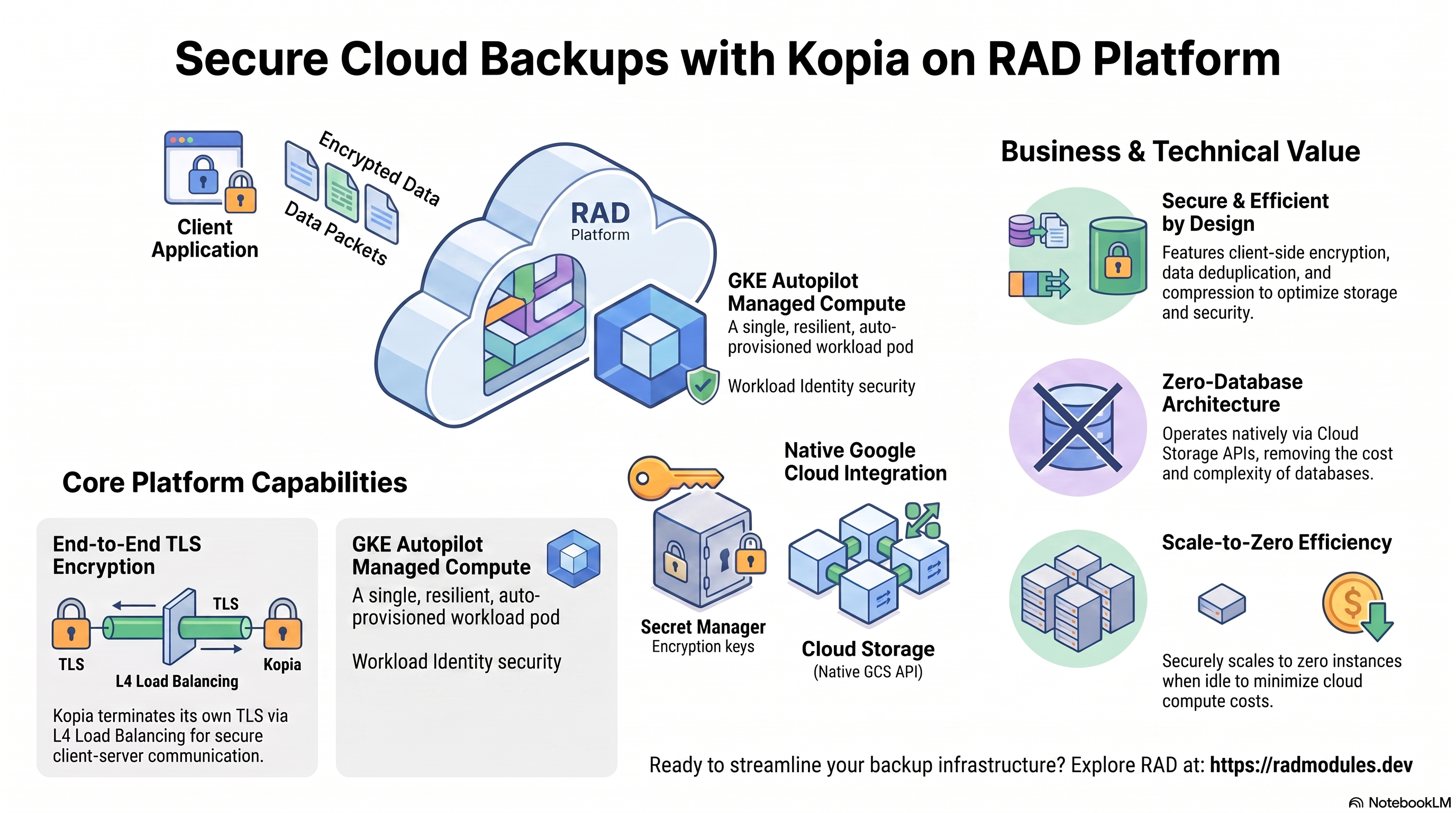
Kopia is a fast, secure, open-source backup tool with client-side encryption,
compression, and deduplication. This module runs Kopia in repository-server
mode on GKE Autopilot: a single always-addressable server that remote kopia
CLI clients elsewhere connect to and push/pull encrypted snapshots into, backed
natively by a Cloud Storage bucket — on top of the App_GKE
foundation, which provisions and manages the shared Google Cloud and Kubernetes
infrastructure.
This guide focuses on the cloud services Kopia uses and how to explore and operate them from the Google Cloud Console and the command line. For the mechanics common to every GKE application — Workload Identity, ingress, autoscaling, CI/CD, Cloud Armor, IAP, Binary Authorization, VPC Service Controls, and the deployment lifecycle — refer to the App_GKE foundation guide rather than repeating them here.
There is no Kopia_CloudRun. Kopia's client-server snapshot protocol is
exclusively gRPC, which only ever gets real HTTP/2 through Kopia's own TLS+ALPN —
Cloud Run's GFE always terminates public HTTPS at its own edge and can never pass a
container-terminated TLS stream through, so a Cloud Run variant (built, deployed,
and live-tested) failed every actual snapshot session. See
Kopia_Common for the full source-confirmed writeup.
What Kopia costs on RAD, and how that compares
Kopia on RAD's GKE Autopilot module costs about US$42 a month in a Google Cloud project you own, plus a one-off 75-credit (US$7.50) module fee. Kopia itself is free and open source, with no database — it stores encrypted, deduplicated snapshots natively in Cloud Storage, so there's no Cloud SQL line in the table below. If you only need it occasionally, a RAD-managed project can be deleted and restored within 30 days for a handful of credits, so that US$42 becomes a few dollars a month instead. See Pause it for free, below.
What you pay on RAD
| In a Google Cloud project you own | In a project RAD manages for you | |
|---|---|---|
| Module fee, once per deployment | 75 credits (US$7.50 at the top-up price) | 67.5 credits (10% lower) |
| Build time | A few credits per build | The same |
| Google Cloud running cost | Billed by Google to your own billing account, about US$42 a month for the default configuration (table below) | Metered hourly in credits; RAD publishes 67 credits a day, about 2010 a month (about US$201 at the top-up price, US$161 at the Scale plan's rate) |
| Who owns what | You own the project and its billing; RAD deploys and updates it | RAD owns the project, with guardrails, quotas and budget alerts; you get console access, and a minimum purchased balance is held in reserve |
10 credits cost US$1 on a one-off top-up, and less on a monthly plan. In a project RAD manages, the database, file server and network are shared by every application in the project, so a second application does not add a second database.
Default running cost in your own project (us-central1, Google list prices):
| Resource (module default) | Per month |
|---|---|
| GKE Autopilot pod, 1x vCPU / 1 GiB | US$36.08 |
| Cloud NAT and networking | US$5.00 |
| Cloud Storage (add-ons, backups) | US$1.00 |
| GKE cluster management fee | shared across every GKE app in the project; $0 if this is your only cluster, else ~73 |
| Total | about US$42 |
How it compares
- No vendor sells a hosted Kopia SaaS. Kopia is a client-server backup tool you point your own
kopiaclients at; the nearest commercial comparison is a managed backup-storage service (e.g. Backblaze B2), which prices storage, not a running repository server, so it isn't a like-for-like comparison. - Kopia's server itself is light (1 vCPU/1 GiB) — a small self-managed VPS well under the usual 2 vCPU/4 GB, US$24/month comparison class can run
kopia serverdirectly, plus your own time for TLS, upgrades and exposing it safely to remote clients. A GKE pod carries the cluster's own baseline cost on top of what Kopia itself needs. - RAD's value here is less about cash price and more about not having to run and patch the repository server yourself: Secret Manager holds its credentials, and the Cloud Storage bucket it writes to inherits RAD's backup and monitoring conventions.
Pause it for free: delete a RAD-managed project, restore it when you need it
If Kopia runs in a project RAD manages for you, you have a second option that goes well beyond scaling to zero: delete the whole project, and restore it within 30 days for close to nothing. This suits Kopia you only need occasionally — a course project, a demo, a short-lived evaluation — far better than running it continuously.
- How it works. Deleting a RAD-managed project unlinks its billing first, then asks Google to delete the project. Google does not remove the project immediately: it keeps it, recoverable, for 30 days. Because billing is already unlinked, nothing is charged while it waits. Unlike deleting one module, this does not tear down Kopia's own compute one by one — the whole project, and everything in it, simply stops.
- Restoring costs a handful of credits, not a rebuild. Within 30 days, the project's owner can restore it. RAD asks Google to undelete the project and reattaches its billing account, then asks you to run Update on each deployment to confirm everything came back. Because nothing was individually destroyed, that Update finds the same resources already there — it is a check, not a rebuild, and an Update never charges the module fee again. For Kopia behind a small Services_GCP and Project_GCP, that is a handful of credits (under US$1) in total, against the 80 credits a full redeploy costs.
- What this needs. You must own the project (not a bring-your-own one RAD only manages billing for), and you restore it yourself within the 30 days — after that, Google deletes it for good. Restoring is admitted like creating a new project: your purchased credit balance must still clear the tier's floor (100 credits for the sandbox tier most study and demo use fits). Google says most services are fully working again within 36 hours of a restore.
- One real gap: the backup bucket does not survive. Kopia's nightly backups are written to a bucket inside the project, and that bucket is not protected by Cloud Storage's soft-delete, so it is very likely gone as soon as you delete the project — even though the project itself is recoverable for 30 days. If you've customised Kopia and want to keep that work, copy a backup out (to Google Drive, or a bucket outside the project) before you delete, the same as the redeploy workflow below. For a default installation with nothing irreplaceable in it, this does not matter.
Pay only while you use it, the other way: delete and redeploy
GKE keeps at least one pod running, so it never scales to zero on its own. The option above only applies to a RAD-managed project; in your own project, or once the 30-day window has passed, the way to stop paying is to delete the deployment and deploy it again when you need it.
- What a redeploy costs. The module fee again plus the builds: about 80 credits (US$8.00), because RAD recreates the project and shared services before Kopia. Deleting saves money only once Kopia would otherwise sit unused for about six days or more, both in your own project (about US$1.40 a day) and in a RAD-managed one (67 credits a day).
- Delete everything Kopia uses. Most of the running cost here is the compute itself and, on GKE, the cluster management fee once this project runs more than one cluster — so deleting Kopia while something else shares the project and its cluster saves only Kopia's own pod.
- Keep your data first. Nightly backups go to a bucket inside the deployment and are deleted with it, so copy the latest backup out before deleting if you want to keep it.
Lab sessions and Managed Environments
- Lab sessions, for training. A trainer runs a Kopia session for a class. Each participant gets Kopia in their own Google Cloud project for 15 minutes to 24 hours, within an allowance the trainer sets. Either the trainer funds every place up front, or each participant pays for their own. Everything is deleted when the session ends, and unused credits go back to the trainer.
- Managed Environments, for consultancies. A partner runs Kopia for a client from a ring-fenced wallet it funds, and settles with the client directly. If the wallet runs low, billing pauses and the data is kept, so nobody receives an unexpected charge. At the end of the engagement the partner hands the project over, and the deployments become the client's own.
Credits can be bought in more than 20 currencies, including XAF, XOF, NGN, GHS, KES and ZAR, by card, bank transfer or mobile money.
Sources (8 October 2026): Google Cloud list prices from the Cloud Billing Catalog API; RAD fees and the 67-credit daily estimate from radmodules.dev/pricing; Delete and restore projects for the 30-day recovery window and what it says about Cloud Storage objects without soft delete. Prices change; check each source before relying on a figure.
1. Overview
Kopia runs as a single-pod GKE Autopilot workload with its repository living natively in Cloud Storage — no database, no filesystem-mounted data volume for the backups themselves:
| Capability | Google Cloud service | Notes |
|---|---|---|
| Compute | GKE Autopilot | Go server pod, 1 vCPU / 1 GiB by default; a single Deployment replica |
| Repository storage | Cloud Storage (native GCS API, not a mount) | Every snapshot ever written, under a repository/ object prefix |
| TLS certificate persistence | Cloud Storage (GCS FUSE mount at /var/lib/kopia) | Same bucket, tls/ prefix — self-signed cert/key, generated once |
| Secrets | Secret Manager | Two independent secrets: ADMIN_PASSWORD (login) and REPO_PASSWORD (repository encryption key) |
| Ingress | LoadBalancer / Cloud Load Balancing | External by default (remote clients need to reach it); bare L4 TCP passthrough — Kopia terminates its own TLS |
Sensible defaults worth knowing up front:
- No database, no data-plane filesystem mount. Kopia's repository is written
directly through Kopia's own native GCS API client (ADC-authenticated) — the
bucket is not mounted as a filesystem for backup data.
database_type = "NONE". - One bucket, two roles. The same
storagebucket is also FUSE-mounted at/var/lib/kopiapurely to persist the self-signed TLS certificate across restarts (tls/prefix — never collides withrepository/). - Kopia terminates its own TLS. Required because GKE's plain L4
LoadBalancerService has no HTTP-terminating edge of its own (unlike Cloud Run's GFE). Generated once, on first boot; every later boot reuses the same persisted certificate (Kopia refuses to regenerate against an existing cert file). The SHA256 fingerprint every client needs prints once, to logs, at generation time. - Two independent secrets, not interchangeable.
ADMIN_PASSWORDgates the Web UI/control API and is safe to rotate.REPO_PASSWORDis the repository's own content-encryption key, set once at first deploy — rotating it independently of the actual repository content permanently orphans every existing snapshot. - A real client session needs more than HTTP Basic Auth. The entrypoint
provisions a repository-stored user (
<ADMIN_USERNAME>@kopia) with ACLs enabled on every boot — required for an actual gRPC snapshot session, which theADMIN_PASSWORDlayer alone does not authorize. - Port
51515, LoadBalancer by default. Kopia's native server port is fixed byKopia_Common;service_typedefaults toLoadBalancersince external reachability from remote clients is the entire point of this module. - Single server, scale-to-zero-safe.
max_instance_countshould stay1(repository maintenance assumes single-server ownership);min_instance_count = 0is safe because the repository lives in Cloud Storage, not an instance-local volume.
2. Google Cloud Services & How to Explore Them
All commands assume you have run
gcloud container clusters get-credentials <cluster> --region <region> --project <project>
and that PROJECT, REGION, and NAMESPACE are set. The namespace and other
identifiers are reported in the deployment Outputs.
A. GKE Autopilot — the Kopia workload
Kopia runs as a single pod (Deployment by default; StatefulSet is available but not needed — see §4).
- Console: Kubernetes Engine → Workloads → select the Kopia workload to see the pod and events.
- CLI:
kubectl get deployment,pods,svc -n "$NAMESPACE"
kubectl logs -n "$NAMESPACE" deployment/<service-name> --tail=100
See App_GKE for how Autopilot scheduling and Workload Identity work.
B. Cloud Storage — the repository (no Cloud SQL)
There is no Cloud SQL instance — database_type = "NONE". Kopia's repository
data is written directly to the storage bucket through Kopia's own native GCS API
client, under the repository/ object prefix:
gcloud storage buckets list --project "$PROJECT" --filter="name~storage"
gcloud storage ls -r gs://<storage-bucket>/repository/ | head
The same bucket is also FUSE-mounted at /var/lib/kopia purely to persist the
self-signed TLS certificate under a separate tls/ prefix (see §D) — the two never
collide.
C. Secret Manager — two independent secrets
gcloud secrets list --project "$PROJECT" --filter="name~admin-password OR name~repo-password"
gcloud secrets versions access latest --secret=<secret-name> --project "$PROJECT"
ADMIN_PASSWORD gates the Web UI/control API; REPO_PASSWORD is the repository's
own content-encryption key and the credential a real client connects with. See
Kopia_Common §2 for
the full detail on why they are not interchangeable.
D. TLS certificate — self-signed, persisted
# From the pod's first-boot logs (fingerprint prints once, at generation time):
kubectl logs <pod> -n "$NAMESPACE" -c kopia | grep -A2 -i fingerprint

# Recompute at any time (GKE gives real shell access, unlike Cloud Run):
kubectl exec <pod> -n "$NAMESPACE" -c kopia -- \
  openssl x509 -in /var/lib/kopia/tls/cert.pem -noout -fingerprint -sha256
E. Networking & ingress
By default the workload is a LoadBalancer Service, external and reachable from
remote kopia CLI clients out of the box. It is a bare L4 TCP passthrough — no
HTTP-terminating edge — so Kopia's own TLS reaches the client end-to-end.
kubectl get svc -n "$NAMESPACE"    # confirm the external port -> 51515 mapping
gcloud compute addresses list --project "$PROJECT"
The external Service port defaults to
80, not51515.Kopia_GKEdoes not exposeApp_GKE'sservice_portvariable, so it is always theApp_GKEdefault (80); the Service'starget_portis Kopia's real port (51515). Since it's a bare TCP passthrough, Kopia's TLS still terminates correctly end-to-end — but a client must connect tohttps://<external-ip>:80explicitly (https://alone implies port 443, which is not open). Always confirm the actual mapping withkubectl get svcbefore connecting a client.
F. Cloud Logging & Monitoring
Pod stdout/stderr flows to Cloud Logging; GKE metrics flow to Cloud Monitoring.
gcloud logging read 'resource.type="k8s_container" AND resource.labels.namespace_name="'"$NAMESPACE"'"' \
  --project "$PROJECT" --limit 50
An uptime_check_config is available but disabled by default — if enabled, be
aware it issues an HTTP check, and Kopia has no unauthenticated HTTP endpoint to
target, so it will fail continuously.
3. Kopia Application Behaviour
- Repository connect-or-create on every boot. The entrypoint runs
kopia repository connect gcs --bucket=... --prefix=repository/, falling back tokopia repository create gcs ...if the repository doesn't exist yet. This idempotent logic fully replaces what a database-app's init job would otherwise do — there is no separate migration/init job for Kopia. - Repository-stored user + ACLs, provisioned every boot.
kopia server users add/set "${ADMIN_USERNAME}@kopia" --user-password="${REPO_PASSWORD}"followed bykopia server acl enable, both idempotent (add-or-set / enable-or-skip). This is what actually authorizes a client's gRPC snapshot session — HTTP Basic Auth (ADMIN_PASSWORD) alone does not. - TLS generated once, reused forever. First boot: no persisted cert files →
--tls-generate-cert, fingerprint printed once to logs. Every later boot: cert files found at/var/lib/kopia/tls/→ reused as-is, no regeneration (Kopia refuses to regenerate against an existing cert file). - Client connect command — the exact, live-verified flow:
plus
kopia repository connect server \
  --url=https://<external-ip>:<service-port> \
  --server-cert-fingerprint=<sha256-fingerprint> \
  --password=<REPO_PASSWORD> \
--override-username=admin --override-hostname=kopiaKOPIA_SERVER_USERNAME=admin/KOPIA_SERVER_PASSWORD=<ADMIN_PASSWORD>env vars for the outer HTTP Basic Auth layer the Web UI/control API use. Note the password used for the repository connection isREPO_PASSWORD, notADMIN_PASSWORD— see Kopia_Common §4. - Single-writer repository maintenance. Kopia's own GC/compaction assumes one
server owns the repository at a time — keep
max_instance_count = 1. - Scale-to-zero is data-safe. The repository lives in Cloud Storage, not an instance-local volume, so a cold start just reconnects (and, on the very first boot ever, regenerates the TLS cert).
- Updates recreate the pod. A version bump rebuilds the custom image and recreates the single pod; the entrypoint's connect-or-create/user/ACL logic runs again on the new pod with no special handling needed.
4. Configuration Variables
Variables are grouped exactly as they appear on the deployment platform. Only
settings specific to or notable for Kopia are listed; every other input is
inherited from App_GKE with its standard behaviour and defaults. See
the modules/Kopia_GKE/README.md for the exhaustive,
group-by-group input reference.
Group 1 — Project & Identity
| Variable | Default | Description |
|---|---|---|
project_id | (required) | Target Google Cloud project. |
region | us-central1 | Region for the workload and regional resources. |
Group 2 — Deployment Environment
| Variable | Default | Description |
|---|---|---|
tenant_id | demo | Short suffix that makes resource names unique per environment. Use gke to run alongside a Cloud Run variant of a different app on the same tenant. |
support_users | [] | Emails granted project access and monitoring alerts. |
Group 3 — Application Identity
| Variable | Default | Description |
|---|---|---|
application_name | kopia | Base name for resources. Do not change after first deploy. |
application_version | latest | Kopia image tag; latest pins the build to 0.23.1 (Docker Hub, not GHCR — no v prefix ambiguity here). |
deploy_application | true | Set false to provision infrastructure only. |
Group 4 — Runtime & Scaling
| Variable | Default | Description |
|---|---|---|
cpu_limit | 1000m | Snapshot uploads/restores are CPU-bound (compression, encryption, hashing) — raise for large/frequent backup jobs. |
memory_limit | 1Gi | Kopia's own footprint is modest; extra headroom benefits the content cache on repositories with many/large snapshots. |
min_instance_count | 0 | Scale-to-zero is safe — the repository lives in Cloud Storage. |
max_instance_count | 1 | Keep at 1 — Kopia's repository maintenance assumes single-server ownership. |
enable_cloudsql_volume | false | Kopia has no Cloud SQL — keep false. |
enable_image_mirroring | true | Mirror the built Kopia image into Artifact Registry. |
Group 5 — Environment Variables & Secrets
| Variable | Default | Description |
|---|---|---|
environment_variables | {} | Extra plain-text settings, merged with the module default ADMIN_USERNAME=admin. |
secret_environment_variables | {} | Additional Secret Manager references injected as env vars. |
Group 6 — GKE Backend & Cluster
| Variable | Default | Description |
|---|---|---|
service_type | LoadBalancer | External reachability by default — remote clients need to reach this server. Use ClusterIP only when every client already runs inside the same cluster/VPC. |
workload_type | null | Auto-resolves to StatefulSet only if stateful_pvc_enabled = true (not recommended — see Group 7). |
termination_grace_period_seconds | 60 | Seconds after SIGTERM before SIGKILL — lets Kopia flush in-flight writes. |
service_portis not exposed by this module — see §2E above. The external LoadBalancer port is always80(theApp_GKEdefault);target_portis Kopia's real51515.
Group 7 — StatefulSet
| Variable | Default | Description |
|---|---|---|
stateful_pvc_enabled | null | Available but not recommended. The only thing that would live on a PVC is the tiny persisted TLS certificate — no meaningful IOPS/locking need a block device improves on. GCS FUSE (the default) is fine. |
stateful_pvc_mount_path | /var/lib/kopia | Must match the default GCS FUSE mount path if you do enable a PVC. |
stateful_pvc_storage_class | standard | HDD pd-standard by default — the persisted cert is a tiny file with no high-IOPS need. |
Group 10 — Observability & Health
| Variable | Default | Description |
|---|---|---|
startup_probe | TCP, 15s delay, 10-retry threshold | TCP, not HTTP — every Kopia endpoint requires authentication, so an HTTP-path probe would always 401. |
liveness_probe | TCP, 30s delay, 3-retry threshold | Same reasoning as startup_probe. |
uptime_check_config | disabled | If enabled, it's an HTTP check and will fail continuously against Kopia's auth-gated endpoints. |
Group 11 — Jobs & Scheduled Tasks
| Variable | Default | Description |
|---|---|---|
initialization_jobs | [] | No default init job — the entrypoint's own connect-or-create logic replaces it. |
cron_jobs | [] | Kubernetes CronJobs (e.g., a periodic kopia maintenance run for repository GC). |
Group 14 — Cloud Storage & Artifact Registry
| Variable | Default | Description |
|---|---|---|
create_cloud_storage | true | Creates the storage bucket (repository data + TLS-cert persistence). |
gcs_volumes | [] | Additional GCS FUSE mounts — the Kopia TLS-cert mount is added automatically. |
Group 15 / 16 — Redis / Database (not applicable)
Kopia uses neither. enable_redis is hardcoded false in main.tf (overriding the
App_GKE default of true); database_type is fixed to NONE.
Group 19 — Custom Domain, Static IP & Networking
| Variable | Default | Description |
|---|---|---|
enable_custom_domain | true | Provision Gateway for a custom hostname. Note Kopia's client protocol is raw gRPC, not browser HTTP — a custom domain mainly benefits a stable --url for clients, not a browsable UI. |
reserve_static_ip | true | Stable external IP across redeploys, so remote clients don't need to re-pin --url. |
Group 20 — Identity-Aware Proxy (IAP)
| Variable | Default | Description |
|---|---|---|
enable_iap | false | IAP is designed for browser/HTTP auth, not the raw gRPC snapshot protocol — only appropriate for gating the Web UI on a custom domain, not the client connect endpoint. |
Groups 12, 8, 9, 13, 17, 18, 21, 22
Standard App_GKE behaviour — CI/CD & Binary Authorization, Resource Quota,
Reliability Policies, NFS, Backup & Maintenance (Foundation-generic, not Kopia's own
repository), Custom SQL (not applicable), Cloud Armor, and VPC Service Controls. See
App_GKE.
5. Outputs
These values are returned on a successful deployment and are the quickest way to locate and explore the running resources.
| Output | Description |
|---|---|
service_name | Kubernetes Service name. |
namespace | Namespace the workload runs in. |
service_cluster_ip | In-cluster ClusterIP. |
service_external_ip | External IP (when reserve_static_ip = true) — the host half of the kopia repository connect server --url= value. |
service_url | Foundation-computed URL. Do not trust the scheme/port for Kopia — defaults to bare http://<ip> with no port; confirm the real port with kubectl get svc. |
storage_buckets | Created Cloud Storage buckets (the storage bucket). |
network_name / network_exists / regions | VPC network, presence, available regions. |
container_image / container_registry | Deployed image and Artifact Registry repo. |
monitoring_enabled / monitoring_notification_channels | Monitoring status and channels. |
initialization_jobs | Empty by default — Kopia has no init job. |
statefulset_name | Name of the StatefulSet (only when workload_type = "StatefulSet"). |
deployment_id / tenant_id / resource_prefix | Naming identifiers. |
project_id / project_number | Project identifiers. |
cicd_enabled / cicd_configuration | CI/CD status and details. |
kubernetes_ready | Whether the cluster/workload is ready. |
vpc_sc_enabled / vpc_sc_perimeter_name / vpc_sc_dry_run_mode | VPC-SC status. |
audit_logging_enabled / artifact_registry_cmek_enabled | Audit logging and CMEK status. |
6. Configuration Pitfalls & Sensible Defaults
Risk: Critical (data loss / outage / security) — High (service degraded) — Medium (cost or partial degradation) — Low (minor).
Inherited plan-time validation. This module passes its configuration through the App_GKE foundation engine, which validates values and combinations at plan time —
workload_type = "Deployment"withstateful_pvc_enabled = true, IAP with no authorized identities, non-binary quota units. Invalid configuration fails the plan with a clear, named error before any resource is created.
| Setting | Sensible value | Risk | Consequence if wrong |
|---|---|---|---|
REPO_PASSWORD (Secret Manager) | Never hand-rotate after first deploy | Critical | There is no supported re-encrypt path for a live repository — rotating this secret independently of the actual GCS repository content permanently orphans every existing snapshot. |
| Repository-user password | Connect clients with --password=<REPO_PASSWORD>, never <ADMIN_PASSWORD> | Critical | kopia repository connect server has no separate server-user-password flag — its one password input IS the gRPC session credential, checked against the repository-stored user's password. Using ADMIN_PASSWORD fails every session with PermissionDenied. |
max_instance_count | 1 | Critical | Kopia's own repository maintenance (GC/compaction) assumes single-server ownership; a second concurrent server races maintenance runs against the same repository. |
| Health probes | Leave as TCP (module default) | High | Every Kopia endpoint requires authentication — an HTTP-path probe always 401s, and the pod never becomes Ready even though the server booted fine. |
| Client connect URL/port | Explicit port, confirmed via kubectl get svc | High | service_port is not exposed by this module and defaults to 80, not Kopia's real 51515. A bare https://<ip> implies port 443 (not open) and silently fails to connect. |
uptime_check_config | Leave enabled = false (module default) | Medium | If enabled it issues an HTTP check against an auth-gated endpoint and will fail continuously, generating false alerts. |
stateful_pvc_enabled | Leave false/unset (module default) | Low | Available, but the only thing that would live on it is the tiny persisted TLS cert — no IOPS/locking benefit over the default GCS FUSE mount. |
enable_iap | Only for the Web UI/control API, not the client connect endpoint | Medium | IAP is browser/HTTP-auth oriented; it does not (and cannot usefully) gate the raw gRPC snapshot session. |
| TLS certificate | Never delete /var/lib/kopia/tls/* out-of-band | High | Every already-connected remote client has pinned the old fingerprint via --server-cert-fingerprint=; a regenerated cert breaks every existing client until they re-pin. |
For the foundation behaviour referenced throughout — IAM and Workload Identity, autoscaling, ingress and certificates, CI/CD, Cloud Armor, IAP, Binary Authorization, VPC-SC, and image mirroring — see App_GKE. Kopia-specific application configuration is described in Kopia_Common.
Related guides
- Hands-on lab: Kopia on GKE Autopilot — deploy it step by step, with the console screens and commands at each stage.
- Kopia Common — Shared Application Configuration — the configuration shared by both deployment targets.
- Deployed alongside UrBackup on GKE Autopilot, Filebrowser on GKE Autopilot in the Backup & Disaster Recovery solution.
Need RAD to do something it does not do yet? Request it on the roadmap, or vote on what is already there.