Certification track: Associate Cloud Engineer (ACE)
Mattermost on Google Cloud Run
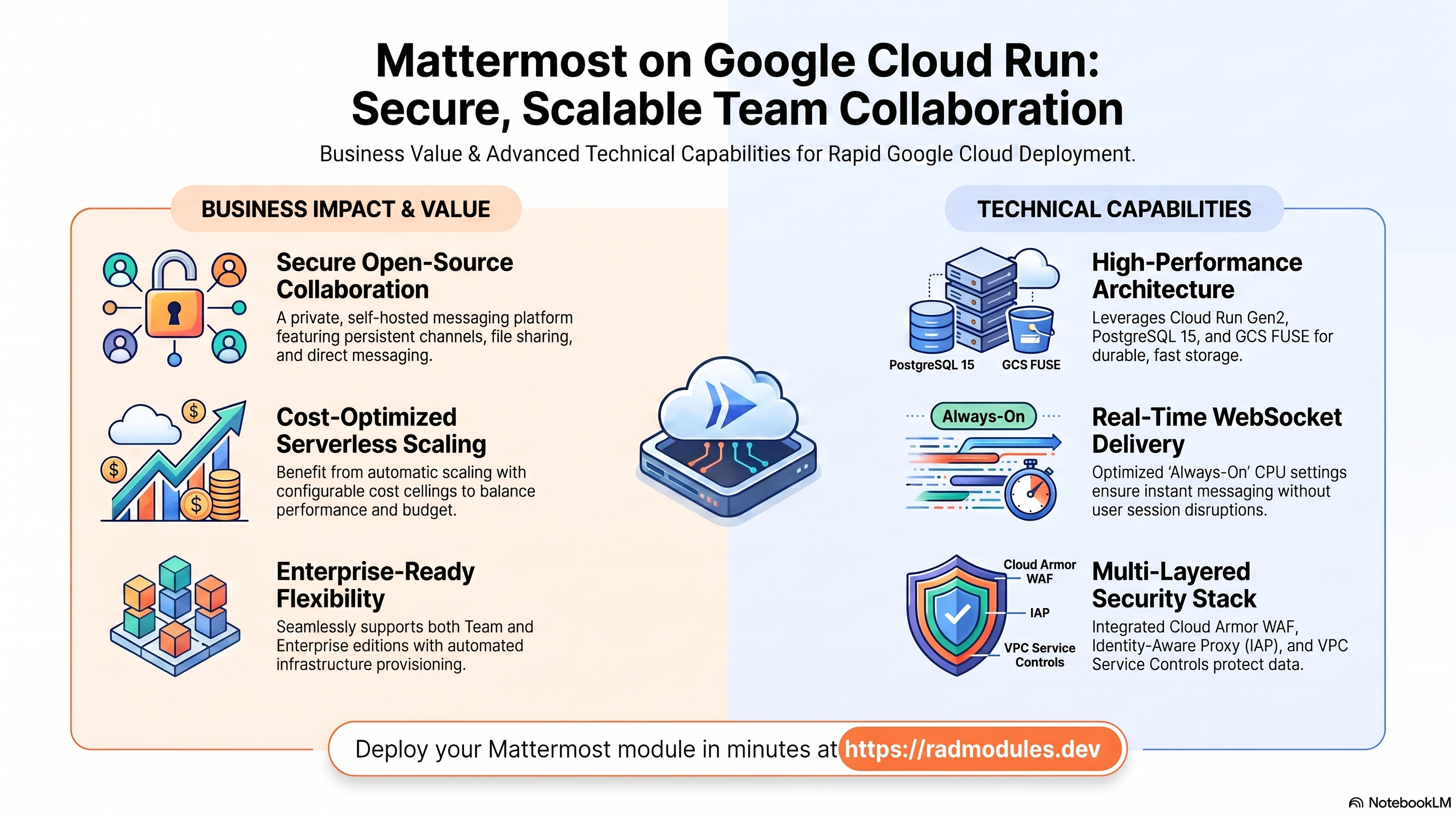
This document provides a comprehensive reference for the modules/Mattermost_CloudRun module. It covers architecture, IAM, configuration variables, Mattermost-specific behaviours, and operational patterns for deploying Mattermost on Google Cloud Run (v2).
What Mattermost costs on RAD, and how that compares
Mattermost on RAD's Cloud Run module costs about US$170 a month in your own project, flat regardless of how many people use it. RAD charges 175 credits once per deployment in your own project (157.5 credits, 10% lower, in a project RAD manages), plus build time. Mattermost also deploys on GKE Autopilot for about US$150 a month — see the GKE guide if you need it to run there instead. If you only need it occasionally, a RAD-managed project can be deleted and restored within 30 days for a few credits, so that monthly figure becomes a few dollars instead — see Pause it for free, below.
What you pay on RAD
| In a Google Cloud project you own | In a project RAD manages for you | |
|---|---|---|
| Module fee, once per deployment | 175 credits (US$17.50 at the top-up price) | 157.5 credits (10% lower) |
| Build time | A few credits per build | The same |
| Google Cloud running cost | Billed by Google to your own billing account, about US$170 a month for the default configuration (table below) | Metered hourly in credits; RAD publishes 78 credits a day, about 2,340 a month (about US$234.00 at the top-up price, less on a plan) |
| Who owns what | You own the project and its billing; RAD deploys and updates it | RAD owns the project, with guardrails, quotas and budget alerts; you get console access, and a minimum purchased balance is held in reserve |
10 credits cost US$1 on a one-off top-up, and less on a monthly plan. In a project RAD manages, the database, file server and network are shared by every application in the project, so a second application does not add a second database.
Default running cost in your own project (us-central1, Google list prices):
| Resource (module default) | Per month |
|---|---|
| Cloud Run, 2x vCPU / 2 GiB (alwaysOn) | US$100 |
| Cloud SQL for PostgreSQL, 1 vCPU / 3.75 GB, zonal, 10 GB SSD | US$51 |
| NFS/cache file server (small VM) | US$13 |
| Cloud NAT and networking | US$5 |
| Cloud Storage (add-ons, backups) | US$1 |
| Total | about US$170 |
How it compares
- Slack, priced per user, costs £7 a user a month on its Pro plan (£70 a month for a team of ten) or £14.40 a user a month on Business+ (£144 a month for ten), billed monthly; annual billing is cheaper. Prices were read from slack.com from the United Kingdom.
- RAD's Mattermost module costs a flat about US$170 a month in your own project regardless of headcount — for a team of ten that is close to Slack Pro, but a team of fifty pays Slack fifty times the per-seat fee while RAD's infrastructure cost barely moves, and every message, file and export stays inside your own project rather than a vendor's multi-tenant platform.
- Self-managed comparison: Mattermost's 2 vCPU footprint is close to a GCP Compute Engine e2-standard-2 (~US$49/month) for the smaller configuration, but then you run PostgreSQL, the file store, security patches and uptime yourself.
Pause it for free: delete a RAD-managed project, restore it when you need it
If Mattermost runs in a project RAD manages for you, you have a second option that goes well beyond scaling to zero: delete the whole project, and restore it within 30 days for close to nothing. This suits Mattermost you only need occasionally — evaluating it, a demo environment, a seasonal or intermittent workload — far better than running it continuously.
- How it works. Deleting a RAD-managed project unlinks its billing first, then asks Google to delete the project. Google does not remove the project immediately: it keeps it, recoverable, for 30 days. Because billing is already unlinked, nothing is charged while it waits. Unlike deleting one module, this does not tear down the database, any VM or the compute resource one by one — the whole project, and everything in it, simply stops.
- Restoring costs a few credits, not a rebuild. Within 30 days, the project's owner can restore it. RAD asks Google to undelete the project and reattaches its billing account, then asks you to run Update on each deployment to confirm everything came back. Because nothing was individually destroyed, that Update finds the same resources already there — it is a check, not a rebuild, and an Update never charges the module fee again. For Mattermost behind Services_GCP (a small NFS/cache VM, a Postgres database) and Project_GCP, that is roughly a handful of credits (under US$1) in total, against the about 180 credits (US$18.00) a full redeploy costs.
- So a month of occasional use can cost a few dollars, not US$170. Deploy Mattermost, use it for a while, delete the project. Restore it next time you need it, confirm with Update, and delete it again when you're done. You pay only for the module fee once, the builds, and whatever time it was actually live.
- What this needs. You must own the project (not one RAD only manages billing for), and you restore it yourself within the 30 days — after that, Google deletes it for good. Restoring is admitted like creating a new project: your purchased credit balance must still clear the tier's floor (100 credits for the sandbox tier most evaluation use fits). Google says most services are fully working again within 36 hours of a restore.
- One real gap: nightly backups do not survive. Backups and other generated files are written to a bucket inside the project, and that bucket is not protected by Cloud Storage's soft-delete, so it is very likely gone as soon as you delete the project — even though the project itself is recoverable for 30 days. If you have customised Mattermost and want to keep that work, copy a backup out (to Google Drive, or a bucket outside the project) before you delete. For a default installation with nothing irreplaceable in it, this does not matter.
Pay only while you use it, the other way: delete and redeploy
The option above only applies to a RAD-managed project; in your own project, or once the 30-day window has passed, the way to stop paying is to delete the deployment and deploy it again when you need it.
- What a redeploy costs. The module fee again, plus the builds — roughly 180 credits (US$18.00) in total. Deleting saves money only once Mattermost would otherwise sit unused long enough to clear that redeploy cost against its own running cost — about 4 days or more, both in your own project (about US$5.68 a day) and in a RAD-managed one (78 credits a day).
- Most of the running cost is usually shared. For Mattermost that is the database and the shared file/cache VM. They stop only when nothing else in the project uses them, so deleting this app while something else shares the project saves only this app's own compute part.
- Keep your data first. Nightly backups go to a bucket inside the deployment and are deleted with it, so copy the latest backup out before deleting if you want to keep it.
Lab sessions and Managed Environments
- Lab sessions, for training. A trainer runs a session for a class. Each participant gets the app in their own Google Cloud project for 15 minutes to 24 hours, within an allowance the trainer sets. Either the trainer funds every place, or each participant pays for their own. Everything is deleted when the session ends and unused credits go back to the trainer.
- Managed Environments, for consultancies. A partner runs the app for a client from a ring-fenced wallet it funds, and settles with the client directly. If the wallet runs low, billing pauses and the data is kept, so nobody receives an unexpected charge. At the end the partner hands the project over and the deployments become the client's own.
Credits can be bought in more than 20 currencies, including XAF, XOF, NGN, GHS, KES and ZAR, by card, bank transfer or mobile money.
Sources (8 October 2026): Google Cloud list prices from the Cloud Billing Catalog API; RAD fees and the daily-credit estimate from radmodules.dev/pricing; Delete and restore projects for the pause/restore mechanics and what it says about Cloud Storage objects without soft delete; Slack. Prices change; check each source before relying on a figure.
1. Module Overview
Mattermost is an open-source, self-hostable team messaging and collaboration platform — a secure Slack alternative with persistent channels, direct messages, file sharing, integrations, bots, slash commands, and enterprise security features. Mattermost CloudRun is a wrapper module built on top of App CloudRun. It uses App CloudRun for all GCP infrastructure provisioning and injects Mattermost-specific application configuration, database initialisation, and storage via Mattermost Common.
Key Capabilities:
- Compute: Cloud Run v2 (Gen2), custom Mattermost container, 2 vCPU / 2 Gi by default. Minimum instances default to 1 — Mattermost maintains persistent WebSocket connections for real-time messaging, making scale-to-zero unsuitable for most deployments.
- Data Persistence: Cloud SQL PostgreSQL 15. The shared NFS volume is mounted at
/mattermost/databy default (enable_nfs = true), so file uploads and attachments survive restarts and new revisions. - Security: Inherits Cloud Armor WAF, IAP, Binary Authorization, and VPC Service Controls from
App CloudRun. Mattermost generates its own internal signing keys at first startup and stores them in the database — no application-level secrets are auto-generated by this module. - Caching: Redis is optional (
enable_redis = falseby default). When enabled, Mattermost uses Redis as its distributed cache and session backend — required for correct behaviour across multiple replicas. - Editions: Team Edition (free, default) or Enterprise Edition (paid licence required). Controlled by the
editionvariable. - Real-time Messaging: Mattermost maintains WebSocket connections for real-time message delivery. Cloud Run's 60-minute request timeout means
timeout_secondsshould be set to3600for WebSocket-heavy deployments. For production workloads requiring persistent long-lived connections, considerMattermost GKE.
Project & Application Identity
| Variable | Group | Type | Default | Description |
|---|---|---|---|---|
project_id | 1 | string | — | GCP project ID. Required. |
tenant_id | 1 | string | 'demo' | Short suffix appended to all resource names. |
support_users | 1 | list(string) | [] | Email recipients for IAM access and monitoring alerts. |
resource_labels | 1 | map(string) | {} | Labels applied to all provisioned resources. |
application_name | 3 | string | 'mattermost' | Base resource name. Do not change after initial deployment. |
display_name | 3 | string | 'Mattermost' | Human-readable name shown in the platform UI. |
description | 3 | string | 'Mattermost - Open-source team messaging and collaboration' | Cloud Run service description. |
application_version | 3 | string | '9.11.2' | Mattermost image version tag. Increment to deploy a new release. |
Wrapper architecture: Mattermost CloudRun calls Mattermost Common to build an application_config object containing Mattermost-specific environment variables, probe configuration, and the db-init job definition. module_storage_buckets carries any GCS data bucket configured for FUSE mounting. scripts_dir is resolved to the Mattermost Common scripts directory at apply time.
2. IAM & Access Control
Mattermost_CloudRun delegates all IAM provisioning to App_CloudRun. The Cloud Run SA, Cloud Build SA, IAP service agent, and password rotation role sets are identical to those in App_CloudRun.
No application-level secrets auto-generated: Unlike many other application modules, Mattermost Common does not auto-generate application secrets such as a SECRET_KEY. Mattermost generates its own internal signing keys at first startup and stores them in PostgreSQL. The DB_PASSWORD and ROOT_PASSWORD secrets are provisioned automatically by App CloudRun and consumed by the db-init job.
Database initialisation identity: The db-init Cloud Run Job runs under the Cloud Run SA. It connects to Cloud SQL PostgreSQL via the Auth Proxy Unix socket, using DB_HOST, DB_USER, and the DB_PASSWORD secret from Secret Manager.
120-second IAM propagation delay: Inherited from App CloudRun — the Mattermost service is not deployed until the delay completes, preventing secret-read failures on the first revision start.
3. Core Service Configuration
A. Compute (Cloud Run)
Mattermost is a Go-based application that is resource-efficient at startup but benefits from consistent CPU allocation for WebSocket connection handling and message delivery. Mattermost CloudRun exposes cpu_limit and memory_limit as top-level variables.
Minimum instance count defaults to 1 (min_instance_count = 1). This prevents scale-to-zero cold starts that would interrupt active WebSocket connections. For development or cost-sensitive environments, min_instance_count = 0 is supported but will cause user sessions to drop when the instance scales down.
Startup CPU Boost is always enabled (hardcoded in App CloudRun).
Container image: container_image_source defaults to 'custom', meaning Cloud Build compiles a custom image using Mattermost Common's Dockerfile (based on the official mattermost/mattermost-team-edition or mattermost/mattermost-enterprise-edition image, depending on edition). Set container_image_source = 'prebuilt' and container_image to an image URI to skip the build step.
| Variable | Group | Default | Description |
|---|---|---|---|
deploy_application | 4 | true | Set false for infrastructure-only deployment (SQL, storage, secrets). |
container_image_source | 4 | 'custom' | 'custom' builds via Cloud Build. 'prebuilt' deploys an existing image URI. |
container_image | 4 | "" | Override image URI. Leave empty for Cloud Build to manage the image. |
cpu_limit | 4 | '2000m' | CPU per instance. 2 vCPU recommended for Mattermost. |
memory_limit | 4 | '2Gi' | Memory per instance. 2 Gi is the minimum; increase for large teams. |
cpu_always_allocated | 4 | true | CPU allocated at all times (instance-based billing). Kept true: real-time WebSocket connections require an unthrottled instance (pair with min_instance_count >= 1). |
container_resources | 4 | null | When set, overrides cpu_limit and memory_limit. |
min_instance_count | 4 | 1 | Keep at 1 for production to avoid WebSocket disruption. |
max_instance_count | 4 | 1 | Cost ceiling for auto-scaling. |
container_port | 4 | 8065 | Mattermost's native HTTP port. |
execution_environment | 4 | 'gen2' | Gen2 required for GCS Fuse volume mounts. |
timeout_seconds | 4 | 300 | Max request duration. Set to 3600 for WebSocket-heavy deployments. |
enable_cloudsql_volume | 4 | true | Injects the Cloud SQL Auth Proxy sidecar. Set false for TCP. |
container_protocol | 4 | 'http1' | 'http1' or 'h2c'. |
enable_image_mirroring | 4 | true | Mirrors the Mattermost image into Artifact Registry. |
traffic_split | 4 | [] | Percentage-based canary/blue-green traffic allocation. |
max_revisions_to_retain | 4 | 7 | Maximum Cloud Run revisions to keep. Set 0 to disable. |
service_annotations | 4 | {} | Advanced Cloud Run annotations. |
service_labels | 4 | {} | Labels applied to the Cloud Run service. |
Differences from App CloudRun defaults:
| Variable | App CloudRun | Mattermost CloudRun | Reason |
|---|---|---|---|
container_port | 8080 | 8065 | Mattermost's native port. |
cpu_limit | '1000m' | '2000m' | Mattermost handles concurrent WebSocket connections and message indexing. |
memory_limit | '512Mi' | '2Gi' | Mattermost caches channels, users, and sessions in memory. |
min_instance_count | 0 | 1 | Scale-to-zero drops active user WebSocket connections. |
cpu_always_allocated | false | true | Real-time WebSocket delivery must not be CPU-throttled between requests. |
B. Database (Cloud SQL — PostgreSQL 15)
Mattermost requires PostgreSQL 13 or later — PostgreSQL 15 is the default. Mattermost runs its own schema migrations on startup; no manual database schema setup is needed beyond creating the database and user (handled by the db-init job).
The module uses db_name and db_user shorthand variables that flow through Mattermost Common into the application configuration.
| Variable | Group | Default | Description |
|---|---|---|---|
database_type | 12 | 'POSTGRES_15' | Cloud SQL database engine. Do not change from PostgreSQL. |
db_name | 12 | 'mattermost' | PostgreSQL database name. Do not change after initial deployment. |
db_user | 12 | 'mattermost' | PostgreSQL application user. Password auto-generated and stored in Secret Manager. |
database_password_length | 12 | 32 | Auto-generated password length. Range: 16–64. |
enable_auto_password_rotation | 12 | false | Automated zero-downtime password rotation. |
rotation_propagation_delay_sec | 12 | 90 | Seconds to wait after rotation before restarting the service. |
C. Storage (NFS)
Mattermost stores uploaded files, attachments, and plugin data under /mattermost/data. Without persistent storage, all user uploads are lost on container restart or new revision deployment.
By default the shared NFS volume is mounted at /mattermost/data (enable_nfs = true, nfs_mount_path = "/mattermost/data"), which is where MM_FILESETTINGS_DIRECTORY points — so uploads are durable with no extra configuration. Mounting a GCS bucket there with gcs_volumes is an alternative only if you turn NFS off; do not mount both at the same path.
| Variable | Group | Default | Description |
|---|---|---|---|
enable_nfs | 11 | true | Mounts the shared NFS volume at nfs_mount_path, where Mattermost keeps uploads. Keep it on unless you mount other durable storage there. |
nfs_mount_path | 11 | '/mattermost/data' | Container path where NFS is mounted. |
nfs_instance_name | 11 | "" | Existing NFS GCE VM name. Leave empty to auto-discover. |
nfs_instance_base_name | 11 | 'app-nfs' | Base name for the inline NFS GCE VM. |
create_cloud_storage | 11 | true | Set false to skip GCS bucket creation. |
storage_buckets | 11 | [] | Additional GCS buckets to provision. |
gcs_volumes | 11 | [] | GCS buckets to mount via GCS Fuse. Each entry: name, bucket_name, mount_path, readonly, mount_options. Only needed at /mattermost/data if NFS is turned off. |
manage_storage_kms_iam | 11 | false | Creates CMEK KMS key and enables CMEK on all storage buckets. |
enable_artifact_registry_cmek | 11 | false | Creates Artifact Registry KMS key for at-rest image encryption. |
Alternative (NFS off): a GCS FUSE volume for Mattermost file storage:
gcs_volumes = [
  {
    name        = "mattermost-data"
    bucket_name = "my-project-mattermost-data"
    mount_path  = "/mattermost/data"
    readonly    = false
    mount_options = [
      "implicit-dirs",
      "stat-cache-ttl=60s",
      "type-cache-ttl=60s"
    ]
  }
]
D. Networking
Cloud Run uses Direct VPC Egress to reach Cloud SQL's private IP. The Auth Proxy sidecar (enable_cloudsql_volume = true) handles the database connection via Unix socket.
| Variable | Group | Default | Description |
|---|---|---|---|
ingress_settings | 5 | 'all' | 'all' — public internet; 'internal' — VPC only; 'internal-and-cloud-load-balancing' — forces traffic through the HTTPS Load Balancer. |
vpc_egress_setting | 5 | 'PRIVATE_RANGES_ONLY' | 'PRIVATE_RANGES_ONLY' routes only RFC 1918 traffic via VPC. 'ALL_TRAFFIC' routes all egress via VPC. |
E. Initialization & Bootstrap
A db-init Cloud Run Job is automatically provisioned by Mattermost Common when initialization_jobs is left as the default empty list ([]). It uses a postgres-based image and executes Mattermost_Common/scripts/db-init.sh, which performs the following idempotent operations:
- Connects to Cloud SQL PostgreSQL via the Auth Proxy Unix socket.
- Creates the
mattermostdatabase if it does not exist. - Creates the
mattermostuser with the password from Secret Manager. - Grants the user full privileges on the database.
Mattermost then runs its own schema migrations on first startup — no manual schema setup is required.
| Variable | Group | Default | Description |
|---|---|---|---|
initialization_jobs | 13 | [] | One-shot Cloud Run Jobs. Leave empty for Mattermost Common to supply the default db-init job. Non-empty list replaces it entirely. Each entry: name, description, image, command, args, env_vars, secret_env_vars, cpu_limit, memory_limit, timeout_seconds, max_retries, task_count, execution_mode, mount_nfs, mount_gcs_volumes, depends_on_jobs, execute_on_apply, script_path. |
cron_jobs | 13 | [] | Recurring Cloud Run Jobs triggered by Cloud Scheduler. Each entry: name, schedule, image, command, args, env_vars, secret_env_vars, cpu_limit, memory_limit, timeout_seconds, max_retries, task_count, parallelism, mount_nfs, mount_gcs_volumes, script_path, paused. |
4. Advanced Security
A. Cloud Armor WAF
When enable_cloud_armor = true, a Global HTTPS Load Balancer with a Cloud Armor WAF policy (OWASP Top 10, adaptive DDoS, 500 req/min rate limiting) is provisioned in front of Cloud Run.
| Variable | Group | Default | Description |
|---|---|---|---|
enable_cloud_armor | 10 | false | Provisions Global HTTPS LB + Cloud Armor WAF. Required for custom domains, CDN, and DDoS protection. |
admin_ip_ranges | 10 | [] | CIDR ranges exempted from WAF rules (e.g., office VPN, CI/CD egress IPs). |
B. Identity-Aware Proxy (IAP)
When enable_iap = true, Cloud Run's native IAP integration is enabled on the service. Google identity authentication is required before requests reach Mattermost. Useful for internal-only deployments where users must authenticate with their organisation's Google Workspace account before reaching the Mattermost login page.
| Variable | Group | Default | Description |
|---|---|---|---|
enable_iap | 5 | false | Enables IAP natively on the Cloud Run service. |
iap_authorized_users | 5 | [] | Users/service accounts granted IAP access. Format: 'user:email' or 'serviceAccount:sa@...'. |
iap_authorized_groups | 5 | [] | Google Groups granted IAP access. Format: 'group:name@example.com'. |
C. Binary Authorization
When enable_binary_authorization = true, Cloud Run enforces that deployed Mattermost images carry a valid cryptographic attestation.
| Variable | Group | Default | Description |
|---|---|---|---|
enable_binary_authorization | 8 | false | Enforces image attestation. Requires a Binary Authorization policy and attestor pre-configured in the project. |
D. VPC Service Controls
When enable_vpc_sc = true, all GCP API calls from this module are bound within an existing VPC-SC perimeter.
| Variable | Group | Default | Description |
|---|---|---|---|
enable_vpc_sc | 22 | false | Registers module API calls within the project's VPC-SC perimeter. A perimeter must already exist before enabling. |
E. Secret Manager Integration
Mattermost application secrets are stored in Secret Manager and injected natively by Cloud Run at revision start — plaintext is never written to state. User-defined secrets can be added via secret_environment_variables.
| Variable | Group | Default | Description |
|---|---|---|---|
secret_environment_variables | 6 | {} | Map of env var name → Secret Manager secret ID. Resolved at runtime. |
explicit_secret_values | 6 | {} | Raw sensitive values written into Secret Manager during deployment. |
secret_rotation_period | 6 | '2592000s' | Secret Manager rotation notification frequency. Default: 30 days. |
secret_propagation_delay | 6 | 30 | Seconds to wait after secret creation before dependent resources proceed. |
5. Traffic & Ingress
A. HTTPS Load Balancer
When enable_cloud_armor = true, a Global HTTPS Load Balancer backed by a Serverless NEG is provisioned. Traffic flows: Internet → Cloud Armor → Global HTTPS LB → Serverless NEG → Cloud Run.
Setting ingress_settings = 'internal-and-cloud-load-balancing' forces all Mattermost traffic through the LB, preventing direct *.run.app URL access.
B. Cloud CDN
When enable_cdn = true (requires enable_cloud_armor = true), Cloud CDN is attached to the HTTPS Load Balancer backend.
Mattermost consideration: Mattermost serves a mix of real-time API traffic (WebSocket, REST) and static assets (JavaScript bundles, CSS, plugin files). Cloud CDN is suited for static asset delivery but should not cache API responses or WebSocket upgrades. Mattermost sets appropriate Cache-Control headers on its static assets, so CDN can be safely enabled for edge caching of the application bundle.
| Variable | Group | Default | Description |
|---|---|---|---|
enable_cdn | 10 | false | Enables Cloud CDN on the HTTPS LB backend. Only effective when enable_cloud_armor = true. |
max_images_to_retain | 10 | 7 | Maximum container images to keep in Artifact Registry. Set 0 to disable. |
delete_untagged_images | 10 | true | Automatically deletes untagged images from Artifact Registry. |
image_retention_days | 10 | 30 | Days after which images are eligible for deletion. Set 0 to disable age-based deletion. |
C. Custom Domains
Custom domains are attached to the Global HTTPS Load Balancer via application_domains. Google-managed SSL certificates are provisioned automatically. DNS must point to the load balancer IP after apply.
| Variable | Group | Default | Description |
|---|---|---|---|
application_domains | 10 | [] | Custom domain names. Google-managed SSL certificates provisioned per domain. |
After the first apply, retrieve the LB IP and create an A record. SSL certificate provisioning takes 10–30 minutes after DNS propagation. Then set site_url to the custom domain so Mattermost generates correct invite links and webhook URLs.
6. CI/CD & Delivery
A. Cloud Build Triggers
When enable_cicd_trigger = true, a Cloud Build GitHub connection and push trigger are provisioned. The trigger builds and deploys a custom Mattermost image when code is pushed to the configured branch.
| Variable | Group | Default | Description |
|---|---|---|---|
enable_cicd_trigger | 8 | false | Provisions a Cloud Build GitHub trigger. Requires github_repository_url and credentials. |
github_repository_url | 8 | "" | Full HTTPS URL of the GitHub repository. |
github_token | 8 | "" | GitHub PAT (repo, admin:repo_hook scopes). Required on first apply. Sensitive. |
github_app_installation_id | 8 | "" | GitHub App installation ID (preferred for organisation repos). |
cicd_trigger_config | 8 | { branch_pattern = "^main$" } | Advanced trigger config: branch_pattern, included_files, ignored_files, trigger_name, substitutions. |
B. Cloud Deploy Pipeline
When enable_cloud_deploy = true (requires enable_cicd_trigger = true), the CI/CD pipeline is upgraded to a managed Cloud Deploy delivery pipeline with sequential promotion stages.
| Variable | Group | Default | Description |
|---|---|---|---|
enable_cloud_deploy | 8 | false | Provisions a Cloud Deploy pipeline. Requires enable_cicd_trigger = true. |
cloud_deploy_stages | 8 | [dev, staging, prod(approval)] | Ordered promotion stages. Each: name, target_name, service_name, require_approval, auto_promote. |
7. Reliability & Scheduling
A. Scaling & Concurrency
min_instance_count defaults to 1 — Mattermost maintains active WebSocket connections for real-time messaging, and scale-to-zero would disconnect all active users. max_instance_count defaults to 1: Mattermost Team Edition has no HA clustering (an Enterprise feature), so a second instance does not share WebSocket, session or cache state — clients on different instances stop seeing each other's messages in real time. Raise it only with an Enterprise licence and clustering configured.
B. Traffic Splitting
Traffic splitting is supported for canary deployments.
| Variable | Group | Default | Description |
|---|---|---|---|
traffic_split | 4 | [] | Percentage-based traffic allocation across named revisions. All entries must sum to 100. Empty sends 100% to the latest revision. |
C. Health Probes & Uptime Monitoring
Mattermost exposes a dedicated health endpoint at /api/v4/system/ping that returns HTTP 200 when the application is fully initialised and connected to the database. Health probes target this endpoint.
Mattermost performs schema migrations on first startup. The startup probe allows adequate time for migration to complete before traffic is directed to the new revision.
| Variable | Group | Default | Description |
|---|---|---|---|
startup_probe | 14 | { enabled=true, type="HTTP", path="/", initial_delay_seconds=60, period_seconds=15, failure_threshold=30 } | Startup probe. Container receives no traffic until this succeeds. |
liveness_probe | 14 | { enabled=true, type="HTTP", path="/", initial_delay_seconds=60, timeout_seconds=5, period_seconds=30, failure_threshold=3 } | Liveness probe. Container is restarted after failure_threshold consecutive failures. |
startup_probe_config | 14 | { enabled=true, path="/", initial_delay_seconds=60 } | Inert for Mattermost. App_CloudRun only wires this into its own internal, unused cloudrunapp sample/fallback preset (cloudrunapp.tf) — it never reaches the deployed Mattermost service. |
health_check_config | 14 | { enabled=true, path="/", initial_delay_seconds=60 } | Inert for Mattermost, same as startup_probe_config above. |
uptime_check_config | 14 | { enabled=false, path="/" } | Cloud Monitoring uptime check (disabled by default). When enabled, alerts notify support_users if unreachable. |
alert_policies | 14 | [] | Cloud Monitoring metric alert policies. |
Note on probe path: The actual deployed probes come solely from startup_probe/liveness_probe (forwarded to Mattermost_Common, then into App_CloudRun's local.selected_module.startup_probe/.liveness_probe) — these default to path = "/" in the Cloud Run module, whereas the GKE variant defaults to /api/v4/system/ping. For more precise health signalling in Cloud Run, override startup_probe/liveness_probe's path to /api/v4/system/ping. startup_probe_config/health_check_config are a separate, inert variable pair (see table above) — overriding them has no effect on Mattermost's deployed probes, so don't bother.
D. Auto Password Rotation
When enable_auto_password_rotation = true, a zero-downtime password rotation pipeline is provisioned:
- Secret Manager emits a rotation notification at every
secret_rotation_periodinterval. - Eventarc fires a Cloud Run rotation Job.
- The job generates a new password, updates the Cloud SQL user, writes a new secret version.
- After
rotation_propagation_delay_secseconds, the job restarts the Mattermost service.
| Variable | Group | Default | Description |
|---|---|---|---|
enable_auto_password_rotation | 12 | false | Enables automated password rotation. |
rotation_propagation_delay_sec | 12 | 90 | Seconds to wait after writing the new secret before restarting. |
8. Integrations
A. Mattermost Application Settings
| Variable | Group | Default | Description |
|---|---|---|---|
site_url | 20 | "" | The public URL where Mattermost is accessible. Sets MM_SERVICESETTINGS_SITEURL. Left empty, it is derived at boot from the Cloud Run service URL; set it for a custom domain. (e.g., 'https://chat.example.com') |
edition | 20 | 'team' | 'team' (free) or 'enterprise' (paid — requires a licence key set via environment_variables). Controls which Mattermost container image is selected. |
Site URL. Mattermost uses SiteURL for invite links, emails and OAuth callbacks. With site_url empty, the entrypoint sets it at boot from the Cloud Run service URL; set site_url explicitly when you serve Mattermost on a custom domain.
B. Environment Variables
Mattermost is configured entirely through environment variables using the MM_ prefix. The environment_variables variable accepts any Mattermost configuration key:
| Variable | Group | Default | Description |
|---|---|---|---|
environment_variables | 6 | {} | Plain-text env vars. Use for Mattermost configuration such as email, plugins, and service settings. |
Common Mattermost configuration variables injected automatically by Mattermost Common:
| Environment Variable | Value | Purpose |
|---|---|---|
MM_SERVICESETTINGS_LISTENADDRESS | :8065 | Bind address for the Mattermost HTTP server. |
MM_METRICSSETTINGS_LISTENADDRESS | :8067 | Prometheus metrics endpoint. |
MM_FILESETTINGS_DRIVERTYPE | local | File storage type — local files under the mounted directory. |
MM_FILESETTINGS_DIRECTORY | /mattermost/data/ | File storage path — matches the GCS FUSE or NFS mount point. |
MM_LOGSETTINGS_CONSOLELEVEL | INFO | Log level sent to stdout (captured by Cloud Logging). |
MM_LOGSETTINGS_ENABLEFILE | false | File-based logging disabled — Cloud Run captures stdout to Cloud Logging. |
MM_SERVICESETTINGS_TRUSTEDPROXYIPHEADER | X-Forwarded-For | Enables correct client IP extraction from Cloud Run and load balancer proxy headers. |
MM_EMAILSETTINGS_ENABLEEMAILBATCHING | false | Disabled for Cloud Run scale-to-zero compatibility. Email batching requires persistent in-memory queues. |
MM_CACHEBACKEND | redis or memory | Set to redis when enable_redis = true; otherwise memory. |
MM_REDIS_ADDRESS | Redis host:port | Injected when enable_redis = true. |
C. Redis Cache
Redis is disabled by default (enable_redis = false). Enable Redis for any deployment running more than one instance — without Redis, multiple Mattermost instances cannot share session state or caches, leading to intermittent authentication failures and stale data.
| Variable | Group | Default | Description |
|---|---|---|---|
enable_redis | 21 | false | Enables Redis for Mattermost caching and session storage. Recommended for multi-replica deployments. |
redis_host | 21 | "" | Redis server hostname or IP. Leave blank to use the NFS server IP when enable_redis = true. Override with a Memorystore instance for production. |
redis_port | 21 | '6379' | Redis server TCP port (string). |
redis_auth | 21 | "" | Redis AUTH password. Leave empty if authentication is not required. Sensitive — never stored in state. |
D. Metrics
Mattermost exposes Prometheus-format metrics at port 8067 (/metrics). Enable metrics in Mattermost System Console under Environment → Performance Monitoring, then integrate with Google Cloud Monitoring via a Prometheus remote write endpoint or a scraper running in the same VPC.
E. Backup Import & Recovery
| Variable | Group | Default | Description |
|---|---|---|---|
backup_schedule | 7 | '0 2 * * *' | Cron expression (UTC) for automated daily backups. |
backup_retention_days | 7 | 7 | Days to retain backup files in GCS. |
enable_backup_import | 7 | false | Triggers a one-time restore on apply. Set false after successful import. |
backup_source | 7 | 'gcs' | 'gcs' (GCS bucket filename) or 'gdrive' (Drive file ID). |
backup_file | 7 | 'backup.sql' | Filename of the backup in the module-managed backups GCS bucket. |
backup_format | 7 | 'sql' | Backup format. Options: sql, tar, gz, tgz, tar.gz, zip. |
F. Observability & Alerting
| Variable | Group | Default | Description |
|---|---|---|---|
uptime_check_config | 14 | { enabled=false, path="/" } | Uptime check: enabled, path, check_interval, timeout. Disabled by default. |
alert_policies | 14 | [] | Metric alert policies. Each: name, metric_type, comparison, threshold_value, duration_seconds. |
support_users | 1 | [] | Email addresses notified by uptime and alert policy triggers. |
9. Exploring with the GCP Console
After a successful deployment, the GCP Console is the primary tool for inspecting the live Mattermost deployment.
Cloud Run Service
Navigate to Cloud Run in the GCP Console and select the Mattermost service (named app<name><tenant><id> by default, e.g., appmattermostdemo). From the service page you can:
- View the service URL to access the Mattermost web client.
- Inspect active revisions and their traffic allocation percentages.
- Review container configuration including environment variables, mounted volumes, and resource limits.
- Check the Logs tab to stream Mattermost application logs directly — all
stdoutoutput is captured by Cloud Logging. - Monitor Metrics for request count, latency (p50, p95, p99), container instance count, memory utilisation, and startup latency.
- View Revisions to see the history of deployments, current traffic weights, and active revision tags.
Cloud SQL Navigate to SQL and select the PostgreSQL 15 instance. Useful checks:
- Connections tab: active connection count from the Cloud Run service (via the Auth Proxy).
- Operations & logs: recent CREATE DATABASE, user grant, and migration activity.
- Databases tab: verify the
mattermostdatabase exists after first deployment. - Users tab: confirm the
mattermostuser was created by thedb-initjob. - Backups: automated and on-demand backups. Cross-check with the
backup_schedulevariable.
Cloud Storage
If you replaced NFS with a gcs_volumes bucket at /mattermost/data, navigate to Cloud Storage and select the bucket. (With the default NFS mount, the same tree is on the NFS share.) Mattermost creates this directory structure under the mount point:
teams/— team icons and attachments.users/— profile pictures.plugins/— plugin data files. File operations in the bucket reflect uploads and attachments made by Mattermost users.
Secret Manager
Navigate to Secret Manager and filter by the deployment's resource labels. Secrets created by App CloudRun for Mattermost include:
DB_PASSWORD— the PostgreSQL application user password.ROOT_PASSWORD— the PostgreSQL root/superuser password used by thedb-initjob. Click a secret to view its versions, access history, and rotation configuration.
Cloud Build
Navigate to Cloud Build → History to inspect image build logs. Each deployment creates a build that compiles the Mattermost custom image (when container_image_source = 'custom'). Build logs show the Docker build steps, layer caching behaviour, and push to Artifact Registry.
Artifact Registry
Navigate to Artifact Registry and find the repository for the project. The Mattermost image is stored here after each Cloud Build run. Older images are cleaned up according to max_images_to_retain and image_retention_days.
Cloud Monitoring
Navigate to Monitoring → Dashboards to see Cloud Run metrics dashboards. If uptime_check_config is enabled, the uptime check appears under Monitoring → Uptime checks. Alert policies created via alert_policies appear under Monitoring → Alerting.
10. Exploring with gcloud
The following gcloud commands are useful for day-to-day operations and troubleshooting after deployment. Replace PROJECT_ID, REGION, and SERVICE_NAME with your actual values.
Describe the Cloud Run service:
gcloud run services describe SERVICE_NAME \
  --region=REGION \
  --project=PROJECT_ID \
  --format="yaml(spec.template.spec.containers[0].env)"
View the service URL and current traffic split:
gcloud run services describe SERVICE_NAME \
  --region=REGION \
  --project=PROJECT_ID \
  --format="table(status.url, status.traffic[].revisionName, status.traffic[].percent)"
List all revisions and their traffic weights:
gcloud run revisions list \
  --service=SERVICE_NAME \
  --region=REGION \
  --project=PROJECT_ID \
  --sort-by="~metadata.creationTimestamp" \
  --format="table(metadata.name, status.conditions[0].type, status.conditions[0].status, metadata.creationTimestamp)"
Stream live logs from the Mattermost service:
gcloud logging read \
  "resource.type=cloud_run_revision AND resource.labels.service_name=SERVICE_NAME" \
  --project=PROJECT_ID \
  --format="value(textPayload)" \
  --freshness=10m \
  --order=asc
Check the db-init Cloud Run Job execution history:
gcloud run jobs executions list \
  --job=SERVICE_NAME-db-init \
  --region=REGION \
  --project=PROJECT_ID \
  --format="table(metadata.name, status.conditions[0].type, metadata.creationTimestamp)"
Manually trigger the db-init job (e.g., after a database restore):
gcloud run jobs execute SERVICE_NAME-db-init \
  --region=REGION \
  --project=PROJECT_ID \
  --wait
Inspect the Cloud SQL instance and verify database connectivity:
gcloud sql instances describe SQL_INSTANCE_NAME \
  --project=PROJECT_ID \
  --format="table(name, state, databaseVersion, settings.tier, ipAddresses[].ipAddress)"
List Cloud SQL databases on the instance:
gcloud sql databases list \
  --instance=SQL_INSTANCE_NAME \
  --project=PROJECT_ID
View Secret Manager secrets for the deployment:
gcloud secrets list \
  --project=PROJECT_ID \
  --filter="labels.app=mattermost" \
  --format="table(name, createTime, replication.automatic)"
Access the latest version of the database password secret:
gcloud secrets versions access latest \
  --secret=DB_PASSWORD_SECRET_NAME \
  --project=PROJECT_ID
List container images in Artifact Registry:
gcloud artifacts docker images list REGION-docker.pkg.dev/PROJECT_ID/REPO_NAME \
  --filter="tags:mattermost" \
  --sort-by="~createTime" \
  --format="table(IMAGE, TAGS, CREATE_TIME, UPDATE_TIME)"
Force a new deployment (redeploy the latest revision):
gcloud run services update SERVICE_NAME \
  --region=REGION \
  --project=PROJECT_ID \
  --update-env-vars=DEPLOY_TIMESTAMP=$(date +%s)
Check Cloud Monitoring uptime check status:
gcloud monitoring uptime list-configs \
  --project=PROJECT_ID \
  --format="table(displayName, httpCheck.path, period, selectedRegions)"
View active alert policies:
gcloud alpha monitoring policies list \
  --project=PROJECT_ID \
  --format="table(displayName, enabled, conditions[0].displayName)"
Inspect the GCS bucket used for Mattermost file storage:
gsutil ls -l gs://BUCKET_NAME/
gsutil du -s gs://BUCKET_NAME/
Check if a specific Mattermost upload file is present:
gsutil stat gs://BUCKET_NAME/teams/TEAM_ID/channels/CHANNEL_ID/attachments/FILE_ID
11. Platform-Managed Behaviours
The following behaviours are applied automatically by Mattermost CloudRun regardless of variable values.
| Behaviour | Implementation | Detail |
|---|---|---|
| PostgreSQL 15 required | database_type = "POSTGRES_15" default | Mattermost requires PostgreSQL 13 or later. The database connection string and driver are configured by Mattermost Common. |
| NFS for data | enable_nfs = true, nfs_mount_path = "/mattermost/data" | /mattermost/data is on the shared NFS volume by default, giving durable file storage. |
| Image mirroring enabled by default | enable_image_mirroring = true | The Mattermost Docker Hub image is mirrored to Artifact Registry before deployment, preventing dependency on external registries. |
| Minimum 1 instance | min_instance_count = 1 default | Prevents scale-to-zero from disconnecting active user WebSocket sessions. |
| No auto-generated app secrets | Mattermost generates keys on first boot | Internal signing keys, session secrets, and symmetric encryption keys are generated by Mattermost itself and stored in PostgreSQL — not in Secret Manager. |
| Default db-init job | Supplied by Mattermost Common when initialization_jobs = [] | PostgreSQL database and user are created automatically before Mattermost starts. Override with a non-empty initialization_jobs list to replace. |
| Proxy header trust | MM_SERVICESETTINGS_TRUSTEDPROXYIPHEADER=X-Forwarded-For | Required for correct client IP extraction when Cloud Run is behind Cloud Armor or a load balancer. Injected automatically. |
| Email batching disabled | MM_EMAILSETTINGS_ENABLEEMAILBATCHING=false | Batching requires persistent in-memory queues incompatible with Cloud Run's stateless execution model. |
| Site URL env var | MM_SERVICESETTINGS_SITEURL set from site_url variable | When site_url is non-empty, it is injected as MM_SERVICESETTINGS_SITEURL; otherwise the entrypoint derives it at boot from CLOUDRUN_SERVICE_URL. |
12. Variable Reference
All user-configurable variables exposed by Mattermost CloudRun, sorted by UI group then order.
| Variable | Group | Default | Description |
|---|---|---|---|
project_id | 1 | — | GCP project ID. Required. |
region | 1 | 'us-central1' | GCP region for resource deployment. |
tenant_id | 1 | 'demo' | Short suffix appended to all resource names. |
support_users | 1 | [] | Email addresses for IAM access and monitoring alerts. |
resource_labels | 1 | {} | Labels applied to all provisioned resources. |
application_name | 3 | 'mattermost' | Base resource name. Do not change after deployment. |
display_name | 3 | 'Mattermost' | Human-readable name shown in the UI. |
description | 3 | 'Mattermost - Open-source team messaging and collaboration' | Service description. |
application_version | 3 | '9.11.2' | Mattermost container image tag. |
deploy_application | 4 | true | Set false for infrastructure-only deployment. |
container_image_source | 4 | 'custom' | 'custom' (Cloud Build) or 'prebuilt' (existing image). |
container_image | 4 | "" | Container image URI. Leave empty for Cloud Build to manage. |
cpu_limit | 4 | '2000m' | CPU per instance. 2 vCPU recommended. |
memory_limit | 4 | '2Gi' | Memory per instance. |
cpu_always_allocated | 4 | true | CPU allocated at all times. Kept true for real-time WebSocket handling. |
container_resources | 4 | null | Overrides cpu_limit and memory_limit when set. |
min_instance_count | 4 | 1 | Keep at 1 to avoid WebSocket disconnections. |
max_instance_count | 4 | 1 | Auto-scaling cost ceiling. |
container_port | 4 | 8065 | Mattermost's native HTTP port. |
execution_environment | 4 | 'gen2' | Gen2 required for GCS Fuse. |
timeout_seconds | 4 | 300 | Max request duration. Set 3600 for WebSocket connections. |
enable_cloudsql_volume | 4 | true | Cloud SQL Auth Proxy sidecar. |
container_protocol | 4 | 'http1' | 'http1' or 'h2c'. |
enable_image_mirroring | 4 | true | Mirrors the Mattermost image into Artifact Registry. |
traffic_split | 4 | [] | Canary/blue-green traffic allocation. |
max_revisions_to_retain | 4 | 7 | Maximum Cloud Run revisions to keep. |
service_annotations | 4 | {} | Advanced Cloud Run annotations. |
service_labels | 4 | {} | Labels applied to the Cloud Run service. |
ingress_settings | 5 | 'all' | 'all', 'internal', or 'internal-and-cloud-load-balancing'. |
vpc_egress_setting | 5 | 'PRIVATE_RANGES_ONLY' | 'PRIVATE_RANGES_ONLY' or 'ALL_TRAFFIC'. |
enable_iap | 5 | false | Enables IAP natively on the Cloud Run service. |
iap_authorized_users | 5 | [] | Users/SAs granted IAP access. |
iap_authorized_groups | 5 | [] | Google Groups granted IAP access. |
environment_variables | 6 | {} | Plain-text env vars for Mattermost configuration. |
secret_environment_variables | 6 | {} | Secret Manager references. |
explicit_secret_values | 6 | {} | Raw sensitive values written into Secret Manager. |
secret_propagation_delay | 6 | 30 | Seconds to wait after secret creation. |
secret_rotation_period | 6 | '2592000s' | Secret Manager rotation notification frequency. |
backup_schedule | 7 | '0 2 * * *' | Cron expression (UTC) for automated backups. |
backup_retention_days | 7 | 7 | Days to retain backup files in GCS. |
enable_backup_import | 7 | false | Triggers a one-time restore on apply. |
backup_source | 7 | 'gcs' | 'gcs' or 'gdrive'. |
backup_file | 7 | 'backup.sql' | Backup filename in the module-managed backups bucket. |
backup_format | 7 | 'sql' | Backup format. Options: sql, tar, gz, tgz, tar.gz, zip. |
enable_cicd_trigger | 8 | false | Provisions a Cloud Build GitHub trigger. |
github_repository_url | 8 | "" | Full HTTPS URL of the GitHub repository. |
github_token | 8 | "" | GitHub PAT. Required on first apply. Sensitive. |
github_app_installation_id | 8 | "" | GitHub App installation ID. |
cicd_trigger_config | 8 | { branch_pattern = "^main$" } | Advanced Cloud Build trigger config. |
enable_cloud_deploy | 8 | false | Provisions a Cloud Deploy progressive delivery pipeline. |
cloud_deploy_stages | 8 | [dev, staging, prod(approval)] | Ordered Cloud Deploy promotion stages. |
enable_binary_authorization | 8 | false | Enforces image attestation on deployment. |
binauthz_evaluation_mode | 8 | 'ALWAYS_ALLOW' | 'ALWAYS_ALLOW', 'REQUIRE_ATTESTATION', or 'ALWAYS_DENY'. |
enable_custom_sql_scripts | 9 | false | Runs SQL scripts from GCS after provisioning. |
custom_sql_scripts_bucket | 9 | "" | GCS bucket containing SQL scripts. |
custom_sql_scripts_path | 9 | "" | Path prefix within the bucket. |
custom_sql_scripts_use_root | 9 | false | Run scripts as the root DB user. |
enable_cloud_armor | 10 | false | Provisions Global HTTPS LB + Cloud Armor WAF. |
admin_ip_ranges | 10 | [] | CIDR ranges exempted from WAF rules. |
application_domains | 10 | [] | Custom domains with Google-managed SSL certificates. |
enable_cdn | 10 | false | Enables Cloud CDN on the HTTPS LB backend. |
max_images_to_retain | 10 | 7 | Maximum recent container images in Artifact Registry. |
delete_untagged_images | 10 | true | Deletes untagged images from Artifact Registry. |
image_retention_days | 10 | 30 | Days after which images are eligible for deletion. |
create_cloud_storage | 11 | true | Set false to skip GCS bucket creation. |
storage_buckets | 11 | [] | Additional GCS buckets to provision. |
enable_nfs | 11 | true | Provisions NFS shared storage. |
nfs_mount_path | 11 | '/mattermost/data' | Container path where NFS is mounted. |
nfs_instance_name | 11 | "" | Existing NFS GCE VM name. Leave empty to auto-discover. |
nfs_instance_base_name | 11 | 'app-nfs' | Base name for inline NFS VM. |
gcs_volumes | 11 | [] | GCS buckets to mount via GCS Fuse. |
manage_storage_kms_iam | 11 | false | Creates CMEK KMS key and enables CMEK on storage buckets. |
enable_artifact_registry_cmek | 11 | false | Creates Artifact Registry KMS key for at-rest encryption. |
database_type | 12 | 'POSTGRES_15' | Cloud SQL engine. Mattermost requires PostgreSQL. |
db_name | 12 | 'mattermost' | PostgreSQL database name. Do not change after deployment. |
db_user | 12 | 'mattermost' | PostgreSQL application user. |
database_password_length | 12 | 32 | Auto-generated password length. Range: 16–64. |
enable_auto_password_rotation | 12 | false | Automated zero-downtime password rotation. |
rotation_propagation_delay_sec | 12 | 90 | Seconds to wait after rotation before restarting. |
initialization_jobs | 13 | [] | One-shot Cloud Run Jobs. Leave empty for Mattermost Common default db-init job. |
cron_jobs | 13 | [] | Recurring scheduled Cloud Run Jobs. |
startup_probe | 14 | { path="/", initial_delay_seconds=60, failure_threshold=30 } | Startup probe. |
liveness_probe | 14 | { path="/", initial_delay_seconds=60, failure_threshold=3 } | Liveness probe. |
startup_probe_config | 14 | { enabled=true, path="/" } | Inert for Mattermost — see §C. Use startup_probe instead. |
health_check_config | 14 | { enabled=true, path="/" } | Inert for Mattermost — see §C. Use liveness_probe instead. |
uptime_check_config | 14 | { enabled=false, path="/" } | Cloud Monitoring uptime check (disabled by default). |
alert_policies | 14 | [] | Cloud Monitoring metric alert policies. |
site_url | 20 | "" | Public URL for Mattermost. Sets MM_SERVICESETTINGS_SITEURL. |
edition | 20 | 'team' | 'team' (free) or 'enterprise' (paid). |
enable_redis | 21 | false | Redis for Mattermost caching. Required for multi-replica. |
redis_host | 21 | "" | Redis hostname/IP. Defaults to NFS server IP when empty. |
redis_port | 21 | '6379' | Redis TCP port (string). |
redis_auth | 21 | "" | Redis AUTH password. Sensitive. |
enable_vpc_sc | 22 | false | Registers API calls within the project's VPC-SC perimeter. |
vpc_cidr_ranges | 22 | [] | VPC subnet CIDR ranges for VPC-SC network access level. |
vpc_sc_dry_run | 22 | true | Logs VPC-SC violations without blocking. Set false to enforce. |
organization_id | 22 | "" | GCP Organization ID for VPC-SC. Auto-discovered when empty. |
enable_audit_logging | 22 | false | Enables detailed Cloud Audit Logs. |
13. Outputs
| Output | Description |
|---|---|
service_name | Name of the Cloud Run service. |
service_url | Public URL of the Cloud Run service. |
service_location | GCP region where the Cloud Run service is deployed. |
project_id | GCP project ID. |
deployment_id | Deployment ID suffix used in resource names. |
database_instance_name | Name of the Cloud SQL PostgreSQL instance. |
database_name | Name of the application database. |
database_user | Name of the application database user. |
database_password_secret | Secret Manager secret name for the database password. |
storage_buckets | Created GCS storage buckets. |
container_image | Container image used for the deployment. |
cicd_enabled | Whether the CI/CD pipeline is enabled. |
github_repository_url | GitHub repository URL connected for CI/CD. |
14. Configuration Pitfalls & Sensible Defaults
Risk levels: Critical (data loss, full outage, security breach) — High (service unavailable or significant degradation) — Medium (degraded function or increased cost) — Low (minor impact).
| Variable | Sensible Default | Risk | Consequence of Incorrect Value |
|---|---|---|---|
project_id | (required) | Critical | No default — deployment fails immediately. |
database_type | "POSTGRES_15" | Critical | Mattermost requires PostgreSQL 13 or later. Setting to a MySQL or SQL Server variant causes Mattermost to fail to start with a driver connection error. |
db_name | "mattermost" | Critical | Immutable after first deployment — changing this causes Mattermost to recreate the database, destroying all message history, users, and configuration. |
db_user | "mattermost" | Critical | Immutable after first deployment — changing this recreates the Cloud SQL user and breaks the database connection. |
min_instance_count | 1 | High | Scale-to-zero (0) causes active WebSocket connections (real-time messaging) to drop for all online users whenever the single instance scales down. Set to 1 for any production deployment. |
timeout_seconds | 300 | High | Mattermost maintains WebSocket connections for real-time messaging. A 5-minute timeout causes Cloud Run to terminate all active WebSocket connections every 5 minutes. Set to 3600 for production WebSocket-heavy deployments. |
enable_redis | false | High | Safe at the default single instance. Running multiple replicas (max_instance_count > 1) requires Enterprise HA clustering, and Redis for distributed session sharing. Without it, users experience intermittent authentication failures and stale data as requests route to different instances with independent memory caches. |
site_url | "" (derived from the service URL) | High with a custom domain | Empty is fine on the run.app URL — it is derived at boot. On a custom domain, leaving it empty makes invite links, OAuth redirect URIs and webhook callbacks point at the run.app URL instead. |
enable_nfs | true | High | Turning it off without mounting other durable storage (e.g. gcs_volumes) at /mattermost/data puts uploads and attachments on the container's ephemeral filesystem; they are lost when a new revision is deployed or the container restarts. |
edition | "team" | Medium | Setting edition = "enterprise" selects the Enterprise Edition container image. Without a valid licence key set via environment_variables, Mattermost starts in Enterprise trial mode and eventually falls back to Team Edition features. |
memory_limit | "2Gi" | Medium | Mattermost caches channel lists, user sessions, and message indexes in memory. Reducing below 1Gi causes OOM restarts under moderate team activity. Increase to 4Gi for teams with 100+ active users. |
backup_retention_days | 7 | Medium | Seven days is insufficient for active teams. Increase to 30+ days for any production Mattermost instance to allow point-in-time recovery from data corruption or accidental deletion. |
enable_cloud_armor | false | Medium | Without Cloud Armor, Mattermost is exposed directly on the *.run.app URL. For production teams, enable Cloud Armor to protect the API from bot attacks and credential stuffing. |
enable_iap | false | Low | With IAP disabled, Mattermost is responsible for its own authentication. Consider enabling IAP for internal-only deployments to add an additional authentication layer before requests reach Mattermost. |
secret_propagation_delay | 30 | Low | Occasionally insufficient in multi-region setups. Increase to 60–90s if secrets are not found during apply. |
15. Destroying Resources
Known Deletion Issue: Serverless IPv4 Address Release
When destroying a Cloud Run deployment, you may encounter an error similar to:
Error: Error waiting for Subnetwork to be deleted: The following serverless IPv4 address(es) on subnet ... are still in use.
Cause: GCP holds serverless IPv4 addresses on the VPC subnet asynchronously after a Cloud Run service is deleted. These addresses are released by GCP approximately 20–30 minutes after the Cloud Run service is removed.
Resolution: Wait 20–30 minutes after the initial destroy attempt, then re-run the destroy command:
tofu destroy
The second run will succeed once GCP has released the reserved addresses.
Related guides
- Hands-on lab: Mattermost on Cloud Run — deploy it step by step, with the console screens and commands at each stage.
- Mattermost GKE Module — Configuration Guide — the same application on Kubernetes, for when you need the other deployment target.
- Mattermost Common Shared Configuration Module — the configuration shared by both deployment targets.
- Deployed alongside Nextcloud on Google Cloud Run, OnlyOffice on Google Cloud Run, Vikunja on Google Cloud Run, Homepage on Google Cloud Run in the Team Workspace solution.
Need RAD to do something it does not do yet? Request it on the roadmap, or vote on what is already there.