FreeScout on Google Cloud Run
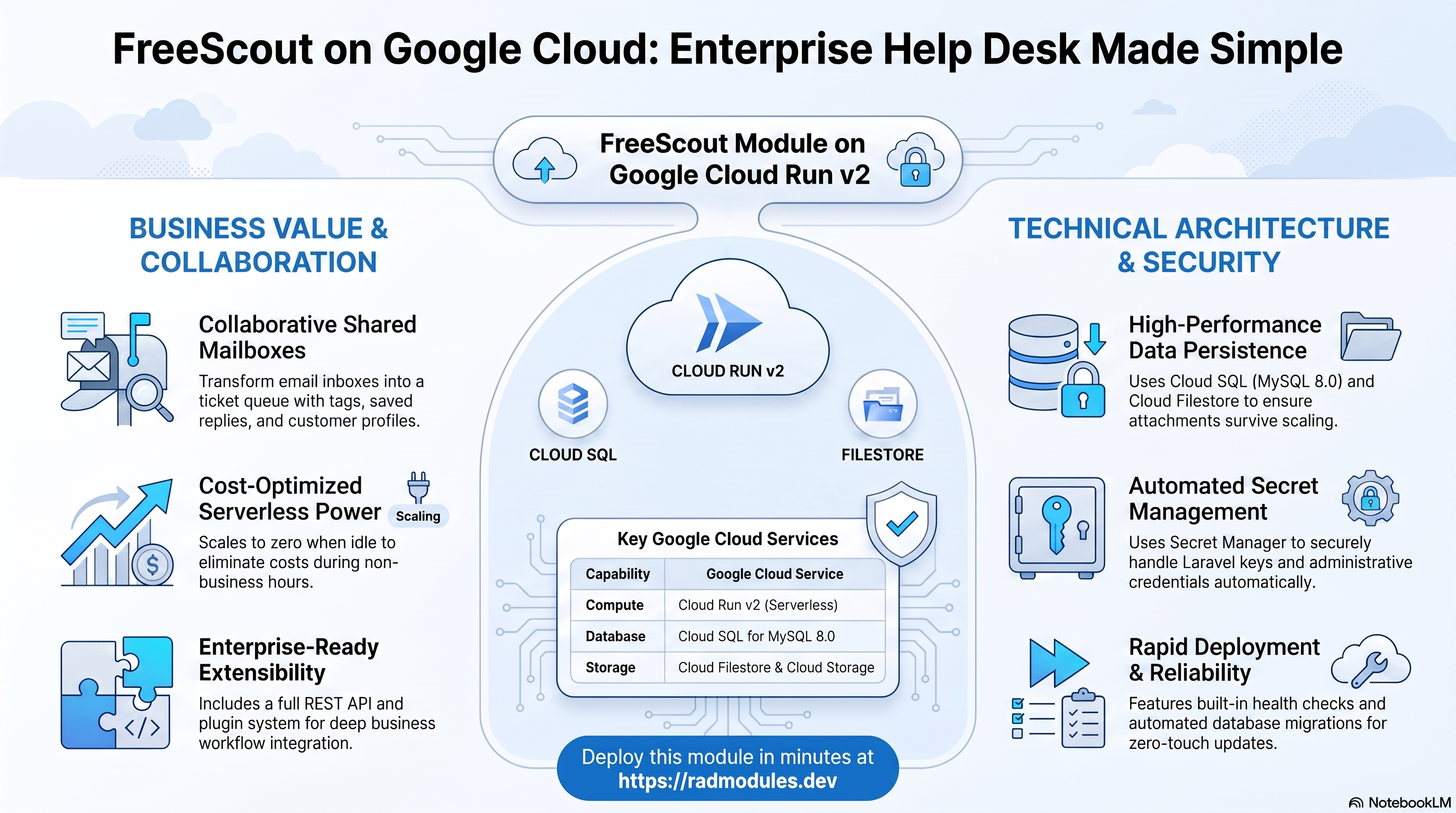
FreeScout is a free, self-hosted help desk and shared-mailbox platform built on Laravel (PHP) — it turns shared email inboxes into a collaborative ticket queue with conversations, tags, saved replies, a customer profile, a REST API, and a plugin system. This module deploys FreeScout on Cloud Run v2 on top of the App_CloudRun foundation, which provisions and manages the shared Google Cloud infrastructure.
This guide focuses on the cloud services FreeScout uses and how to explore and operate them from the Google Cloud Console and the command line. For the mechanics common to every Cloud Run application — service identity, ingress and load balancing, scaling and concurrency, CI/CD, Cloud Armor, IAP, Binary Authorization, VPC Service Controls, backups, and the deployment lifecycle — refer to the App_CloudRun foundation guide rather than repeating them here.
What FreeScout costs on RAD, and how that compares
Running FreeScout in your own Google Cloud project costs about US$83.61/month in Google Cloud charges, on top of a one-time 110-credit RAD module fee (99 credits — 10% lower — in a RAD-managed project). FreeScout is a free, open-source shared-inbox and help desk built on Laravel. If you deploy into a RAD-managed project, you can pause the whole thing for free and pick it back up later — see "Pause it for free" below.
FreeScout is also available on GKE — see the GKE guide if you need Kubernetes-based orchestration; this guide covers the lower-cost Cloud Run option.
What you pay on RAD
| Own project | RAD-managed project | |
|---|---|---|
| Module fee | 110 credits (one-time) | 99 credits (one-time, 10% lower) |
| Build time | ~3–6 credits (one-time, per build) | ~3–6 credits (one-time, per build) |
| Google Cloud running cost | ~US$83.61/month, billed to your own Google billing account at list price | ~32 credits/day (~US$3.20/day), metered hourly at list price plus RAD's margin |
Default running cost in your own project
| Resource | US$/month (Google list price, us-central1) |
|---|---|
| Cloud Run, 1x vCPU / 2 GiB (scaleToZero) | US$13.16 |
| Cloud SQL for MySQL, 1 vCPU / 3.75 GB, zonal, 10 GB SSD | US$51.02 |
| NFS/cache file server (small VM) | US$13.43 |
| Cloud NAT and networking | US$5 |
| Cloud Storage (add-ons, backups) | US$1 |
| Total | US$83.61 |
How it compares
- There is no officially hosted/cloud version of FreeScout to compare against, so the honest comparison is against self-managed infrastructure, not a competing SaaS.
- A bare VPS sized to roughly 1 vCPU / 2 GiB — a Hetzner CPX22 (2 vCPU/4GB, ~US$24/mo), a DigitalOcean 2 vCPU/4GB Droplet (US$24/mo), or GCP's own Compute Engine e2-standard-2 (2 vCPU/8GB, ~US$49/mo) — usually undercuts RAD's sticker price; a VPS a size or two smaller would undercut it further.
- What that lower price does not include is the admin's own time: patching the OS, rotating database backups, renewing TLS certificates and watching for downtime. RAD's managed Cloud SQL, Secret Manager and monitoring do that for you, which is the actual trade being made, not the sticker price.
- RAD is not claiming to be cheaper than a bare VPS in cash terms — it usually is not. The case for RAD is what's managed for you.
Pause it for free: delete a RAD-managed project, restore it when you need it
If FreeScout is running in a RAD-managed project, you can stop paying for it entirely without destroying it. Deleting that project first unlinks its billing, then asks Google to delete the project outright — Google's own 30-day recoverable soft delete. Unlike deleting the FreeScout module on its own, this does not tear down Cloud SQL, any VM or the compute resource one by one: the whole project simply stops, and nothing is charged while it waits, because billing is already unlinked.
Restoring, within 30 days and only by the project's owner, asks Google to undelete the project and reattaches its billing account, then asks you to run Update on each deployment to confirm everything came back. Because nothing was individually destroyed, that Update finds the same resources already there — it is a check, not a rebuild, and an Update never charges the module fee again. This costs only a handful of build-time credits in total — roughly 5–10 credits, under US$1, for a typical 2–3-deployment chain. The 99-credit module fee is not charged again.
What this needs: you must own the project (not one RAD only manages billing for), you must restore it yourself within 30 days — after that Google deletes it for good — and restoring is admitted like creating a new project, so your purchased credit balance must still clear the tier's floor (100 credits for the sandbox tier most study/demo use fits). Google says most services are fully working again within 36 hours of a restore.
One real gap: nightly backups are written to a bucket inside the project, and that bucket has Cloud Storage's soft-delete explicitly turned off, so it is very likely gone as soon as you delete the project — even though the project itself is recoverable for 30 days. If you have customised FreeScout and want to keep that work, copy a backup out (to Google Drive, or a bucket outside the project) before deleting. For a default install with nothing irreplaceable in it, this does not matter.
Pay only while you use it, the other way: delete and redeploy
If FreeScout is in your own project (or more than 30 days have passed on a RAD-managed one), the way to stop paying is to delete the deployment and redeploy later when you need it again.
A redeploy costs the module fee again, plus the builds: roughly 110 + ~3–6 credits (~US$11.45) in your own project, or 99 + ~3–6 credits on a RAD-managed one.
Deleting only saves money once FreeScout would otherwise sit unused long enough to clear that redeploy cost against its own running cost: roughly about 5 days or more idle in your own project (against its ~US$83.61/month Google Cloud bill), or about 4 days or more idle in a RAD-managed project (against its ~32 credits/day).
Most of FreeScout's running cost is the database and the shared file/cache VM. They stop only when nothing else in the project uses them, so deleting this app while something else shares the project saves only this app's own compute share of the total above.
Keep data first: nightly backups go to a bucket inside the deployment and are deleted with it, so copy the latest backup out before deleting if you want to keep it.
Lab sessions and Managed Environments
- Lab sessions, for training: a trainer runs a session for a class. Each participant gets the app in their own Google Cloud project for 15 minutes to 24 hours, within an allowance the trainer sets. Either the trainer funds every place, or each participant pays for their own. Everything is deleted when the session ends and unused credits go back to the trainer.
- Managed Environments, for consultancies: a partner runs the app for a client from a ring-fenced wallet it funds, and settles with the client directly. If the wallet runs low, billing pauses and the data is kept, so nobody receives an unexpected charge. At the end the partner hands the project over and the deployments become the client's own.
- Credits can be bought in more than 20 currencies, including XAF, XOF, NGN, GHS, KES and ZAR, by card, bank transfer or mobile money.
Sources (8 October 2026): Google Cloud Billing Catalog API list prices; radmodules.dev/pricing for RAD's own fees and daily-credit estimates; Google's project delete/restore docs for the pause/restore mechanics.
1. Overview
FreeScout runs as a single PHP (nginx + php-fpm) container on Cloud Run v2, built as a
thin custom image FROM tiredofit/freescout. The deployment wires together a focused
set of Google Cloud services:
| Capability | Google Cloud service | Notes |
|---|---|---|
| Compute | Cloud Run v2 | PHP container on port 80, 1 vCPU / 2 GiB by default, serverless autoscaling; scale-to-zero supported |
| Database | Cloud SQL for MySQL 8.0 | Required — FreeScout does not support PostgreSQL or other engines |
| Persistent files | Cloud Filestore (NFS) | Enabled by default; mounted at /var/lib/freescout for attachments and runtime data |
| Object storage | Cloud Storage | An uploads bucket (gcs-freescout<tenant-prefix>-freescout-uploads) provisioned automatically |
| Cache (optional) | Redis | Optional object cache; disabled by default |
| Secrets | Secret Manager | Auto-generated Laravel APP_KEY and first-run ADMIN_PASS; database password |
| Ingress | Cloud Run URL / Cloud Load Balancing | Default run.app URL; optional external HTTPS load balancer + custom domain |
Sensible defaults worth knowing up front:
- MySQL 8.0 is mandatory. The database engine is fixed by the shared application
layer (
MYSQL_8_0); selecting any other engine breaks startup. - The Laravel
APP_KEYis generated automatically and stored in Secret Manager. It encrypts session data and any encrypted database columns (stored mailbox credentials, OAuth tokens). Never rotate it after first boot — doing so permanently invalidates all previously encrypted data. - A first-run admin is seeded automatically.
ADMIN_EMAIL(defaultadmin@techequity.cloud) with the generatedADMIN_PASSsecret creates the first administrator on first boot. Change the password in the UI after first login. APP_URL/SITE_URLare set to the service URL. FreeScout builds absolute links and its/→ dashboard/login flow fromAPP_URL; the container entrypoint resolves it from the actualCLOUDRUN_SERVICE_URLat runtime.- Cloud SQL is reached over TCP (private IP), not a socket.
enable_cloudsql_volumedefaults tofalseon Cloud Run; the app connects to the injectedDB_IPon port 3306. MySQL over the private IP needs no client SSL. - NFS is enabled by default so attachments and runtime files survive container
recycling and scale-to-zero cold starts. Requires the
gen2execution environment. - Scale-to-zero is enabled (
min_instance_count = 0,max_instance_count = 1). Cold starts add several seconds to the first request after idle; setmin_instance_count = 1to keep the service always warm. - Health is signalled on
GET /. There is no dedicated JSON health endpoint; the startup probe is TCP and the liveness probe isGET /.
2. Google Cloud Services & How to Explore Them
All commands assume PROJECT and REGION are set. Service and resource names are
reported in the deployment Outputs.
A. Cloud Run — the FreeScout service
FreeScout runs as a Cloud Run v2 service that autoscales by request load between the minimum and maximum instance counts. Each deployment creates an immutable revision; traffic can be split across revisions for safe rollouts.
- Console: Cloud Run → select the service for revisions, traffic, logs, and metrics.
- CLI:
gcloud run services list --project "$PROJECT" --region "$REGION" \
  --filter="metadata.name~freescout"
gcloud run services describe <service-name> --project "$PROJECT" --region "$REGION"
gcloud run revisions list --service <service-name> --project "$PROJECT" --region "$REGION"
See App_CloudRun for scaling, concurrency, execution environment, and traffic splitting.
B. Cloud SQL for MySQL 8.0
FreeScout stores all application data (conversations, mailboxes, users, customers,
settings) in a managed Cloud SQL for MySQL 8.0 instance. On Cloud Run the service
connects over the instance private IP (TCP, port 3306) — enable_cloudsql_volume
defaults to false. On first deploy the db-init Job creates the application
database, user, and grants; the app then runs its own schema migrations on start.
- Console: SQL → select the instance for connections, backups, flags, metrics.
- CLI:
gcloud sql instances list --project "$PROJECT" --filter="name~freescout"
gcloud sql instances describe <instance-name> --project "$PROJECT"
gcloud sql connect <instance-name> --user=<db-user> --database=<db-name> --project "$PROJECT"
The instance name, database, user, and password secret are in the Outputs. See App_CloudRun for the connection model, backups, and password rotation.
C. Cloud Filestore (NFS)
FreeScout attachments and runtime files are persisted on an NFS volume mounted at
/var/lib/freescout (enabled by default). This keeps uploads durable across revision
changes and scale-to-zero. NFS requires the gen2 execution environment.
- Console: Filestore → Instances (a Services_GCP-managed or inline instance).
- CLI:
gcloud filestore instances list --project "$PROJECT"
# Confirm the mount in the running revision:
gcloud run services describe <service-name> --region "$REGION" \
  --format='value(spec.template.spec.volumes)'
See App_CloudRun for the shared-NFS discovery model.
D. Cloud Storage
A dedicated Cloud Storage uploads bucket (gcs-freescout<tenant-prefix>-freescout-uploads) is provisioned
automatically. Additional buckets can be declared via storage_buckets.
- Console: Cloud Storage → Buckets.
- CLI:
gcloud storage buckets list --project "$PROJECT" --filter="name~freescout"
gcloud storage ls gs://<bucket-name>/        # bucket name is in the Outputs
See App_CloudRun for GCS Fuse and CMEK options.
E. Redis (optional object cache)
Redis is disabled by default. When enable_redis = true, REDIS_HOST/REDIS_PORT
are injected into the container as an object-cache backend. When redis_host is left
empty and enable_nfs is true, the NFS server VM's IP is used as the Redis endpoint.
- Console: Memorystore → Redis (if using a managed instance).
- CLI:
redis-cli -h <redis-host> ping
gcloud run services describe <service-name> --region "$REGION" \
  --format='value(spec.template.spec.containers[0].env)'
F. Secret Manager
Two secrets are generated automatically and stored in Secret Manager: the Laravel
APP_KEY (encrypts session data and encrypted DB columns) and ADMIN_PASS (the
seeded first-run admin password). The database password is managed separately by the
foundation.
- Console: Security → Secret Manager.
- CLI:
gcloud secrets list --project "$PROJECT" --filter="name~freescout"
gcloud secrets versions access latest --secret=<secret-name> --project "$PROJECT"
See App_CloudRun for injection and rotation details.
G. Networking & ingress
The service is reachable at its run.app URL by default (ingress_settings = "all"),
which allows public access to the help-desk UI. An external HTTPS load balancer with a
custom domain, Cloud CDN, and Cloud Armor can be layered on; ingress settings and VPC
egress control connectivity.
- Console: Cloud Run (service URL); Network services → Load balancing.
- CLI:
gcloud run services describe <service-name> --region "$REGION" --format='value(status.url)'
gcloud compute addresses list --project "$PROJECT"
See App_CloudRun.
H. Cloud Logging & Monitoring
Container logs flow to Cloud Logging; Cloud Run and Cloud SQL metrics flow to Cloud Monitoring, with optional uptime checks and alert policies.
- Console: Logging → Logs Explorer; Monitoring → Dashboards / Alerting.
- CLI:
gcloud run services logs read <service-name> --project "$PROJECT" --region "$REGION" --limit 50
3. FreeScout Application Behaviour
- First-deploy database setup. An initialization Job runs
db-init.shusingmysql:8.0-debian. It connects to Cloud SQL (socket if mounted, otherwise TCP viaDB_IP), idempotently creates the application database and user, grants privileges, and verifies the app user can connect. The job runs on apply and is safe to re-run. - Migrations run on container start. There is no separate migration job — the
tiredofit image runs
php artisan migrate --forceon every container start, so upgradingapplication_versionapplies schema changes on the next boot. - First-run admin is seeded. On first boot the image creates the admin defined by
ADMIN_EMAIL/ADMIN_FIRST_NAME/ADMIN_LAST_NAMEwith theADMIN_PASSsecret. Log in and change the password immediately. APP_KEYis immutable after first boot. The Laravel key is generated once and written to Secret Manager. Changing it permanently invalidates all previously encrypted data (encrypted mailbox credentials, OAuth tokens, encrypted cookies). Only rotate in a planned maintenance window with a full re-configuration.APP_URLmust match the browser host. FreeScout builds absolute links and its/routing fromAPP_URL; the entrypoint sets it from the injectedCLOUDRUN_SERVICE_URL. If you front the service with a custom domain, setAPP_URL/SITE_URL(viaenvironment_variables) to that host so links and redirects resolve correctly. Inspect the running revision:gcloud run services describe <service-name> \
--region "$REGION" --project "$PROJECT" --format='value(status.url)'- Health path. The startup probe is TCP on the container port (30 s delay, 20
failures) and the liveness probe is HTTP
GET /(300 s initial delay). Allow several minutes on first boot while migrations run before the service reports healthy. - Inspect job execution:
gcloud run jobs list --project "$PROJECT" --region "$REGION"
gcloud run jobs executions list --job <job-name> --project "$PROJECT" --region "$REGION"
4. Configuration Variables
Variables are grouped exactly as they appear on the deployment platform. Only settings specific to or notable for FreeScout are listed; every other input is inherited from App_CloudRun with its standard behaviour.
Group 3 — Application Identity
| Variable | Default | Description |
|---|---|---|
application_name | freescout | Base name for resources. Do not change after first deploy. |
display_name | FreeScout | Human-readable name shown in the Console. |
application_version | latest | Base-image tag for the thin build (latest pins to php8.3-1.17.159); set an explicit tag such as 1.8.170 in production. |
php_memory_limit | 512M | PHP memory limit; raise for heavy attachment processing. |
upload_max_filesize / post_max_size | 64M | Maximum attachment upload / POST size. |
Group 4 — Runtime & Scaling
| Variable | Default | Description |
|---|---|---|
deploy_application | true | Set false to provision infrastructure only. |
container_image_source | custom | FreeScout deploys as a thin custom build; leave as custom. |
cpu_limit | 1000m | CPU per instance; minimum 1 vCPU. |
memory_limit | 2Gi | Memory per instance; minimum 512 Mi (gen2 floor), 2 GiB recommended. |
min_instance_count | 0 | 0 enables scale-to-zero; set 1 to avoid cold starts. |
max_instance_count | 1 | Keep at 1 unless shared NFS and session handling are confirmed multi-instance-safe. |
container_port | 80 | FreeScout (nginx/php-fpm) listens on port 80. |
execution_environment | gen2 | Gen2 required for NFS and GCS Fuse mounts. |
enable_cloudsql_volume | false | Cloud Run connects to MySQL over TCP (private IP); leave false. |
Group 5 — Access & Ingress Control
| Variable | Default | Description |
|---|---|---|
ingress_settings | all | Public access to the help-desk UI. |
enable_iap | false | Require Google sign-in in front of FreeScout (Cloud Run native IAP). |
iap_authorized_users / iap_authorized_groups | [] | Who may access through IAP. |
Group 6 — Environment Variables & Secrets
| Variable | Default | Description |
|---|---|---|
environment_variables | {} | Extra non-secret settings (e.g. MAIL_*, or a custom APP_URL for a custom domain). Core DB and admin values are set automatically. |
secret_environment_variables | {} | Map of env var → Secret Manager secret name. APP_KEY and ADMIN_PASS are wired automatically — do not set them here. |
secret_propagation_delay | 30 | Seconds to wait after secret creation. |
Group 11 — Storage & Filesystem
| Variable | Default | Description |
|---|---|---|
enable_nfs | true | NFS is on by default — persists attachments/runtime files. |
nfs_mount_path | /var/lib/freescout | Mount path inside the container. |
create_cloud_storage | true | Create the declared GCS buckets. |
storage_buckets | [{ name_suffix = "data" }] | Additional GCS buckets beyond the auto-provisioned uploads bucket. |
gcs_volumes | [] | GCS Fuse volume mounts (requires gen2). |
Group 12 — Database Backend
| Variable | Default | Description |
|---|---|---|
database_type | MYSQL_8_0 | Fixed MySQL 8.0; do not change engine. |
db_name | freescout | MySQL database name (injected as DB_DATABASE). Immutable after first deploy. |
db_user | freescout | Application DB user (injected as DB_USERNAME). Immutable after first deploy. |
database_password_length | 32 | Generated password length (16–64). |
Group 14 — Observability & Health
| Variable | Default | Description |
|---|---|---|
startup_probe | TCP / 30 s delay, 20 failures | Generous window for first-boot migrations. |
liveness_probe | HTTP GET / 300 s delay | GET / returns 200 once booted; no dedicated health endpoint. |
uptime_check_config | { enabled = false, path = "/" } | Optional Cloud Monitoring uptime check. |
alert_policies | [] | Metric alert policies. |
Group 21 — Redis Cache
| Variable | Default | Description |
|---|---|---|
enable_redis | false | Enable a Redis object cache. |
redis_host | "" | Redis endpoint. Leave empty to use the NFS server IP (requires enable_nfs = true). |
redis_port | 6379 | Redis port. |
All other inputs follow standard App_CloudRun behaviour.
5. Outputs
Returned on a successful deployment — the quickest way to locate and explore the running resources.
| Output | Description |
|---|---|
service_name | Cloud Run service name. |
service_url | Default run.app URL of the service. |
service_location | Region the service runs in. |
stage_services | Stage-specific service URLs (Cloud Deploy). |
load_balancer_ip / load_balancer_url | External HTTPS load balancer IP / URL (when enabled). |
database_instance_name | Cloud SQL instance name. |
database_name / database_user | Application database name / user. |
database_password_secret | Secret Manager secret holding the DB password. |
database_host / database_port | DB endpoint / port. |
storage_buckets | Created Cloud Storage buckets. |
network_name / network_exists / regions | VPC network, presence, regions. |
container_image / container_registry | Deployed image and Artifact Registry repo. |
monitoring_enabled / monitoring_notification_channels / uptime_check_names | Monitoring status, channels, uptime checks. |
initialization_jobs | Names of the setup jobs (db-init). |
deployment_id / tenant_id / resource_prefix | Naming identifiers. |
project_id / project_number | Project identifiers. |
cicd_enabled / github_repository_url / github_repository_owner / github_repository_name / cicd_configuration | CI/CD status and details. |
artifact_registry_repository / cloudbuild_trigger_name / cloudbuild_trigger_id | Registry and build trigger. |
vpc_sc_enabled / vpc_sc_perimeter_name / vpc_sc_dry_run_mode | VPC-SC status. |
audit_logging_enabled / artifact_registry_cmek_enabled | Audit logging and CMEK status. |
6. Configuration Pitfalls & Sensible Defaults
Risk: Critical (data loss / outage / security) — High (service degraded) — Medium (cost or partial degradation) — Low (minor).
Inherited plan-time validation. This module passes its configuration through the App_CloudRun foundation engine, which validates values and combinations at plan time — a
gen1runtime with NFS/GCS mounts, adatabase_typethat does not match the app, an out-of-rangecontainer_port/backup_retention_days, IAP with no authorized identities. Invalid configuration fails the plan with a clear, named error before any resource is created, so most mistakes below are caught up front rather than at apply or runtime.
| Setting | Sensible value | Risk | Consequence if wrong |
|---|---|---|---|
APP_KEY (auto-generated) | Never rotate after first boot | Critical | Rotating it permanently invalidates all previously encrypted data — encrypted mailbox credentials and OAuth tokens can no longer be decrypted. |
database_type | MYSQL_8_0 | Critical | FreeScout is MySQL-only; a Postgres/other engine breaks startup. |
db_name / db_user | Set once | Critical | Immutable after first deploy; renaming recreates the DB/user and destroys all data. |
enable_backup_import | false unless restoring | Critical | Enabling without a valid backup_uri fails the import job. |
APP_URL / SITE_URL | Actual service/domain URL | High | A wrong host breaks absolute links, the / routing, and password-reset / email links. |
enable_nfs | true | High | Disabling loses all attachments and runtime files on container recycle / scale-to-zero. |
enable_cloudsql_volume | false (Cloud Run) | High | Forcing the socket without a real socket file leaves the app with no TCP host — connection fails. |
memory_limit | 2Gi (≥512Mi) | High | Below the gen2 512 Mi floor is rejected at plan time; too low OOM-kills under load. |
max_instance_count | 1 | High | Scaling beyond 1 without confirmed shared-storage/session handling can cause inconsistent state across instances. |
enable_iap | only for private deployments | High | IAP blocks all unauthenticated requests, including inbound email-webhook style integrations. |
ADMIN_PASS (auto-generated) | Change in UI after first login | Medium | The generated password is in Secret Manager; rotate it in-app for a human-owned credential. |
min_instance_count | 1 for production | Medium | Scale-to-zero (0) adds cold-start delay on the first request after idle. |
application_version | Pin in production | Medium | latest can move the base image under you between deploys. |
backup_retention_days | 7 (raise for prod) | Medium | Too short for compliance retention. |
For the foundation behaviour referenced throughout — service identity, scaling and concurrency, ingress and load balancing, CI/CD, Cloud Armor, IAP, Binary Authorization, VPC-SC, backups, and image mirroring — see App_CloudRun. FreeScout-specific application configuration shared with the GKE variant is described in FreeScout_Common.
Related guides
- Hands-on lab: FreeScout on Cloud Run — deploy it step by step, with the console screens and commands at each stage.
- FreeScout on GKE Autopilot — the same application on Kubernetes, for when you need the other deployment target.
- FreeScout Common — Shared Application Configuration — the configuration shared by both deployment targets.
- Deployed alongside Chatwoot on Google Cloud Run, BookStack on Google Cloud Run, Fider on Google Cloud Run, Gotify on Google Cloud Run in the Customer Support Desk solution.
Need RAD to do something it does not do yet? Request it on the roadmap, or vote on what is already there.