GoToSocial on GKE Autopilot
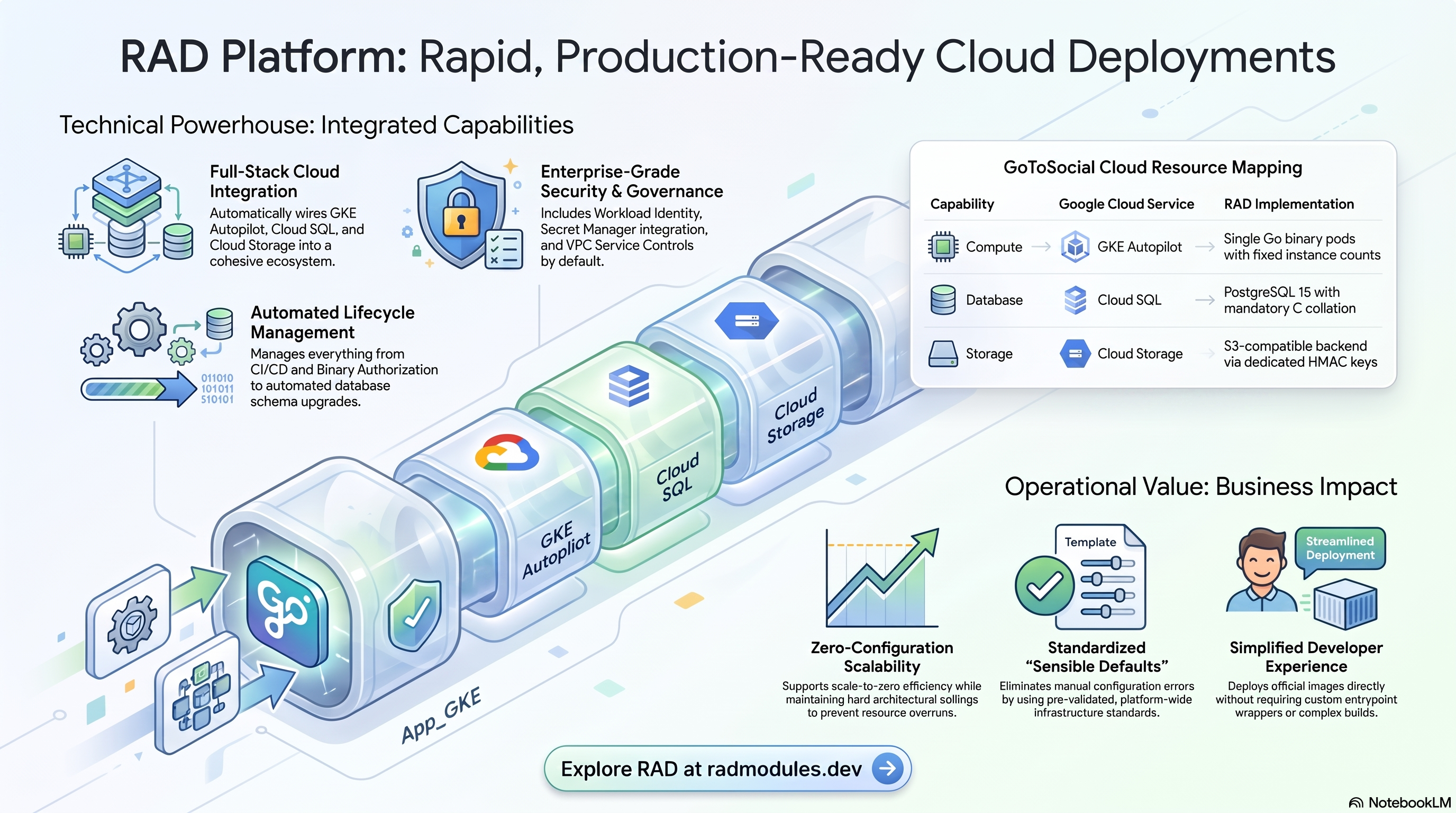
GoToSocial is a lightweight, self-hosted ActivityPub/Fediverse server — a small alternative to Mastodon, written as a single static Go binary. This module deploys GoToSocial on GKE Autopilot on top of the App_GKE foundation, which provisions and manages the shared Google Cloud and Kubernetes infrastructure.
This guide focuses on the cloud services GoToSocial uses and how to explore and operate them from the Google Cloud Console and the command line. For the mechanics that are common to every GKE application — Workload Identity, ingress, autoscaling, CI/CD, Cloud Armor, IAP, Binary Authorization, VPC Service Controls, backups, and the deployment lifecycle — refer to the App_GKE foundation guide rather than repeating them here.
What GoToSocial costs on RAD, and how that compares
Running GoToSocial on GKE Autopilot pod in your own Google Cloud project costs about $136.37/month in Google Cloud charges, on top of a one-off 110-credit RAD module fee charged once at deploy time. Running a single-user or small-group Fediverse instance doesn't need much compute — GoToSocial is a static Go binary — but a real Postgres database behind it is non-negotiable for federation to work reliably. In a RAD-managed project the module fee drops to 99 credits (10% lower) and the running cost is metered hourly in credits instead of billed directly by Google — see Pause it for free below for the one RAD-managed advantage a self-hosted VPS cannot match — or see the Cloud Run guide for the lower-cost option.
What you pay on RAD
| Own project | RAD-managed project | |
|---|---|---|
| Module fee (one-off) | 110 credits | 99 credits (10% lower) |
| Build time | ~3-6 credits per build, either way | ~3-6 credits per build, either way |
| Google Cloud running cost | $136.37/month, billed by Google at list price | ~105 credits/day, metered at list price plus RAD's margin |
Default running cost in your own project
| Resource | US$/month (Google list price, us-central1) |
|---|---|
| GKE Autopilot pod, 2x vCPU / 4 GiB | $79.35 |
| Cloud SQL for PostgreSQL, 1 vCPU / 3.75 GB, zonal, 10 GB SSD | $51.02 |
| Cloud NAT and networking | $5.00 |
| Cloud Storage (add-ons, backups) | $1.00 |
| GKE cluster management fee | shared across every GKE app in the project; $0 if this is your only cluster, else ~73 |
| Total | $136.37 |
The GKE cluster management fee is excluded from the total above because it is shared across every GKE app in the project — $0 if this is the only one, otherwise roughly $73/month split across however many you run.
How it compares
- A self-managed comparison sized to this module's own 2 vCPU/4GB: Hetzner CPX22 (2 vCPU/4GB) runs about $24/mo, a DigitalOcean 2 vCPU/4GB Droplet is the same $24/mo, and a GCP Compute Engine e2-standard-2 (2 vCPU/8GB) is about $49/mo.
- Commercial Fediverse hosts exist (masto.host and similar), but they host Mastodon, not GoToSocial — there's no official hosted SaaS for this exact project, so a price comparison against one would be comparing different software.
- The gap is the same as everywhere else on this list: a VPS is cheaper in cash terms, but you are the one rotating the database password, applying security updates, and restoring from backup if the disk fills.
Pause it for free: delete a RAD-managed project, restore it when you need it
This is the headline advantage of a RAD-managed project, and it costs nothing while paused. Deleting a RAD-managed project unlinks its billing first, then asks Google to delete the project outright — Google's own 30-day recoverable soft delete. Unlike deleting one module, this does not tear down Cloud SQL, any VM, or the compute resource one by one: the whole project simply stops, and nothing is charged while it waits, because billing is already unlinked.
Restoring, within 30 days and only by the project's owner, asks Google to undelete the project and reattaches its billing account, then asks you to run Update on each deployment to confirm everything came back. Because nothing was individually destroyed, that Update finds the same resources already there — it is a check, not a rebuild, and an Update never charges the module fee again. This costs only a handful of credits (under US$1) in total for a typical 2-3-deployment chain.
What this needs: you must own the project (not one RAD only manages billing for), you must restore it yourself within 30 days — after that Google deletes it for good — and restoring is admitted like creating a new project, so your purchased credit balance must still clear the tier's floor (100 credits for the sandbox tier most study/demo use fits). Google says most services are fully working again within 36 hours of a restore.
One real gap: nightly backups are written to a bucket inside the project, and that bucket has Cloud Storage's soft-delete explicitly turned off, so it is very likely gone as soon as you delete the project — even though the project itself is recoverable for 30 days. If you've customised GoToSocial and want to keep that work, copy a backup out (to Google Drive, or a bucket outside the project) before deleting. For a default install with nothing irreplaceable in it, this does not matter.
Pay only while you use it, the other way: delete and redeploy
In your own project, or once 30 days have passed on a RAD-managed one, there is no free pause — deleting removes the resources for good, and bringing GoToSocial back means redeploying from scratch. That costs about 113-116 credits (the 110-credit module fee plus a build).
Deleting only saves money once GoToSocial would otherwise sit unused long enough to clear that redeploy cost against its own running cost — for GoToSocial, that's about 3 days or more. Most of that running cost is usually the database (and, where this module uses one, the shared file-server VM or GKE cluster) — those stop only once nothing else in the project uses them, so deleting this app while something else shares the project saves only its own compute share.
Keep data first: nightly backups go to a bucket inside the deployment and are deleted with it, so copy the latest backup out before deleting if you want to keep it.
Lab sessions and Managed Environments
Lab sessions, for training: a trainer runs a session for a class. Each participant gets the app in their own Google Cloud project for 15 minutes to 24 hours, within an allowance the trainer sets. Either the trainer funds every place, or each participant pays for their own. Everything is deleted when the session ends and unused credits go back to the trainer.
Managed Environments, for consultancies: a partner runs the app for a client from a ring-fenced wallet it funds, and settles with the client directly. If the wallet runs low, billing pauses and the data is kept, so nobody receives an unexpected charge. At the end the partner hands the project over and the deployments become the client's own.
Credits can be bought in more than 20 currencies, including XAF, XOF, NGN, GHS, KES and ZAR, by card, bank transfer or mobile money.
Sources (8 October 2026): Google Cloud Billing Catalog API list prices; radmodules.dev/pricing for RAD's own fees and daily-credit estimates; Google's project delete/restore documentation for the pause/restore claims.
1. Overview
GoToSocial runs as a single Go binary workload on GKE Autopilot, deployed
directly from the official docker.io/superseriousbusiness/gotosocial image
— no custom build. The deployment wires together a focused set of Google
Cloud services:
| Capability | Google Cloud service | Notes |
|---|---|---|
| Compute | GKE Autopilot | Go binary pods on port 8080, 2 vCPU / 4 GiB by default; max_instance_count hard-fixed at 1 |
| Database | Cloud SQL for PostgreSQL 15 | Required — fixed at POSTGRES_15; MySQL not supported. Database created with mandatory LC_COLLATE='C' LC_CTYPE='C' collation |
| Object storage | Cloud Storage | A storage bucket + dedicated HMAC service account, consumed unconditionally via GoToSocial's native S3-compatible client — no GCS FUSE mount |
| Secrets | Secret Manager | Auto-generated SUPERUSER_PASSWORD, S3 HMAC access/secret key pair; database password. Projected via the Secret Store CSI driver |
| Ingress | Cloud Load Balancing / Gateway API | LoadBalancer Service by default; static IP reserved by default |
Sensible defaults worth knowing up front:
- PostgreSQL 15 with
Ccollation is mandatory.database_type = "POSTGRES_15"is the default, andGoToSocial_GKE'svalidation.tfrejects any non-Postgresdatabase_typeat plan time. Thedb-initjob additionally creates the database withLC_COLLATE='C' LC_CTYPE='C'— GoToSocial refuses to start against any other collation. - Prebuilt image, not custom.
container_image_source = "prebuilt"deploysdocker.io/superseriousbusiness/gotosocialdirectly. No entrypoint wrapper is needed — configuration is entirely through discreteGTS_*env vars the binary reads natively. - No migrate job. GoToSocial creates and upgrades its own schema
automatically on every start;
db-initonly prepares the C-collation database and role. max_instance_countis hard-fixed at 1. GoToSocial's in-process cache has no cross-instance synchronization; upstream does not support multiple instances against the same database/storage.min_instance_count = 0(scale-to-zero) is safe.- Cloud SQL is reached through the cloud-sql-proxy sidecar loopback —
GTS_DB_TLS_MODE = "disable"is correct on GKE, unlike Cloud Run (see the CloudRun guide's TLS-mode explanation).App_GKE'sdb_host_env_var_nameimplementation prefers127.0.0.1when the sidecar is present, soGoToSocial_Common's Common-layer default is used unmodified —GoToSocial_GKE'smodule_env_varslocal is empty. - No GCS FUSE mount. Media/avatar/attachment storage uses GoToSocial's native S3-compatible client pointed at GCS's S3-interop XML endpoint via a dedicated HMAC service account — not a filesystem mount.
- Health probes are TCP, not HTTP. GoToSocial's
/readyz//livezendpoints reject any request lacking aUser-Agentheader with an anti-scraper418response — Kubernetes' built-in HTTP prober never sends one. Bothstartup_probeandliveness_probeare TCP against port 8080. - The admin account is created best-effort automatically, but not
guaranteed. Unlike Cloud Run, GKE's looser initialization-job ordering
gives the
admin-createjob's retry loop a real chance to win the race against the main pod's boot — but it can still lose. See §3.
2. Google Cloud Services & How to Explore Them
All commands assume you have run
gcloud container clusters get-credentials <cluster> --region "$REGION" --project "$PROJECT"
and that PROJECT, REGION, and NAMESPACE are set. The namespace and other
identifiers are reported in the deployment Outputs.
A. GKE Autopilot — the GoToSocial workload
- Console: Kubernetes Engine → Workloads → select the GoToSocial workload for pods, revisions, and events. Kubernetes Engine → Services & Ingress shows the external IP.
- CLI:
kubectl get pods,svc -n "$NAMESPACE" --selector="app.kubernetes.io/name=gotosocial" 2>/dev/null \
  || kubectl get pods,svc -n "$NAMESPACE"
kubectl logs -n "$NAMESPACE" deploy/<service-name> --tail=100
kubectl describe pod -n "$NAMESPACE" -l app=<service-name>
See App_GKE for how Autopilot, scaling, and the workload type (Deployment vs StatefulSet) are managed.
B. Cloud SQL for PostgreSQL 15
GoToSocial stores all application data (accounts, statuses, follows, media
metadata) in a managed Cloud SQL for PostgreSQL 15 instance, created with the
mandatory C collation by the db-init job. Pods reach it through the
cloud-sql-proxy sidecar on 127.0.0.1; no public IP is exposed.
- Console: SQL → select the instance for connections, backups, flags, metrics.
- CLI:
gcloud sql instances list --project "$PROJECT" --filter="name~gotosocial"
gcloud sql instances describe <instance-name> --project "$PROJECT"
gcloud sql connect <instance-name> --user=<db-user> --database=<db-name> --project "$PROJECT"
The instance name, database, user, and password secret are in the Outputs. See App_GKE for the connection model, backups, and password rotation.
C. Cloud Storage — media, avatars, attachments
A dedicated Cloud Storage bucket (suffix storage) and a service account
holding an HMAC key are provisioned automatically, granting the storage
SA roles/storage.objectAdmin on the bucket. GoToSocial writes to this
bucket unconditionally from first boot — GTS_STORAGE_BACKEND=s3 is not
optional.
- Console: Cloud Storage → Buckets.
- CLI:
gcloud storage buckets list --project "$PROJECT" --filter="name~gotosocial"
See App_GKE for GCS Fuse (not used here) and CMEK options.
D. Secret Manager
GoToSocial's main container reads GTS_STORAGE_S3_ACCESS_KEY and
GTS_STORAGE_S3_SECRET_KEY as secret-backed environment variables (projected
via the Secret Store CSI driver); SUPERUSER_PASSWORD is only consumed by
the admin-create job. The database password is managed separately by the
foundation.
- Console: Security → Secret Manager.
- CLI:
gcloud secrets list --project "$PROJECT" --filter="name~gotosocial"
gcloud secrets versions access latest --secret=<secret-name> --project "$PROJECT"
See App_GKE for the Secret Store CSI integration and rotation,
and GoToSocial_Common §2 for why these secrets flow
through secret_ids/module_secret_env_vars, not the per-app config
object's (dead) secret_environment_variables field.
E. Networking & ingress
service_type = "LoadBalancer" and reserve_static_ip = true are both
defaults — keep reserve_static_ip = true: without a reserved static
IP, GKE_SERVICE_URL can fall back to an unreachable internal
*.svc.cluster.local hostname before the ephemeral LoadBalancer IP is known
at the moment Terraform renders the Deployment's env vars (a documented,
reproducible fleet-wide race, not specific to GoToSocial).
- Console: Network services → Load balancing; VPC network → IP addresses.
- CLI:
kubectl get svc -n "$NAMESPACE"
gcloud compute addresses list --project "$PROJECT"
See App_GKE for custom domains, Cloud CDN, and static IP details.
F. Cloud Logging & Monitoring
Pod stdout/stderr flow to Cloud Logging; GKE and Cloud SQL metrics flow to Cloud Monitoring. Optional uptime checks and alert policies are available.
- Console: Logging → Logs Explorer; Monitoring → Dashboards / Alerting.
- CLI:
gcloud logging read 'resource.type="k8s_container" AND resource.labels.namespace_name="'"$NAMESPACE"'"' \
  --project "$PROJECT" --limit 50
3. GoToSocial Application Behaviour
- First-deploy database setup. The
db-initjob runsscripts/db-init.shusingpostgres:15-alpine. It waits for Cloud SQL to accept connections, then idempotently creates the application role and the database withLC_COLLATE='C' LC_CTYPE='C', grants privileges, and signals the cloud-sql-proxy sidecar to shut down (POST http://127.0.0.1:9091/quitquitquit) so the Job completes. Safe to re-run (execute_on_apply = true,max_retries = 3). - No separate migrate job. GoToSocial migrates its own schema automatically on every server start.
- The admin account is best-effort automatic — but confirm it, don't
assume it. GoToSocial has no web-based sign-up flow and no REST endpoint
for the very first account. Confirmed live: the CLI panics with
NewSignup: instance application not yet created, run the server at least once before creating usersunless the main server has already booted successfully once. On GKE,execute_on_applyonly controls whether Terraform waits for a job (App_GKE/jobs.tf:wait_for_completion = try(execute_on_apply, true)) — the underlying Job pod is still scheduled immediately, racing the main Deployment's first pod.admin-create.shretries up to 20 times at 15-second intervals to absorb this race and often wins during the sameapply— but it is not guaranteed. Verify the account exists (Task 2 in the lab) and re-trigger manually if it does not:Retrieve the generated password:kubectl get jobs -n "$NAMESPACE"
kubectl logs -n "$NAMESPACE" job/<admin-create-job-name>
kubectl create job --from=job/<admin-create-job-name> <admin-create-job-name>-retry -n "$NAMESPACE"SECRET=$(gcloud secrets list --project "$PROJECT" --filter="name~superuser-password" --format="value(name)")
gcloud secrets versions access latest --secret="$SECRET" --project "$PROJECT" - Orphaned account row — a real, recurring failure mode, not a one-off.
If an
admin-createattempt fails partway through (the common case: it raced the server's boot and lost mid-flow, or was interrupted), GoToSocial'sNewSignupflow can leave theaccountstable row inserted without the matchingusersrow (it inserts the account first, then panics on the user-row step if the instance application doesn't exist yet). A retry then fails confusingly:IsUsernameAvailablereports "already in use" (the orphaned account row exists), butGetAccountByUsernameDomain/GetUserByAccountID(used by both a furthercreateretry andadmin account promote) find nothing, panicking withsql: no rows in result set— a symptom that looks like a completely different bug. Fix: connect to the database directly (e.g. a one-offpostgres:15-alpinedebug pod on GKE, using the DB credentials from Secret Manager) and run:then retrySELECT id, username, domain FROM accounts WHERE username='<username>';
DELETE FROM account_settings WHERE account_id='<the id above>';
DELETE FROM account_stats WHERE account_id='<id>';
DELETE FROM accounts WHERE id='<id>';admin-createcleanly. This can recur on any deploy where the first attempt races the boot and loses — see Task 5 of the lab for the full walkthrough. - Health path — TCP only, and why
curlneeds aUser-Agent. GoToSocial serves real, unauthenticated/readyz(DBSELECT, 500 on failure) and/livez(cheap 200) endpoints, but both reject any request without aUser-Agentheader with a418 I'm a teapotresponse — confirmed live. Kubernetes' HTTP prober never sends one, so bothstartup_probeandliveness_probestay TCP against port 8080. Every manual verification command needs an explicit-A/--user-agentflag:curl -A "gotosocial-check/1.0" -s "http://${EXTERNAL_IP}/readyz" - Storage IAM propagation. GoToSocial panics on boot if it cannot reach
its S3 storage backend. The storage SA's
roles/storage.objectAdmingrant is wired against the Foundation's ownstorage_bucketsoutput (not a whole-moduledepends_on, which would deadlock) — but a fresh first deploy can still see the very first pod boot race the IAM grant's ~1–2 minute propagation delay, producing a briefAccess Deniedcrash-loop that self-resolves. - Inspect the init jobs and running config:
kubectl get jobs -n "$NAMESPACE"
kubectl logs -n "$NAMESPACE" job/<db-init-job-name>
kubectl exec -n "$NAMESPACE" deploy/<service-name> -- env | grep -E 'GTS_HOST|GTS_STORAGE|GTS_DB'
4. Configuration Variables
Variables are grouped exactly as they appear on the deployment platform. Only settings specific to or notable for GoToSocial are listed; every other input is inherited from App_GKE with its standard behaviour and defaults.
Group 3 — Application Identity
| Variable | Default | Description |
|---|---|---|
application_name | gotosocial | Base name for resources. Must be lowercase. Do not change after first deploy. |
application_display_name | GoToSocial | Human-readable name shown in the Console. |
application_description | GoToSocial — a lightweight, self-hosted ActivityPub/Fediverse server, on GKE Autopilot | Workload description field. |
application_version | latest | Docker Hub image tag. |
host | gotosocial.local | GTS_HOST — the public domain. Baked into every ActivityPub URI at creation time, immutable after first boot. Set your real domain before production. |
account_domain | "" | GTS_ACCOUNT_DOMAIN — optional vanity handle domain, separate from host. Defaults to host when empty. Same immutability risk. |
Group 4 — Runtime & Scaling
| Variable | Default | Description |
|---|---|---|
container_image_source | prebuilt | Deploys the official Docker Hub image directly — no custom build needed. |
min_instance_count | 0 | Scale-to-zero is safe — GoToSocial's single-instance constraint is about concurrency, not warmth. |
max_instance_count | 1 | Hard architectural ceiling — GoToSocial's in-process cache has no cross-instance synchronization. Do not raise. |
container_port | 8080 | GoToSocial's native GTS_PORT default. Must match the probe ports, or the pod never becomes Ready. |
container_resources | { cpu_limit = "2000m", memory_limit = "4Gi" } | Per-pod CPU/memory. |
enable_cloudsql_volume | true | Runs the cloud-sql-proxy sidecar — GoToSocial connects over its 127.0.0.1 loopback. |
Group 5 — Environment Variables & Secrets
Standard App_GKE behaviour — see App_GKE.
Group 6 — GKE Backend & Cluster
| Variable | Default | Description |
|---|---|---|
service_type | LoadBalancer | Public-facing app — leave LoadBalancer. |
workload_type | null (resolves to Deployment) | GoToSocial does not need a StatefulSet PVC — media lives in GCS via the S3 client. |
session_affinity | ClientIP | Sticky routing so a client reaches the same pod. |
Group 10 — Observability & Health
| Variable | Default | Description |
|---|---|---|
startup_probe | TCP, /readyz (informational path only), initial_delay_seconds=15, failure_threshold=10 | The only probe type that works against GoToSocial's User-Agent-gated health endpoints. |
liveness_probe | TCP, /livez, initial_delay_seconds=30, failure_threshold=3 | Same reasoning as startup_probe. |
startup_probe_config / health_check_config | HTTP /, various | Foundation-level structured probes; superseded by startup_probe/liveness_probe above for this module. |
Group 13 — Filesystem (NFS)
| Variable | Default | Description |
|---|---|---|
enable_nfs | false | Provisions Filestore. Not used by GoToSocial — media storage is via the native S3 client, not a mount. |
Group 14 — Cloud Storage
| Variable | Default | Description |
|---|---|---|
storage_buckets | one generic data bucket (overridden) | main.tf supplies the actual storage bucket via GoToSocial_Common's output, consumed unconditionally from first boot — not opt-in like some other apps' S3 buckets. |
gcs_volumes | [] | No GCS Fuse volumes mounted by default. |
Group 15 — Redis
| Variable | Default | Description |
|---|---|---|
enable_redis | false | GoToSocial has no Redis dependency at all — its cache is in-process. Leave false. |
Group 16 — Database Backend
| Variable | Default | Description |
|---|---|---|
database_type | POSTGRES_15 | Plan-validated — validation.tf rejects anything but PostgreSQL 13/14/15 or NONE. |
application_database_name | gotosocial | The database actually created (with C collation) and injected as GTS_DB_DATABASE. |
application_database_user | gotosocial | The role actually created and injected as GTS_DB_USER; password auto-generated in Secret Manager. |
db_host_env_var_name / db_port_env_var_name / db_user_env_var_name / db_name_env_var_name / db_password_env_var_name | GTS_DB_ADDRESS / GTS_DB_PORT / GTS_DB_USER / GTS_DB_DATABASE / GTS_DB_PASSWORD | Set by main.tf, not left at their generic-empty variable defaults — the mechanism that lets the GoToSocial binary read the Foundation's DB connection info. |
Group 19 — Custom Domain, Static IP & Networking
| Variable | Default | Description |
|---|---|---|
enable_custom_domain | true | Provisions a Gateway by default. GoToSocial is told HTTPS is in use (GTS_PROTOCOL=https, Secure cookies) only when application_domains is also set; on a bare IP it runs as http. |
application_domains | [] | If empty, a nip.io-style hostname based on the reserved static IP is used. |
reserve_static_ip | true | Keep true — see §2E for the internal-DNS race this avoids. |
All other inputs follow standard App_GKE behaviour.
5. Outputs
These values are returned on a successful deployment and are the quickest way to locate and explore the running resources.
| Output | Description |
|---|---|
service_name | Kubernetes Service name. |
namespace | Namespace the workload runs in. |
service_cluster_ip | In-cluster ClusterIP. |
service_external_ip | External LoadBalancer IP (reserved by default). |
service_url | URL to reach GoToSocial. |
database_instance_name | Cloud SQL instance name. |
database_name / database_user | Application database name / user. |
database_password_secret | Secret Manager secret holding the DB password. |
database_host / database_port | DB endpoint (127.0.0.1 via the Auth Proxy sidecar) / port. |
storage_buckets | Created Cloud Storage buckets (the storage media bucket). |
network_name / network_exists / regions | VPC network, presence, available regions. |
container_image / container_registry | Deployed image and Artifact Registry repo. |
monitoring_enabled / monitoring_notification_channels | Monitoring status and channels. |
initialization_jobs / db_import_job | Names of the setup (db-init, admin-create) and (optional) import jobs. |
deployment_id / tenant_id / resource_prefix | Naming identifiers. |
project_id / project_number | Project identifiers. |
cicd_enabled / cicd_configuration | CI/CD status and details (repo, trigger, registry). |
artifact_registry_repository / cloudbuild_trigger_name / cloudbuild_trigger_id | Registry and build trigger. |
kubernetes_ready | Whether the cluster/workload is ready. |
vpc_sc_enabled / vpc_sc_perimeter_name / vpc_sc_dry_run_mode | VPC-SC status. |
audit_logging_enabled / artifact_registry_cmek_enabled | Audit logging and CMEK status. |
6. Configuration Pitfalls & Sensible Defaults
Risk: Critical (data loss / outage / security) — High (service degraded) — Medium (cost or partial degradation) — Low (minor).
Inherited plan-time validation. This module passes its configuration through the App_GKE foundation engine, which validates values and combinations at plan time.
GoToSocial_GKE's ownvalidation.tfadditionally blocksmin_instance_count > max_instance_count,enable_redis = truewith neitherredis_hostnorenable_nfs,database_typeaway from PostgreSQL,enable_iap = truewithout both OAuth credentials, andenable_cloudsql_volume = truewithdatabase_type = "NONE".
| Setting | Sensible value | Risk | Consequence if wrong |
|---|---|---|---|
host (GTS_HOST) | Set your real domain before first deploy | Critical | Baked into every ActivityPub actor/object URI at creation time; changing it after real accounts/posts exist breaks federation for everything created under the old value. |
max_instance_count | 1 (do not raise) | Critical | GoToSocial's in-process cache has no cross-instance synchronization; upstream does not support multiple instances against the same database/storage. |
database_type | POSTGRES_15 | Critical | Plan-time validated by GoToSocial_GKE's own validation.tf — MySQL/SQL Server are rejected before apply. |
container_port / probe ports | 8080 everywhere | Critical | A mismatch makes the probe hit a dead port and the pod never becomes Ready even though the app is healthy. |
Storage IAM wiring (google_storage_bucket_iam_member) | Leave as shipped (references module.app_gke.storage_buckets["storage"]) | Critical | GoToSocial panics on boot without S3 access. A depends_on = [module.app_gke] alternative would deadlock the Deployment against its own IAM prerequisite. |
admin-create recovery | Follow the orphaned-account-row SQL fix if a retry panics with "no rows" | High | A partially-failed first attempt can leave an orphaned accounts row with no matching users row; naive retries fail confusingly without the cleanup SQL. |
Health probes (startup_probe/liveness_probe) | Leave type = "TCP" | High | GoToSocial's /readyz//livez reject any request without a User-Agent header (418); switching to type = "HTTP" makes the probe fail forever, since Kubernetes' prober never sends one. |
admin-create job outcome | Verify, don't assume | High | GKE's looser job ordering often lets admin-create win its race against the pod's boot automatically, but not always — confirm the account exists before treating the deploy as fully operational. |
reserve_static_ip | true (default) | Medium | Without it, GKE_SERVICE_URL can fall back to an unreachable internal *.svc.cluster.local hostname before the ephemeral LoadBalancer IP is known — a documented fleet-wide race. |
Manual curl/health checks | Always pass -A "<agent>" | Medium | Bare curl (and most default HTTP clients/monitors) get 418 I'm a teapot from GoToSocial's anti-scraper User-Agent gate, even on "unauthenticated" endpoints. |
quota_memory_requests / _limits | binary units (4Gi, 8192Mi) | Critical | Bare integers are treated as bytes and block all pod scheduling in the namespace. |
enable_nfs | false (the default) | Low | GoToSocial does not use the NFS mount in its default configuration, and Filestore is billed whether or not the app writes to it. |
enable_redis | false (default) | Low | GoToSocial has no Redis dependency; leaving this true has no functional effect. |
For the foundation behaviour referenced throughout — IAM and Workload
Identity, autoscaling, ingress and certificates, CI/CD, Cloud Armor, IAP,
Binary Authorization, VPC-SC, backups, and image mirroring — see
App_GKE. GoToSocial-specific application configuration
shared with the Cloud Run variant (secrets, the db-init/admin-create
jobs, and the storage service account) is described in
GoToSocial_Common (module source:
modules/GoToSocial_Common).
Related guides
- Hands-on lab: GoToSocial on GKE Autopilot — deploy it step by step, with the console screens and commands at each stage.
- GoToSocial on Google Cloud Run — the same application on Cloud Run, for when you need the other deployment target.
- GoToSocial Common — Shared Application Configuration — the configuration shared by both deployment targets.
Need RAD to do something it does not do yet? Request it on the roadmap, or vote on what is already there.