Payload CMS on Google Cloud Run
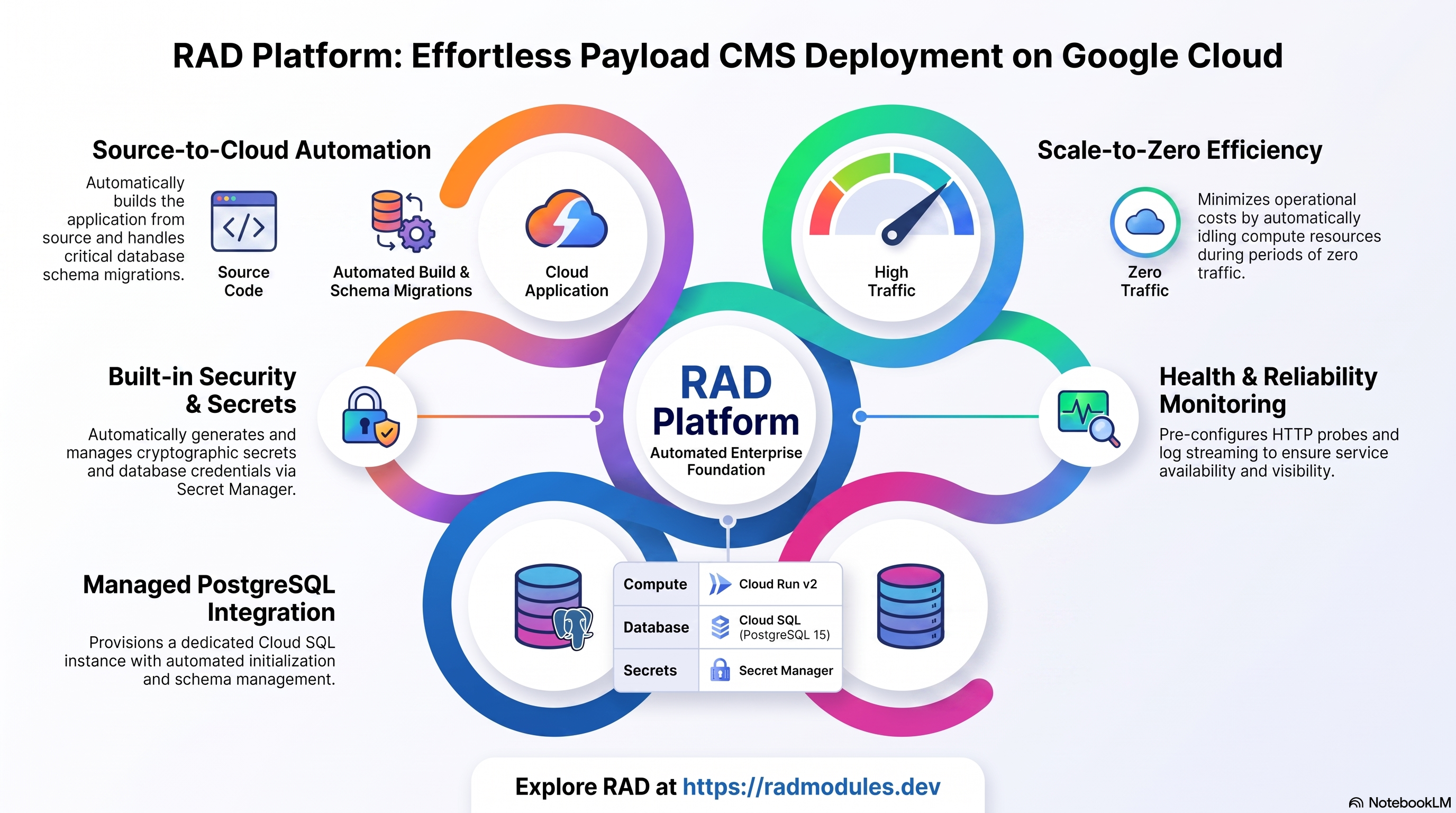
Payload CMS is a TypeScript-native, code-first headless CMS and application framework built
directly on Next.js — not a hosted SaaS product, but a library installed into your own Next.js
application. Content is modeled through typed "Collections" defined in payload.config.ts, and
Payload generates an admin UI plus REST, GraphQL, and Local APIs from that same config. This
module deploys a real Payload application on Cloud Run v2 on top of the
App_CloudRun foundation, which provisions and manages the shared Google Cloud
infrastructure.
This guide focuses on the cloud services this deployment uses and how to explore and operate them from the Google Cloud Console and the command line. For the mechanics common to every Cloud Run application — service identity, ingress and load balancing, scaling and concurrency, CI/CD, Cloud Armor, IAP, Binary Authorization, VPC Service Controls, backups, and the deployment lifecycle — refer to the App_CloudRun foundation guide rather than repeating them here.
What Payload costs on RAD, and how that compares
For a small team, Payload on RAD's Cloud Run module costs about US$84 a month with no per-user licence. Payload Cloud, the project's own hosted offering, does not publish a current public price list; a self-managed server is cheaper in cash than RAD, but then you run the database, backups, security patches and upgrades yourself. Figures are as at 8 October 2026; sources are listed at the end of this section.
If you only need it occasionally — studying for a certification, a demo, a seasonal business — a RAD-managed project can be deleted and restored within 30 days for a few credits, so that US$84 becomes a few dollars a month instead. See Pause it for free, below.
What you pay on RAD
| In a Google Cloud project you own | In a project RAD manages for you | |
|---|---|---|
| Module fee, once per deployment | 110 credits (US$11 at the top-up price) | 99 credits (10% lower) |
| Build time | About 19 credits per build (RAD's average build takes about 19 minutes) | The same |
| Google Cloud running cost | Billed by Google to your own billing account (table below) | Metered hourly in credits; RAD publishes 32 credits a day, about 960 credits a month (about US$96 at the top-up price, US$77 at the Scale plan's rate) |
| Who owns what | You own the project and its billing; RAD deploys and updates it | RAD owns the project, with guardrails, quotas and budget alerts; you get console access, and a minimum purchased balance is held in reserve |
10 credits cost US$1 on a one-off top-up, and less on a monthly plan. In a project RAD manages, the database, file server and network are shared by every application in the project, so a second application does not add a second database.
Default running cost in your own project (us-central1, Google list prices):
| Resource (module default) | Per month |
|---|---|
| Cloud Run, 1x vCPU / 2 GiB (scaleToZero) | US$13.16 |
| Cloud SQL for PostgreSQL, 1 vCPU / 3.75 GB, zonal, 10 GB SSD | US$51.02 |
| NFS/cache file server (small VM) | US$13.43 |
| Cloud NAT and networking | US$5 |
| Cloud Storage (add-ons, backups) | US$1 |
| Total | about US$84 |
- Cloud SQL and Cloud Run cost the same in africa-south1 (Johannesburg); the VM costs about 10% more.
- Scale-to-zero is the default. The Cloud Run line above already reflects that cost; setting
min_instance_count = 1keeps an instance warm and raises this line, in exchange for no cold starts. - Avoid Filestore for a small deployment. The module uses a small NFS/cache VM by default. Filestore's smallest instance is 1 TiB, which costs about US$164 a month on its own.
How it compares
- Payload Cloud, the project's own hosted offering, does not publish a current public price list, so this compares against a bare server instead.
- A bare VPS — Hetzner CPX22 or a DigitalOcean 2 vCPU/4 GB Droplet, both about US$24/month — undercuts RAD's own-project figure above. Payload only needs 1 vCPU / 1–2 GiB, so a smaller/cheaper VPS tier would likely do; the figures above are the smallest independently verified class.
- The difference is the database and secrets handling: Cloud SQL backups and point-in-time recovery, and Secret Manager, are included on RAD rather than being your own job on a VPS.
- If Payload needs to stay up without scaling to zero, or run beside other Kubernetes workloads, see the GKE guide instead — about US$107 a month in your own project, or 2,760 credits (about US$221–276) a month in one RAD manages.
Pause it for free: delete a RAD-managed project, restore it when you need it
If Payload runs in a project RAD manages for you, you have a second option that goes well beyond scaling to zero: delete the whole project, and restore it within 30 days for close to nothing. This suits occasional use — studying for a certification, a demo environment, a seasonal business — far better than running Payload continuously.
- How it works. Deleting a RAD-managed project unlinks its billing first, then asks Google to delete the project. Google does not remove the project immediately: it keeps it, recoverable, for 30 days. Because billing is already unlinked, nothing is charged while it waits. Unlike deleting one module, this does not tear down Cloud SQL, any VM or Cloud Run one by one — the whole project, and everything in it, simply stops.
- Restoring costs a handful of credits, not a rebuild. Within 30 days, the project's owner can restore it. RAD asks Google to undelete the project and reattaches its billing account, then asks you to run Update on each deployment to confirm everything came back. Because nothing was individually destroyed, that Update finds the same resources already there — it is a check, not a rebuild, and an Update never charges the module fee again. That costs a handful of credits (under US$1) for a typical 2–3-deployment chain, against the 115 credits (US$11.50) a full redeploy costs below.
- So a month of occasional use can cost a few dollars, not US$84. Deploy Payload, use it for a while, delete the project. Restore it next time you want it, confirm with Update, and delete it again when you're done. You pay only for the module fee once, the builds, and whatever time Payload was actually live.
- What this needs. You must own the project (not a bring-your-own one RAD only manages billing for), and you restore it yourself within the 30 days — after that, Google deletes it for good. Restoring is admitted like creating a new project: your purchased credit balance must still clear the tier's floor (100 credits for the sandbox tier most study and demo use fits). Google says most services are fully working again within 36 hours of a restore.
- One real gap: the backup bucket does not survive. Payload's backups are written to a bucket inside the project, and that bucket is not protected by Cloud Storage's soft-delete, so it is very likely gone as soon as you delete the project — even though the project itself is recoverable for 30 days. If you have made changes to Payload you want to keep, copy a backup out (to Google Drive, or a bucket outside the project) before you delete, the same as the redeploy workflow below. For a default installation with nothing irreplaceable in it, this does not matter.
Pay only while you use it, the other way: delete and redeploy
Cloud Run already scales to zero between requests. The option above only applies to a RAD-managed project; in your own project, or once the 30-day window has passed, the way to stop paying is to delete the deployment and deploy it again when you need it.
- What a redeploy costs. The module fee again plus the builds: about 115 credits (US$11.50), because RAD recreates the project and shared services before Payload. Deleting saves money only once Payload would otherwise sit unused for about 5 days or more, both in your own project (about US$2.79 a day) and in a RAD-managed one (32 credits a day).
- Most of the running cost is usually the database and the shared file/cache VM. They stop only when nothing else in the project uses them, so deleting Payload while something else shares the project saves only Payload's own compute part.
- Keep data first. Backups are written to a bucket inside the deployment and are deleted with it, so copy the latest backup out before deleting if you want to keep it.
- RAD does not recreate a deleted deployment for you; you enter the settings again when you deploy.
Lab sessions and Managed Environments
- Lab sessions, for training. A trainer runs a session for a class. Each participant gets the app in their own Google Cloud project for 15 minutes to 24 hours, within an allowance the trainer sets. Either the trainer funds every place, or each participant pays for their own. Everything is deleted when the session ends and unused credits go back to the trainer.
- Managed Environments, for consultancies. A partner runs the app for a client from a ring-fenced wallet it funds, and settles with the client directly. If the wallet runs low, billing pauses and the data is kept, so nobody receives an unexpected charge. At the end the partner hands the project over and the deployments become the client's own.
Credits can be bought in more than 20 currencies, including XAF, XOF, NGN, GHS, KES and ZAR, by card, bank transfer or mobile money.
Sources (8 October 2026): Google Cloud list prices from the Cloud Billing Catalog API; radmodules.dev/pricing for RAD's own fees and daily-credit estimates; Delete and restore projects for the pause/restore window and what it says about Cloud Storage objects without soft delete.
1. Overview
Payload runs as a Node.js (Next.js) container on Cloud Run v2. There is no official Payload
Docker image — this module builds a real, locally-verified starter application from source (a
blank create-payload-app template using the PostgreSQL adapter) via Cloud Build. The deployment
wires together a focused set of Google Cloud services:
| Capability | Google Cloud service | Notes |
|---|---|---|
| Compute | Cloud Run v2 | Node.js (Next.js standalone) service, serverless autoscaling; scale-to-zero supported by default |
| Build | Cloud Build | Builds the bundled Payload starter app from Payload_Common/scripts/Dockerfile — no prebuilt image exists to pull |
| Database | Cloud SQL for PostgreSQL 15 | Required — Payload's Postgres adapter is used; MySQL/MongoDB are not wired |
| Object storage | None | No bucket is provisioned; media uploads go to local, ephemeral container disk |
| Secrets | Secret Manager | Auto-generated PAYLOAD_SECRET; database password |
| Ingress | Cloud Run URL / Cloud Load Balancing | Default run.app URL; optional external HTTPS load balancer + custom domain |
Sensible defaults worth knowing up front:
- PostgreSQL 15 is mandatory and schema is not created on boot. Booting the built server
against a fresh database creates zero tables — the
payload-migrateinit job applies schema via thepayload migrateCLI, using a pre-generated migration file baked into the image. container_image_sourceis fixed at"custom". There is nothing to deploy without a Cloud Build run — the module always buildsPayload_Common/scripts/from source.- Health probes target
/admin, not/or an API route./adminserves Payload's login/first-user-creation form and returns an unauthenticated200; Payload's REST/GraphQL routes require auth and are unsuitable probe targets. - No storage bucket is provisioned. Uploaded media is written to local container disk and does not survive a pod restart or redeploy.
enable_redisand related Group 21 variables are declared but inert. They are not forwarded toPayload_Common, which has no Redis wiring.- Scale-to-zero is enabled by default (
min_instance_count = 0). Cold starts add latency to the first request after idle, compounded by Next.js's own cold-start cost. - The first admin user is created manually. Payload has no non-interactive CLI for this —
visiting
/adminon an emptyuserscollection shows a signup form.
2. Google Cloud Services & How to Explore Them
All commands assume PROJECT and REGION are set. Service and resource names are reported in
the deployment Outputs.
A. Cloud Run — the Payload service
Payload runs as a Cloud Run v2 service that autoscales by request load between the minimum and maximum instance counts. Each deployment creates an immutable revision.
- Console: Cloud Run → select the service for revisions, traffic, logs, and metrics.
- CLI:
gcloud run services list --project "$PROJECT" --region "$REGION"
gcloud run services describe <service-name> --project "$PROJECT" --region "$REGION"
gcloud run revisions list --service <service-name> --project "$PROJECT" --region "$REGION"
See App_CloudRun for scaling, concurrency, execution environment, and traffic splitting.
B. Cloud Build — building the Payload image
Because no official Payload image exists, every deploy (and every redeploy after a Dockerfile or
source change) triggers a Cloud Build run against Payload_Common/scripts/.
- Console: Cloud Build → History.
- CLI:
gcloud builds list --project "$PROJECT" --limit=10
gcloud builds log <build-id> --project "$PROJECT"
C. Cloud SQL for PostgreSQL 15
Payload stores all application data (Collections, users, uploaded document metadata) in a managed
Cloud SQL for PostgreSQL 15 instance. The service connects privately through the Cloud SQL Auth
Proxy over a Unix socket; no public IP is exposed. On first deploy, db-init creates the
database and role, then payload-migrate applies the schema.
- Console: SQL → select the instance for connections, backups, flags, metrics.
- CLI:
gcloud sql instances list --project "$PROJECT"
gcloud sql instances describe <instance-name> --project "$PROJECT"
gcloud sql connect <instance-name> --user=<db-user> --database=<db-name> --project "$PROJECT"
The instance name, database, user, and password secret are in the Outputs. See App_CloudRun for the connection model, backups, and password rotation.
D. Secret Manager
One cryptographic secret is generated automatically and stored in Secret Manager: PAYLOAD_SECRET
(used to sign Payload's own session/auth tokens). The database password is managed separately by
the foundation.
- Console: Security → Secret Manager.
- CLI:
gcloud secrets list --project "$PROJECT"
gcloud secrets versions access latest --secret=<secret-name> --project "$PROJECT"
See App_CloudRun for injection and rotation details.
E. Networking & ingress
The service is reachable at its run.app URL by default. An external HTTPS load balancer with a
custom domain, Cloud CDN, and Cloud Armor can be layered on.
- Console: Cloud Run (service URL); Network services → Load balancing.
- CLI:
gcloud run services describe <service-name> --region "$REGION" --format='value(status.url)'
gcloud compute addresses list --project "$PROJECT"
See App_CloudRun.
F. Cloud Logging & Monitoring
Container logs flow to Cloud Logging; Cloud Run and Cloud SQL metrics flow to Cloud Monitoring, with optional uptime checks and alert policies.
- Console: Logging → Logs Explorer; Monitoring → Dashboards / Alerting.
- CLI:
gcloud run services logs read <service-name> --project "$PROJECT" --region "$REGION" --limit 50
3. Payload Application Behaviour
- First-deploy database setup.
db-init(usingpostgres:15-alpine) connects through the Cloud SQL Auth Proxy and idempotently creates the application role and database. - Schema migration is a separate, dependent job.
payload-migrate(depends_on_jobs = ["db-init"]) runs./node_modules/.bin/payload migratefrom a full/app/clicopy ofnode_modules+ TypeScript source baked into the image — the trimmed Next.js standalone runtime used to serve traffic does not include the Payload CLI or its dependencies. This is a real behavioural fact confirmed locally: booting the app against a schema-less database serves zero tables and every collection query fails until migrations have run. PAYLOAD_SECRETshould be treated as immutable after first boot. It signs Payload's session/auth tokens; rotating it invalidates all active sessions.- Health path. Startup and liveness probes target
/admin— Payload's admin UI route, which returns an unauthenticated200once the Node.js server and database connection are ready. Allow several minutes on first boot for thepayload-migratejob to complete before the service is expected to serve real content. - First admin account. Payload has no CLI command to create the first admin user
non-interactively. Visit
$SERVICE_URL/admin— with an emptyuserscollection Payload shows a signup form to create the first administrator. This is a manual, one-time operator step. - Media uploads do not persist. No storage bucket is provisioned; uploaded files are written to local container disk and are lost on the next pod restart, redeploy, or scale-to-zero cold start replacing the container.
- Inspect job execution:
gcloud run jobs list --project "$PROJECT" --region "$REGION"
gcloud run jobs executions list --job <job-name> --project "$PROJECT" --region "$REGION"
4. Configuration Variables
Variables are grouped exactly as they appear on the deployment platform. Only settings specific to or notable for Payload are listed; every other input is inherited from App_CloudRun with its standard behaviour.
Group 1 — Project & Identity
| Variable | Default | Description |
|---|---|---|
project_id | (required) | Target Google Cloud project. |
region | us-central1 | Region for the service and regional resources. |
Group 2 — Deployment Environment
| Variable | Default | Description |
|---|---|---|
tenant_id | demo | Short suffix that makes resource names unique per environment. |
Group 3 — Application Identity
| Variable | Default | Description |
|---|---|---|
application_name | payload | Base name for resources. Do not change after first deploy. |
display_name | Payload CMS | Human-readable name shown in the Console. Leftover text from the module's clone source — override to Payload CMS (or any label you prefer) at deploy time; it is cosmetic only. |
application_version | latest | Deployment-tracking tag baked into the image via the Cloud Build application_version build arg. |
Group 4 — Runtime & Scaling
| Variable | Default | Description |
|---|---|---|
deploy_application | true | Set false to provision infrastructure only. |
cpu_limit / memory_limit | 1000m / 2Gi | Payload (Next.js) needs headroom for the standalone server plus the migrate job's TypeScript/CLI footprint. |
cpu_always_allocated | false | Request-based billing — Payload runs server-only (no worker process, cron disabled), so it is pure request/response with nothing to throttle. |
min_instance_count / max_instance_count | 0 / 3 | 0 enables scale-to-zero. |
container_port | 3000 | Next.js default. |
container_image_source | custom | Fixed — there is no prebuilt Payload image to deploy. |
enable_cloudsql_volume | true | Cloud SQL Auth Proxy for socket connections. |
enable_image_mirroring | true | Mirrors the built image into Artifact Registry. |
Group 5 — Access & Ingress Control
| Variable | Default | Description |
|---|---|---|
ingress_settings | all | Public by default. |
enable_iap | false | Require Google sign-in — blocks anonymous visitors from /admin's first-user signup form if enabled before the first admin exists. |
Group 6 — Environment Variables & Secrets
| Variable | Default | Description |
|---|---|---|
environment_variables | {} | Extra non-secret settings. Do not set PAYLOAD_SECRET or DATABASE_URL here — both are computed automatically. |
secret_environment_variables | {} | Map of env var → Secret Manager secret name. |
Group 11 — Cloud Storage & Filesystem
| Variable | Default | Description |
|---|---|---|
enable_gcs_storage | false | Declared in variables.tf with a description implying an S3-compatible GCS storage adapter, but not forwarded to Payload_Common — has no effect. Payload_Common's storage_buckets output is always []. |
gcs_volumes | [] | Genuinely forwarded — GCS Fuse volume mounts, if you want to wire persistent storage in yourself. |
Group 12 — Database Backend
| Variable | Default | Description |
|---|---|---|
database_type | POSTGRES_15 | Fixed; Payload requires PostgreSQL. |
db_name / db_user | payload / payload | PostgreSQL database name and application user. Immutable after first deploy. |
Group 13 — Jobs & Scheduled Tasks
| Variable | Default | Description |
|---|---|---|
initialization_jobs | [] | Leave empty to use the built-in db-init → payload-migrate chain. |
Group 14 — Observability & Health
| Variable | Default | Description |
|---|---|---|
startup_probe | HTTP /admin, 120s delay, 15s period, 40 retries | ~12-minute total window for first-boot migrations to complete. |
liveness_probe | HTTP /admin, 30s delay | Liveness probe. |
Group 21 — Redis Cache
| Variable | Default | Description |
|---|---|---|
enable_redis / redis_host / redis_port / redis_auth | true / "" / 6379 / "" | Inert. Declared in variables.tf (with a description claiming Payload v0.4+ requires Redis) but never forwarded to Payload_Common, which has no Redis wiring at all. Setting these has no effect. |
5. Outputs
Returned on a successful deployment — the quickest way to locate and explore the running resources.
| Output | Description |
|---|---|
service_name | Cloud Run service name. |
service_url | Default run.app URL of the service. |
service_location | Region the service runs in. |
load_balancer_ip / load_balancer_url | External HTTPS load balancer IP / URL (when enabled). |
database_instance_name | Cloud SQL instance name. |
database_name / database_user | Application database name / user. |
database_password_secret | Secret Manager secret holding the DB password. |
database_host / database_port | DB endpoint / port. |
storage_buckets | Always empty — no bucket is provisioned. |
container_image / container_registry | Built image and Artifact Registry repo. |
initialization_jobs | Names of the db-init and payload-migrate jobs. |
deployment_id / tenant_id / resource_prefix | Naming identifiers. |
project_id / project_number | Project identifiers. |
monitoring_enabled / monitoring_notification_channels / uptime_check_names | Monitoring status, channels, uptime checks. |
cicd_enabled / cicd_configuration | CI/CD status and details. |
vpc_sc_enabled / vpc_sc_perimeter_name / vpc_sc_dry_run_mode | VPC-SC status. |
audit_logging_enabled / artifact_registry_cmek_enabled | Audit logging and CMEK status. |
6. Configuration Pitfalls & Sensible Defaults
Risk: Critical (data loss / outage / security) — High (service degraded) — Medium (cost or partial degradation) — Low (minor).
| Setting | Sensible value | Risk | Consequence if wrong |
|---|---|---|---|
PAYLOAD_SECRET (auto-generated) | Never rotate after first boot | Critical | Rotating it invalidates every active session, forcing all users to log back in. |
db_name / db_user | Set once | Critical | Immutable after first deploy; renaming recreates the DB/user and destroys all data. |
startup_probe / payload-migrate timing | Allow the full ~12-minute window | High | If the probe window is shortened below the time payload-migrate needs, the revision can be marked unhealthy before schema migration finishes, since the two run concurrently rather than the probe waiting on the job. |
| Media/upload persistence | Add a real storage adapter before production use | High | With no storage bucket wired, all uploaded media lives on local container disk and is lost on every pod restart, redeploy, or cold start. |
enable_gcs_storage | Do not rely on this toggle | Medium | Declared but not forwarded to Payload_Common — enabling it does not provision or wire any storage. |
enable_redis / redis_* | Do not rely on these toggles | Medium | Declared but not forwarded to Payload_Common, which has no Redis wiring — setting them has no effect. |
| First admin creation | Complete promptly after deploy | Medium | Until the first admin is created via the /admin signup form, the instance has no authenticated user at all. |
container_image_source | Leave at custom | Low | There is no prebuilt Payload image; setting prebuilt without a valid container_image breaks the deploy. |
For the foundation behaviour referenced throughout — service identity, scaling and concurrency, ingress and load balancing, CI/CD, Cloud Armor, IAP, Binary Authorization, VPC-SC, backups, and image mirroring — see App_CloudRun. Payload-specific application configuration shared with the GKE variant is described in Payload_Common.
Related guides
- Hands-on lab: Payload CMS on Cloud Run — deploy it step by step, with the console screens and commands at each stage.
- Payload CMS on GKE Autopilot — the same application on Kubernetes, for when you need the other deployment target.
- Payload Common — Shared Application Configuration — the configuration shared by both deployment targets.
- Deployed alongside Medusa on Google Cloud Run, Matomo on Google Cloud Run, Listmonk on Google Cloud Run in the E-commerce Storefront solution.
Need RAD to do something it does not do yet? Request it on the roadmap, or vote on what is already there.