Medusa on Google Cloud Run
1. Introduction
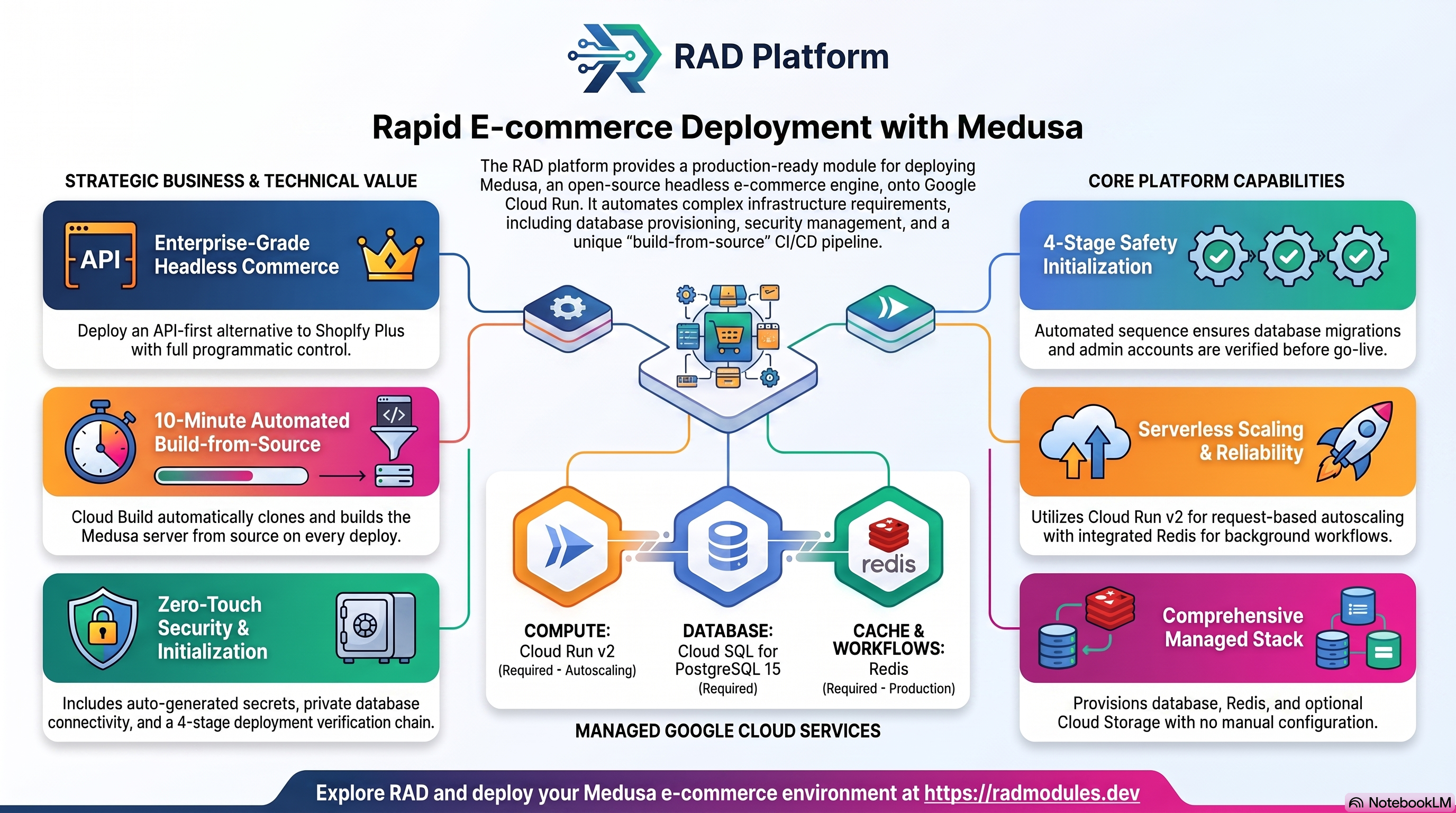
The single most important thing to know about this module: Medusa has no
official Docker image, so Medusa_CloudRun builds one from source on every
deploy. Every other application module in this catalogue wraps a prebuilt
upstream image; this one instead has Cloud Build clone the
medusajs/dtc-starter monorepo template (only apps/backend — the Medusa
server plus its built-in Admin UI, same process and port — is built; the
separate Next.js apps/storefront is explicitly out of scope) and run medusa build inside a multi-stage Dockerfile. Expect a real git clone + pnpm install + medusa build on every image build — budget roughly 10 minutes for
the build step alone, separate from Cloud SQL provisioning and init-job
execution time.
Medusa itself is an open-source, headless e-commerce platform — an API-first alternative to Shopify Plus/Saleor with full programmatic control over products, carts, orders, customers, and payments, plus a built-in Admin UI served by the same server process. This module deploys Medusa on Cloud Run v2 on top of the App_CloudRun foundation, which provisions and manages the shared Google Cloud infrastructure.
This guide focuses on the cloud services Medusa uses and how to explore and operate them from the Google Cloud Console and the command line. For the mechanics common to every Cloud Run application — service identity, ingress and load balancing, scaling and concurrency, CI/CD, Cloud Armor, IAP, Binary Authorization, VPC Service Controls, backups, and the deployment lifecycle — refer to the App_CloudRun foundation guide rather than repeating them here.
What Medusa costs on RAD, and how that compares
Running Medusa in your own GCP project costs about $90.17/month in Google Cloud charges; RAD's module fee is a one-time 175 credits (or 157.5 credits in a RAD-managed project), covering setup and support -- not the ongoing cloud bill, which Google bills you directly in your own project or RAD meters hourly in credits in a RAD-managed one. Or see the GKE guide for the alternative deployment target; either way, if you deploy into a RAD-managed project you can pause the whole thing for free when you are not using it -- see Pause it for free below.
What you pay on RAD
| Your own project | RAD-managed project | |
|---|---|---|
| Module fee | 175 credits, once | 157.5 credits, once (10% lower) |
| Build time | metered in credits as the build runs (a few credits, typically) | same |
| Google Cloud running cost | ~$90.17/month, billed to your own billing account at Google's list price | ~41 credits/day, metered hourly by RAD at list price plus margin |
Default running cost in your own project
| Resource | US$/month (Google list price, us-central1) |
|---|---|
| Cloud Run, 1x vCPU / 2 GiB (warm) | $19.72 |
| Cloud SQL for PostgreSQL, 1 vCPU / 3.75 GB, zonal, 10 GB SSD | $51.02 |
| NFS/cache file server (small VM) | $13.43 |
| Cloud NAT and networking | $5.00 |
| Cloud Storage (add-ons, backups) | $1.00 |
| Total | $90.17 |
How it compares
- Medusa's own official managed cloud (Medusa Cloud) starts at $29/month for its entry Develop plan, rising to $99/month (Launch, adds autoscaling and backups) and $299/month (Scale) (source: https://medusajs.com/pricing/), run by the project itself with no infrastructure to operate -- the comparison that matters here is less the sticker price and more whether you want the vendor's own cloud or your own GCP project with RAD managing it.
- Running it yourself on a bare VPS is still the cheapest cash option -- Hetzner CPX22 (2 vCPU/4GB) runs about $24/month, a DigitalOcean 2 vCPU/4GB Droplet is also $24/month, and a GCP Compute Engine e2-standard-2 (2 vCPU/8GB) is about $49/month -- plus the admin's own time for backups, security patches and upgrades, which RAD's managed Cloud SQL, Secret Manager and monitoring cover for you -- but RAD's price is never meant to beat a VPS, only to replace the admin time a VPS still needs.
- Either way, this is a production storefront backend, so the running cost above is what actually drives the bill, not the module fee -- and that running cost is the one you can pause (see below).
Pause it for free: delete a RAD-managed project, restore it when you need it
This is the headline for a RAD-managed project. Deleting a RAD-managed project first unlinks its billing, then asks Google to delete the project outright -- Google's own 30-day recoverable soft delete. Unlike deleting one module, this does not tear down Cloud SQL, any VM or the compute resource one by one: the whole project simply stops, and nothing is charged while it waits, because billing is already unlinked.
Restoring, within 30 days and only by the project's owner, asks Google to undelete the project and reattaches its billing account, then asks you to run Update on each deployment to confirm everything came back. Because nothing was individually destroyed, that Update finds the same resources already there -- it is a check, not a rebuild, and an Update never charges the module fee again. This costs only a handful of credits (under US$1) in total for a typical 2-3-deployment chain.
What this needs: you must own the project (not one RAD only manages billing for), you must restore it yourself within 30 days -- after that Google deletes it for good -- and restoring is admitted like creating a new project, so your purchased credit balance must still clear the tier's floor (100 credits for the sandbox tier most study/demo use fits). Google says most services are fully working again within 36 hours of a restore.
One real gap: nightly backups are written to a bucket inside the project, and that bucket has Cloud Storage's soft-delete explicitly turned off, so it is very likely gone as soon as you delete the project -- even though the project itself is recoverable for 30 days. If you have customised the app and want to keep that work, copy a backup out (to Google Drive, or a bucket outside the project) before deleting. For a default install with nothing irreplaceable in it, this does not matter.
Pay only while you use it, the other way: delete and redeploy
In your own project (or once you are past the 30-day restore window above), the alternative is to delete Medusa outright and redeploy it later. A redeploy costs the module fee again, plus the builds -- roughly 175 + 3-6 credits of build time.
Deleting saves money only once Medusa would otherwise sit unused long enough to clear that redeploy cost against its own daily running cost -- against the own-project total above, that works out to about 6 days or more. Most of the running cost here is usually the database and the shared file/cache VM; they stop only when nothing else in the project uses them, so deleting this app while something else shares the project saves only this app's own compute part.
Keep data first: nightly backups go to a bucket inside the deployment and are deleted with it, so copy the latest backup out before deleting if you want to keep it.
Lab sessions and Managed Environments
- Lab sessions, for training: a trainer runs a session for a class. Each participant gets the app in their own Google Cloud project for 15 minutes to 24 hours, within an allowance the trainer sets. Either the trainer funds every place, or each participant pays for their own. Everything is deleted when the session ends and unused credits go back to the trainer.
- Managed Environments, for consultancies: a partner runs the app for a client from a ring-fenced wallet it funds, and settles with the client directly. If the wallet runs low, billing pauses and the data is kept, so nobody receives an unexpected charge. At the end the partner hands the project over and the deployments become the client's own.
- Credits can be bought in more than 20 currencies, including XAF, XOF, NGN, GHS, KES and ZAR, by card, bank transfer or mobile money.
Sources (8 October 2026): Google Cloud Billing Catalog API list prices; radmodules.dev/pricing for RAD's own fees and daily-credit estimates; https://cloud.google.com/resource-manager/docs/delete-restore-projects for the pause/restore mechanics; https://medusajs.com/pricing/ for the named competitor's price.
2. Overview
| Capability | Google Cloud service | Notes |
|---|---|---|
| Compute | Cloud Run v2 | Node.js service (built from source), 1 vCPU / 2 GiB by default, serverless autoscaling; min_instance_count = 1 by default |
| Database | Cloud SQL for PostgreSQL 15 | Required — Medusa does not support MySQL or other engines |
| Cache & background workflows | Redis (required) | Session/cache/event-bus/workflow-engine/locking; no supported production fallback |
| Object storage (optional) | Cloud Storage | Off by default (enable_gcs_storage = false); when enabled, a bucket + dedicated service account + auto-generated HMAC key are provisioned |
| Secrets | Secret Manager | Auto-generated JWT_SECRET, COOKIE_SECRET, admin password; database password |
| Ingress | Cloud Run URL / Cloud Load Balancing | Default run.app URL; optional external HTTPS load balancer + custom domain |
| Build | Cloud Build | Clones medusajs/dtc-starter, runs medusa build — no prebuilt image exists to pull instead |
Sensible defaults worth knowing up front:
- PostgreSQL 15 is mandatory. The database engine is fixed by the shared application layer; selecting any other engine breaks startup.
- Redis is required, not optional, in production.
enable_redis = trueby default. Medusa logs"redisUrl not found. A fake redis instance will be used."and boots anyway if Redis is unreachable — that is a dev/test fallback, not a supported production mode. container_port = 9000— Medusa's documented default port, serving both the REST API and the Admin UI.container_image_source = "custom"cannot be changed to"prebuilt"meaningfully — there is no prebuilt Medusa image to deploy instead.- Build time is real and separate from deploy time. The Cloud Build step
is allotted up to 30 minutes (
timeout: 1800sin the referencecloudbuild.yaml) though a typical build — clone,pnpm install,medusa build— completes in roughly 10 minutes. This is on top of normal Cloud SQL provisioning (20–35 minutes on a first deploy) and the four init-job executions that follow. - A four-stage initialization chain runs before the service is considered
ready:
db-init→medusa-migrate→medusa-verify→medusa-admin-create, each depending on the previous. MEDUSA_WORKER_MODE = "shared"— a single Cloud Run instance handles both API requests and Medusa's background jobs/subscribers/workflows, since Medusa's officially-recommended split server/worker topology doesn't map onto a single Cloud Run service.enable_gcs_storage = falseby default. Medusa falls back to local, ephemeral container filesystem storage for uploaded files until you opt in.application_versiondoes not pin what gets built. The Dockerfile has noARGconsuming it — onlyMEDUSA_STARTER_REF(hardcoded tomaininMedusa_Common) controls whichdtc-starterbranch is cloned.
3. Google Cloud Services & How to Explore Them
All commands assume PROJECT and REGION are set. Service and resource names
are reported in the deployment Outputs.
A. Cloud Run — the Medusa service
Medusa runs as a Cloud Run v2 service that autoscales by request load between the minimum and maximum instance counts. Each deployment creates an immutable revision.
gcloud run services list --project "$PROJECT" --region "$REGION"
gcloud run services describe <service-name> --project "$PROJECT" --region "$REGION"
gcloud run revisions list --service <service-name> --project "$PROJECT" --region "$REGION"
See App_CloudRun for scaling, concurrency, execution environment, and traffic splitting.
B. Cloud Build — the from-source image build
Every deploy (and every rebuild triggered by an edit to the Application
module's build config) runs a real build: git clone --depth 1 --branch main https://github.com/medusajs/dtc-starter.git, pnpm install, pnpm build
inside apps/backend, then a second pnpm install --prod outside the pnpm
workspace before the runtime image is assembled.
gcloud builds list --project "$PROJECT" --limit 5
gcloud builds log <build-id> --project "$PROJECT"
C. Cloud SQL for PostgreSQL 15
Medusa stores all application data (products, orders, customers, carts,
inventory) in a managed Cloud SQL for PostgreSQL 15 instance. The service
connects privately through the Cloud SQL Auth Proxy over a Unix socket by
default (enable_cloudsql_volume = true); no public IP is exposed.
gcloud sql instances list --project "$PROJECT"
gcloud sql instances describe <instance-name> --project "$PROJECT"
gcloud sql connect <instance-name> --user=<db-user> --database=<db-name> --project "$PROJECT"
The instance name, database, user, and password secret are in the Outputs. See App_CloudRun for the connection model, backups, and password rotation.
D. Redis
Redis is enabled by default. When redis_host is left empty, the platform
NFS VM's IP is used as the Redis host fallback (requires enable_nfs = true
or a discovered Services_GCP-managed NFS server); otherwise set redis_host
explicitly.
redis-cli -h <redis-host> ping
# Confirm the resolved REDIS_URL in the running revision's logs (constructed
# by entrypoint.sh at boot):
gcloud run services logs read <service-name> --project "$PROJECT" --region "$REGION" --limit 50 | grep -i redis
E. Cloud Storage (optional)
Only provisioned when enable_gcs_storage = true. Unlike many apps in this
catalogue, no manual HMAC key setup is required — Medusa_Common generates a
dedicated service account and access-key/secret-key pair automatically.
gcloud storage buckets list --project "$PROJECT"
gcloud storage ls gs://gcs-<service-name>-storage/
F. Secret Manager
JWT_SECRET, COOKIE_SECRET, and the bootstrapped admin password are
generated automatically. The database password is managed separately by the
foundation.
gcloud secrets list --project "$PROJECT" --filter="name~medusa"
gcloud secrets versions access latest --secret=<secret-name> --project "$PROJECT"
G. Cloud Logging & Monitoring
gcloud run services logs read <service-name> --project "$PROJECT" --region "$REGION" --limit 50
See App_CloudRun for uptime checks and alert policies.
4. Medusa Application Behaviour
The four-stage initialization chain
db-init(postgres:15-alpine) — waits for the database, creates the application role and database, grants privileges onpublic, and best-effort installs theuuid-ossp/postgisextensions.medusa-migrate— runsnpx medusa db:migrateon the built image (2 vCPU / 2Gi, up to 30 minutes, 3 retries).medusa-verify— a guard job that connects aftermedusa-migrateand fails the apply if thepublicschema has zero tables. This exists because this Foundation does not fail the module apply when an init job fails on its own — withoutmedusa-verify, a raced or failed migration could silently ship a healthy-looking Cloud Run service pointed at an empty database, and every request would then fail against missing tables with no obvious signal at deploy time. Live-verified: logged"public schema has 146 table(s)"on a successful deploy.medusa-admin-create— runsnpx medusa user -e <email> -p <password>to create the first admin login, usingadmin_email(defaultadmin@techequity.cloud) and the auto-generated admin-password secret. Live-verified: logged"User created successfully.".
gcloud run jobs list --project "$PROJECT" --region "$REGION"
gcloud run jobs executions list --job <job-name> --project "$PROJECT" --region "$REGION"
Health endpoint
/health is unauthenticated and used by both the startup probe (120-second
initial delay, 40 × 15-second retries — roughly 12 minutes total) and the
liveness probe (30-second initial delay, 3 retries). Live-verified: curl /health returns OK with HTTP 200.
curl -s -o /dev/null -w "%{http_code}\n" "$SERVICE_URL/health"
MEDUSA_WORKER_MODE = "shared"
A single Cloud Run instance runs both the API server and Medusa's background jobs/subscribers/workflows — Medusa's officially-recommended split server/worker topology doesn't map onto a single Cloud Run service, so this module always runs shared mode. Practically: every running instance is doing both request handling and whatever background work Medusa's workflow engine schedules.
Retrieving the first-run admin credentials
ADMIN_SECRET=$(gcloud secrets list --project "$PROJECT" --filter="name~medusa-admin-password" --format="value(name)")
gcloud secrets versions access latest --secret="$ADMIN_SECRET" --project "$PROJECT"
The admin email is whatever admin_email was set to at deploy time (default
admin@techequity.cloud).
Accessing the built-in Admin UI
Medusa serves its Admin UI from the same process and port as the API — open
$SERVICE_URL/app in a browser and sign in with the email/password retrieved
above.
5. Configuration Variables
Variables are grouped exactly as they appear on the deployment platform. Only settings specific to or notable for Medusa are listed; every other input is inherited from App_CloudRun with its standard behaviour.
Group 3 — Application Identity
| Variable | Default | Description |
|---|---|---|
application_name | medusa | Base name for resources. Do not change after first deploy. |
admin_email | admin@techequity.cloud | Email for the first admin user created by medusa-admin-create. |
application_version | latest | Deployment-tracking tag only. Does not select what's built — the Dockerfile has no ARG consuming it; only MEDUSA_STARTER_REF (fixed to main) determines the cloned code. |
Group 4 — Runtime & Scaling
| Variable | Default | Description |
|---|---|---|
cpu_limit / memory_limit | 1000m / 2Gi | Per-instance resource limits. |
min_instance_count / max_instance_count | 1 / 3 | Instance bounds. |
container_port | 9000 | Medusa's documented default port. |
cpu_always_allocated | false | Request-based billing. Consider true if you rely on Medusa's own scheduled/event-driven workflows — shared worker mode processes them in the same instance, and request-based billing throttles CPU between inbound requests. |
container_image_source | custom | Always builds from source — there is no "prebuilt" Medusa image. |
enable_cloudsql_volume | true | Cloud SQL Auth Proxy Unix socket. |
Group 12 — Database
| Variable | Default | Description |
|---|---|---|
database_type | POSTGRES_15 | Fixed by Medusa_Common; MySQL is not supported. |
db_name / db_user | medusa / medusa | Database name / application user. |
Group 11 — Storage & Filesystem
| Variable | Default | Description |
|---|---|---|
enable_gcs_storage | false | Provisions a GCS bucket + auto-generated HMAC key for Medusa's S3-compatible file provider. When false, uploads use local, ephemeral container storage. |
Group 21 — Redis
| Variable | Default | Description |
|---|---|---|
enable_redis | true | Required in production. |
redis_host | "" | Empty uses the platform NFS VM IP as a fallback (requires enable_nfs = true); otherwise set explicitly. |
redis_port / redis_auth | "6379" / "" | Redis port / auth password (sensitive). |
Group 14 — Observability & Health
| Variable | Default | Description |
|---|---|---|
startup_probe | HTTP /health, 120s delay, 40-failure threshold | ~12-minute total window. |
liveness_probe | HTTP /health, 30s delay, 3-failure threshold |
For every other group (CI/CD, backup, IAM, VPC-SC, load balancer/CDN, etc.), see App_CloudRun — Medusa inherits the Foundation's standard behaviour with no application-specific override.
6. Outputs
| Output | Description |
|---|---|
service_name | Cloud Run service name. |
service_url | Default run.app URL of the service. |
service_location | Region the service runs in. |
database_instance_name / database_name / database_user | Cloud SQL identifiers. |
database_password_secret | Secret Manager secret holding the DB password. |
database_host / database_port | DB endpoint (sensitive) / port. |
storage_buckets | Created Cloud Storage buckets — empty unless enable_gcs_storage = true. |
container_image / container_registry | The Cloud-Build-produced Medusa image and its Artifact Registry repo. |
monitoring_enabled / monitoring_notification_channels / uptime_check_names | Monitoring status, channels, uptime checks. |
initialization_jobs | Names of the four created init jobs. |
deployment_id / tenant_id / resource_prefix | Naming identifiers. |
project_id / project_number | Project identifiers. |
cicd_enabled / cicd_configuration / artifact_registry_repository | CI/CD status and details. |
vpc_sc_enabled / audit_logging_enabled / artifact_registry_cmek_enabled | Security posture flags. |
7. Configuration Pitfalls & Sensible Defaults
Risk: Critical (data loss / outage / security) — High (service degraded) — Medium (cost or partial degradation) — Low (minor).
Inherited plan-time validation. This module passes its configuration through the App_CloudRun foundation engine, which validates values and combinations at plan time. Invalid configuration fails the plan with a clear, named error before any resource is created.
| Setting | Sensible value | Risk | Consequence if wrong |
|---|---|---|---|
From-source build (container_image_source = "custom") | No action needed — it's the only valid mode | High | Any change to the Dockerfile, entrypoint.sh, or build args in Medusa_Common requires a real Cloud Build rebuild (~10 minutes for the build step alone) before it takes effect — there is no way to "just restart" onto new source, unlike custom-build apps whose base image already exists. Force a rebuild with tofu taint 'module.medusa_app.module.app_build.null_resource.build_and_push_application_image[0]' if the content-hash trigger misses an edit. |
enable_redis | true | Critical | Medusa logs "redisUrl not found. A fake redis instance will be used." and boots anyway — this graceful-looking log message is a dev/test fallback, not a supported production mode. Cache/session/event-bus/workflow-engine/locking all depend on Redis; disabling it in a long-running production deployment is unsupported. |
medusa-verify init job | Leave in the default chain | Critical | This job exists specifically because an init-job failure does not fail the module apply in this Foundation. Removing it (by overriding initialization_jobs) reopens the exact silent-empty-database risk it was added to close — a raced or failed medusa-migrate would otherwise ship a "successfully deployed" service against an empty public schema, and every request would fail with no obvious signal at deploy time. |
| pnpm workspace-isolation (lesson for extending this Dockerfile pattern) | N/A — informational | High | If you clone this from-source pattern for another pnpm/npm-workspace-based application, remember that build output produced inside a cloned monorepo is still nested under that monorepo's pnpm-workspace.yaml. Running pnpm install --prod directly on that output silently reinstalls it as part of the outer workspace and can write zero node_modules — confirmed here as sh: medusa: not found at runtime. Always copy standalone build output to a directory with no ancestor pnpm-workspace.yaml before installing its production dependencies. |
admin_email / bootstrapped admin password | Retrieve from Secret Manager after deploy | High | There is no pre-seeded admin credential visible anywhere except Secret Manager (admin_password_secret_id output) — losing track of it means recovering access via npx medusa user manually against the running database. |
MEDUSA_WORKER_MODE = "shared" + cpu_always_allocated = false (default) | Set cpu_always_allocated = true if you rely on scheduled/event-driven workflows | Medium | Shared worker mode processes background workflows/subscribers in the same instance that serves HTTP requests. Request-based billing (the default) throttles CPU to near-zero between inbound requests, which can stall in-process background work — the same class of issue documented fleet-wide for n8n/OpenClaw-style apps in this catalogue. |
application_version | Understand it's metadata-only | Low | Changing it does not pin or change what code is built; only MEDUSA_STARTER_REF (fixed to main) controls the cloned dtc-starter branch. A fully reproducible pinned build requires overriding container_build_config.build_args. |
enable_gcs_storage = false (default) | Enable it for any persistent-upload use case | Medium | Local storage is ephemeral container filesystem — uploaded product images/files do not survive a restart, redeploy, or scale-to-zero cold start. |
For the foundation behaviour referenced throughout — service identity, scaling and concurrency, ingress and load balancing, CI/CD, Cloud Armor, IAP, Binary Authorization, VPC-SC, backups, and image mirroring — see App_CloudRun. Medusa-specific application configuration shared with the GKE variant is described in Medusa_Common.
Related guides
- Hands-on lab: Medusa on Cloud Run — deploy it step by step, with the console screens and commands at each stage.
- Medusa on GKE Autopilot — the same application on Kubernetes, for when you need the other deployment target.
- Medusa Common — Shared Application Configuration — the configuration shared by both deployment targets.
- Deployed alongside Payload CMS on Google Cloud Run, Matomo on Google Cloud Run, Listmonk on Google Cloud Run in the E-commerce Storefront solution.
Need RAD to do something it does not do yet? Request it on the roadmap, or vote on what is already there.