VictoriaMetrics on GKE Autopilot
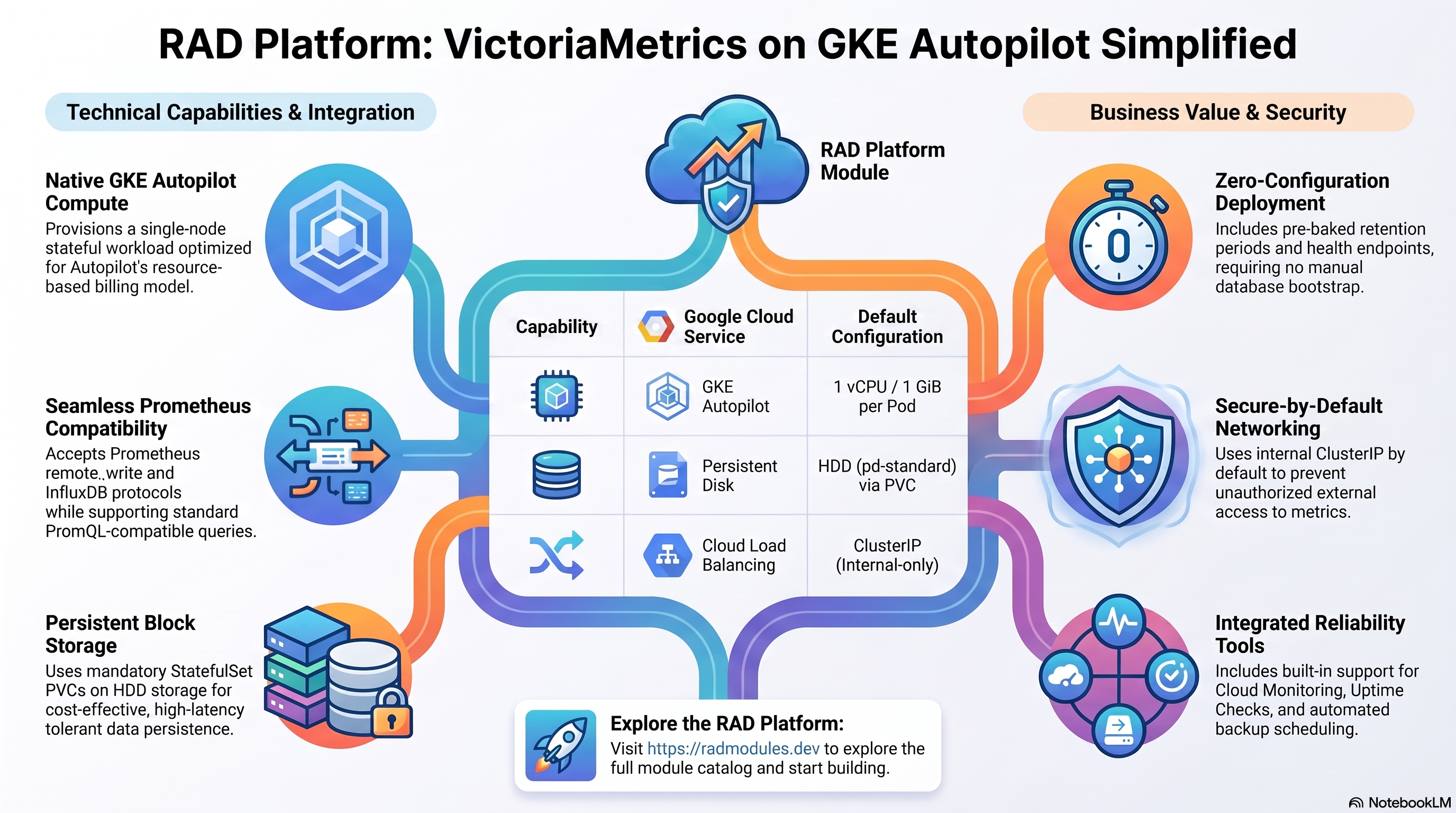
VictoriaMetrics is a fast, cost-efficient, Prometheus-compatible time-series
database — the standard self-hosted metrics-storage backend for pairing with
this catalog's Grafana module. It accepts Prometheus remote_write, InfluxDB
line protocol, Graphite, and OpenTSDB ingestion over plain HTTP, and answers
PromQL-compatible queries. This module deploys VictoriaMetrics on GKE
Autopilot on top of the App_GKE foundation, which provisions
and manages the shared Google Cloud and Kubernetes infrastructure.
There is no Cloud Run variant of this module — see §1 below for why.
This guide focuses on the cloud services VictoriaMetrics uses and how to explore and operate them from the Google Cloud Console and the command line. For the mechanics that are common to every GKE application — Workload Identity, ingress, autoscaling, CI/CD, Cloud Armor, IAP, Binary Authorization, VPC Service Controls, backups, and the deployment lifecycle — refer to the App_GKE foundation guide rather than repeating them here.
What VictoriaMetrics costs on RAD, and how that compares
Running VictoriaMetrics on GKE Autopilot in your own Google Cloud project costs about US$42.08/month in Google Cloud charges (about US$115.08 if this isn't your only Autopilot cluster), on top of a one-off 75-credit RAD module fee (US$7.50) charged once at deploy time. There is no Cloud Run variant of this module. In a RAD-managed project the module fee drops to 67.5 credits (10% lower) and the running cost is metered hourly in credits — see Pause it for free below.
What you pay on RAD
| Own project | RAD-managed project | |
|---|---|---|
| Module fee (one-off) | 75 credits | 67.5 credits (10% lower) |
| Build time | ~3-6 credits per build, either way | ~3-6 credits per build, either way |
| Google Cloud running cost | US$42.08/month, billed by Google at list price | ~52 credits/day (about 1560/month, US$156 at the top-up price), metered at list price plus RAD's margin |
10 credits cost US$1 on a one-off top-up, and less on a monthly plan.
Default running cost in your own project
| Resource (module default) | Per month |
|---|---|
| GKE Autopilot pod, 1x vCPU / 1 GiB | US$36.08 |
| Cloud NAT and networking | US$5 |
| Cloud Storage (add-ons, backups) | US$1 |
| Total | US$42.08 |
The GKE cluster management fee is excluded from the total above because it is shared across every GKE app in the project — $0 if this is the only one, otherwise roughly $73/month split across however many you run.
How it compares
- The project's own creators sell VictoriaMetrics Cloud, starting from $200/month for a managed instance (500k active time series) — verified on VictoriaMetrics' pricing page, 8 October 2026. RAD's own-project running cost here (~US$42/month) is roughly a fifth of that starting price, though VictoriaMetrics Cloud includes elastic storage and ingestion limits this fixed-size pod does not try to match.
- A self-managed VPS comparison, sized to VictoriaMetrics' 1 vCPU / 1 GiB default: a Hetzner CPX11 or DigitalOcean 1 vCPU/2GB Droplet runs about $6-12/month, cheaper in cash terms than either RAD option here — plus your own time for backups and patching, and no Kubernetes control plane to run.
- VictoriaMetrics is almost always paired with Grafana as the metrics backend; this module's running cost is deliberately minimal (no NFS, no managed database — VictoriaMetrics manages its own on-disk storage) so the pair's total cost is dominated by whichever of the two needs more compute.
Pause it for free: delete a RAD-managed project, restore it when you need it
This is the headline advantage of a RAD-managed project, and it costs nothing while paused. Deleting a RAD-managed project unlinks its billing first, then asks Google to delete the project outright — Google's own 30-day recoverable soft delete. Unlike deleting one module, this does not tear down Cloud SQL, any VM, or the compute resource one by one: the whole project simply stops, and nothing is charged while it waits, because billing is already unlinked.
Restoring, within 30 days and only by the project's owner, asks Google to undelete the project and reattaches its billing account, then asks you to run Update on each deployment to confirm everything came back. Because nothing was individually destroyed, that Update finds the same resources already there — it is a check, not a rebuild, and an Update never charges the module fee again. This costs only a handful of credits (under US$1) in total for a typical 2-3-deployment chain.
What this needs: you must own the project (not one RAD only manages billing for), you must restore it yourself within 30 days — after that Google deletes it for good — and restoring is admitted like creating a new project, so your purchased credit balance must still clear the tier's floor (100 credits for the sandbox tier most study/demo use fits). Google says most services are fully working again within 36 hours of a restore.
One real gap: nightly backups are written to a bucket inside the project, and that bucket has Cloud Storage's soft-delete explicitly turned off, so it is very likely gone as soon as you delete the project — even though the project itself is recoverable for 30 days. If you've customised VictoriaMetrics and want to keep that work, copy a backup out (to Google Drive, or a bucket outside the project) before deleting. For a default install with nothing irreplaceable in it, this does not matter.
Pay only while you use it, the other way: delete and redeploy
In your own project, or once 30 days have passed on a RAD-managed one, there is no free pause — deleting removes the resources for good, and bringing VictoriaMetrics back means redeploying from scratch. That costs about 78-81 credits in your own project, or about 70.5-73.5 credits in a RAD-managed one.
Deleting only saves money once VictoriaMetrics would otherwise sit unused long enough to clear that redeploy cost against its own running cost — about 6 days or more in your own project (about US$1.40 a day), or about 1 days or more in a RAD-managed one (52 credits a day).
Keep data first: nightly backups go to a bucket inside the deployment and are deleted with it, so copy the latest backup out before deleting if you want to keep it.
Lab sessions and Managed Environments
Lab sessions, for training: a trainer runs a session for a class. Each participant gets the app in their own Google Cloud project for 15 minutes to 24 hours, within an allowance the trainer sets. Either the trainer funds every place, or each participant pays for their own. Everything is deleted when the session ends and unused credits go back to the trainer.
Managed Environments, for consultancies: a partner runs the app for a client from a ring-fenced wallet it funds, and settles with the client directly. If the wallet runs low, billing pauses and the data is kept, so nobody receives an unexpected charge. At the end the partner hands the project over and the deployments become the client's own.
Credits can be bought in more than 20 currencies, including XAF, XOF, NGN, GHS, KES and ZAR, by card, bank transfer or mobile money.
Sources (8 October 2026): Google Cloud Billing Catalog API list prices; radmodules.dev/pricing for RAD's own fees and daily-credit estimates; Google's project delete/restore documentation for the pause/restore claims; VictoriaMetrics Cloud pricing.
1. Overview
VictoriaMetrics runs as a single-node, stateful time-series-database workload on Autopilot. The deployment wires together a focused set of Google Cloud services:
| Capability | Google Cloud service | Notes |
|---|---|---|
| Compute | GKE Autopilot | Single VictoriaMetrics pod, 1 vCPU / 1 GiB by default |
| Persistent storage | Persistent Disk via StatefulSet PVC | Required — mounted at /victoria-metrics-data; standard (HDD pd-standard) storage class by default |
| Secrets | none | VictoriaMetrics has no built-in authentication — no Secret Manager secrets are created |
| Ingress | Cloud Load Balancing | ClusterIP by default (internal-only, by design — see below); LoadBalancer or custom domain when external scraping/querying is genuinely needed |
Why GKE-only: VictoriaMetrics stores its time-series data as mmap'd local
files on disk (confirmed via the official FAQ: "VictoriaMetrics stores data
in block storage..."). This is incompatible with Cloud Run's ephemeral,
per-revision filesystem and with GCS FUSE's file-locking/mmap semantics — the
same class of constraint already documented for ClickHouse, Elasticsearch,
and MongoDB in this catalog. VictoriaMetrics_GKE therefore requires a real
block PersistentVolumeClaim (stateful_pvc_enabled = true by default) and has
no Cloud Run sibling.
Sensible defaults worth knowing up front:
- No SQL database, no Redis. VictoriaMetrics manages its own embedded
TSDB. No Cloud SQL instance is created;
enable_redisis hard-coded tofalse. - Single-instance by default, and this is not a "scale it up later"
knob.
max_instance_count = 1— single-node VictoriaMetrics has no built-in clustering or replication. Two pods writing the same PVC would corrupt data. - StatefulSet PVC is required, not optional. Unlike some stateful apps in
this catalog where a GCS FUSE fallback exists, VictoriaMetrics has no
fallback — its mmap'd data files are not FUSE-compatible even as a
degraded mode.
stateful_pvc_enabled = trueis the default and should stay that way. ClusterIPby default — this is correct, not a bug. VictoriaMetrics is meant to be scraped and queried internally by Prometheus-compatible clients (aremote_writesender,vmagent, or Grafana) running in the same cluster, not exposed as a public web application. This is the same confirmed-correct pattern already documented for Qdrant and PhpMyAdmin in this catalog — do not "fix" it toLoadBalancerunder the assumption it's the fleet-wide ClusterIP-copy-paste bug found elsewhere; it genuinely isn't here.- HDD storage class by default.
stateful_pvc_storage_class = "standard"(pd-standard), not the SSD-backedstandard-rwomany other stateful modules default to — VictoriaMetrics is documented as tolerant of high-latency, low-IOPS storage, so this avoids drawing from the tightSSD_TOTAL_GBquota. - CLI-flag configuration, not environment variables. VictoriaMetrics has
no environment-variable-based configuration. The custom image's
ENTRYPOINTpins-storageDataPath,-httpListenAddr, and-retentionPerioddirectly — see §4. - A single
/healthendpoint serves both the startup and liveness probe — there is no separate readiness/liveness distinction.
2. Google Cloud Services & How to Explore Them
All commands assume you have run
gcloud container clusters get-credentials <cluster> --region <region> --project <project>
and that PROJECT, REGION, and NAMESPACE are set. The namespace and other
identifiers are reported in the deployment Outputs.
A. GKE Autopilot — the VictoriaMetrics workload
The VictoriaMetrics pod runs on Autopilot, which bills for the CPU/memory the
pod actually requests. max_instance_count = 1 keeps a single pod running —
horizontal scaling is intentionally not supported for this single-node
deployment.
- Console: Kubernetes Engine → Workloads → select the VictoriaMetrics
workload for pods, events, and resource usage. Kubernetes Engine → Services
& Ingress shows the ClusterIP (or external IP if
LoadBalanceris used). - CLI:
kubectl get pods,svc -n "$NAMESPACE"
kubectl logs -n "$NAMESPACE" statefulset/<service-name> --tail=100
kubectl describe pod -n "$NAMESPACE" -l app=<service-name>
See App_GKE for how Autopilot and the workload type (StatefulSet) are managed.
B. Persistent Storage — StatefulSet PVC (the only supported backend)
VictoriaMetrics persists its time-series data files at
/victoria-metrics-data. Unlike several other stateful apps in this catalog,
there is no GCS FUSE fallback — a real block PersistentVolumeClaim is
required. The storage class is standard (HDD pd-standard) by default.
- Console: Kubernetes Engine → Storage → PersistentVolumeClaims. Compute Engine → Disks to see the underlying Persistent Disk.
- CLI:
# PVC status
kubectl get pvc -n "$NAMESPACE"
kubectl describe pvc -n "$NAMESPACE"

# Confirm the mount and inspect on-disk data files inside the pod
kubectl exec -n "$NAMESPACE" <pod-name> -- ls -la /victoria-metrics-data
See App_GKE for StatefulSet PVC mechanics and storage-class options in general.
C. No Secret Manager secrets
VictoriaMetrics has no built-in authentication, so VictoriaMetrics_Common
generates and stores no secrets. Access is gated entirely at the network
layer — the ClusterIP default, or IAP / Cloud Armor if the service is
deliberately made externally reachable. There is nothing to retrieve from
Secret Manager for this module.
D. Networking & ingress
By default the workload is exposed only inside the cluster via a ClusterIP
service — the intended access pattern is Grafana, vmagent, or a Prometheus
remote_write sender running in the same cluster. Change service_type to
LoadBalancer only if you have a genuine need to scrape or query from outside
the cluster (and add your own access controls first — VictoriaMetrics itself
enforces none).
- Console: Kubernetes Engine → Services & Ingress; VPC network → IP addresses (when a static IP is reserved).
- CLI:
kubectl get svc -n "$NAMESPACE"
gcloud compute addresses list --project "$PROJECT"
See App_GKE for custom domains, Cloud CDN, and static IP details.
E. Cloud Logging & Monitoring
Pod stdout/stderr flow to Cloud Logging; GKE metrics flow to Cloud
Monitoring. Optional uptime checks (against /health) and alert policies are
available, but only meaningful once the service is reachable from wherever
the check originates.
- Console: Logging → Logs Explorer; Monitoring → Dashboards / Alerting.
- CLI:
gcloud logging read 'resource.type="k8s_container" AND resource.labels.namespace_name="'"$NAMESPACE"'"' \
  --project "$PROJECT" --limit 50
3. VictoriaMetrics Application Behaviour
- No database bootstrap, no init jobs. VictoriaMetrics manages its own embedded TSDB. It is a self-contained binary with no schema or migration concept — no initialization job is injected by default, and none is needed. The workload starts serving as soon as its data directory is mounted.
- Health endpoint. A single unauthenticated
/healthendpoint (returnsOK) serves both the startup and liveness probes — there is no separate readiness-vs-liveness split, unlike apps with a heavier startup sequence. - How metrics get IN. VictoriaMetrics accepts several ingestion
protocols over plain HTTP on port
8428:- Prometheus
remote_write→POST /api/v1/write - InfluxDB line protocol →
/write - Graphite plaintext / pickle protocol
- OpenTSDB
/api/putand telnet put - Its own scrape-config-driven agent,
vmagent, can also be deployed as a sidecar (viaadditional_services) to pull metrics from Prometheus/metricsendpoints, mirroring what a standalone Prometheus server would do.
- Prometheus
- How to QUERY it. VictoriaMetrics exposes a PromQL-compatible query API
(
/api/v1/query,/api/v1/query_range,/api/v1/series, ...) — the same surface as Prometheus's own HTTP API. Point Grafana at it using the Prometheus datasource type with the URL set to the VictoriaMetrics service's internal DNS name (or external URL, if exposed), no plugin required. - Retention is baked into the image, not runtime-configurable.
-retentionPeriod=12(12 months) is compiled into the custom image'sENTRYPOINT(see §4). It is not exposed as a Terraform variable — changing it requires editingVictoriaMetrics_Common/scripts/Dockerfileand forcing a rebuild. - No clustering. This module deploys VictoriaMetrics single-node
mode. VictoriaMetrics also has a "cluster" edition (
vminsert/vmstorage/vmselect) for horizontal scale, but that is a different deployment topology entirely and is not what this module provisions.
4. Configuration Variables
Variables are grouped exactly as they appear on the deployment platform. Only settings specific to or notable for VictoriaMetrics are listed; every other input is inherited from App_GKE with its standard behaviour and defaults.
Group 1 — Project & Identity
| Variable | Default | Description |
|---|---|---|
project_id | (required) | Target Google Cloud project. |
region | us-central1 | Region for the workload and regional resources. |
Group 2 — Deployment Environment
| Variable | Default | Description |
|---|---|---|
tenant_id | demo | Short suffix that makes resource names unique per environment. |
support_users | [] | Emails granted project access and monitoring alerts. |
resource_labels | {} | Labels applied to all resources for cost/ownership tracking. |
Group 3 — Application Identity
| Variable | Default | Description |
|---|---|---|
application_name | victoriametrics | Base name for resources. Do not change after first deploy. |
application_display_name | VictoriaMetrics | Friendly name shown in the Console. |
application_version | latest | VictoriaMetrics image tag. latest maps to a pinned known-good release (v1.148.0) as the Dockerfile build arg, since the upstream image has no floating latest tag of its own. |
Group 4 — Runtime & Scaling
| Variable | Default | Description |
|---|---|---|
deploy_application | true | Set false to provision infrastructure only. |
cpu_limit | 1000m | CPU per pod. |
memory_limit | 1Gi | Memory per pod. ~1 GB RAM per 1M active time series is the upstream scaling guideline; keep VictoriaMetrics's own usage under ~50% of available memory for OS page-cache headroom. |
min_instance_count | 1 | Minimum replicas. Keep at 1 — a StatefulSet with replicas=0 has nothing to serve queries. |
max_instance_count | 1 | Maximum replicas. Must stay 1 — no clustering/replication in single-node mode. |
enable_vertical_pod_autoscaling | false | Let Autopilot tune resource requests automatically (disables CPU/Memory HPA). |
enable_image_mirroring | true | Mirror the VictoriaMetrics image into Artifact Registry to avoid Docker Hub rate limits. |
timeout_seconds | 300 | Request timeout in seconds (0–3600). |
termination_grace_period_seconds | 60 | Seconds Kubernetes waits after SIGTERM for VictoriaMetrics to flush in-flight writes to disk. |
Group 5 — Environment Variables & Secrets
| Variable | Default | Description |
|---|---|---|
environment_variables | {} | Extra env vars. VictoriaMetrics does not read environment variables for configuration — only CLI flags baked into the image (§4 above); values here have no effect on the running binary unless it happens to read that exact variable, which it does not by default. |
secret_environment_variables | {} | Map of env var → Secret Manager secret name. Not populated by default — VictoriaMetrics has no built-in auth. |
secret_propagation_delay | 30 | Seconds to wait after secret creation before proceeding. |
secret_rotation_period | 2592000s | Secret Manager rotation reminder period (30 days default). Not applicable unless you add your own secrets. |
Group 6 — GKE Backend & Cluster
| Variable | Default | Description |
|---|---|---|
gke_cluster_name | "" | Target cluster name. Auto-discovered when empty. |
gke_cluster_selection_mode | primary | Cluster selection strategy: explicit, round-robin, or primary. |
namespace_name | "" | Kubernetes namespace. Auto-generated when empty. |
workload_type | null | Auto-resolves to StatefulSet when stateful_pvc_enabled = true (the default). |
service_type | ClusterIP | How the Service is exposed. ClusterIP is correct and intentional here — see §1. |
session_affinity | None | None or ClientIP. |
enable_network_segmentation | false | Create Kubernetes NetworkPolicy resources for micro-segmentation. |
configure_service_mesh | false | Enable Istio injection for the application namespace. |
Group 7 — StatefulSet Configuration
| Variable | Default | Description |
|---|---|---|
stateful_pvc_enabled | true | Required — VictoriaMetrics's mmap'd local-disk data files are not GCS FUSE compatible even as a fallback. Must stay true. |
stateful_pvc_size | 20Gi | Per-pod PVC size. Size to hold the full retention window (12 months by default) plus merge overhead — ~20% free space recommended. |
stateful_pvc_mount_path | /victoria-metrics-data | Container path for the PVC. Must match the -storageDataPath flag baked into the image. |
stateful_pvc_storage_class | standard | HDD pd-standard by default — VictoriaMetrics is documented as IOPS-tolerant, avoiding the tight SSD_TOTAL_GB quota. |
stateful_headless_service | null | Create a headless Service for stable network identities. |
stateful_pod_management_policy | null | OrderedReady ensures safe sequential restarts. |
stateful_update_strategy | null | RollingUpdate for zero-downtime updates. |
stateful_fs_group | 3000 | fsGroup GID set in the pod security context. VictoriaMetrics runs as UID 1000/GID 2000; 3000 ensures the PVC is group-writable. |
Group 8 — Resource Quota
| Variable | Default | Description |
|---|---|---|
enable_resource_quota | false | Cap namespace CPU/memory/object counts. |
quota_memory_requests / quota_memory_limits | "" | Must use binary units (4Gi, 8192Mi) — bare integers are read as bytes and block scheduling. |
Group 9 — Reliability Policies
| Variable | Default | Description |
|---|---|---|
enable_pod_disruption_budget | true | Protect availability during node upgrades. With max_instance_count = 1, one pod cannot be evicted while satisfying pdb_min_available = 1 — factor this into node-upgrade planning. |
pdb_min_available | 1 | Minimum pods available during voluntary disruptions. |
enable_topology_spread | false | Not meaningful with a single replica. |
Group 10 — Observability & Health
| Variable | Default | Description |
|---|---|---|
startup_probe | /health, 15s delay | HTTP probe. |
liveness_probe | /health, 30s delay | HTTP probe. Same endpoint as startup — VictoriaMetrics has no separate readiness/liveness distinction. |
uptime_check_config | disabled | Optional Cloud Monitoring uptime check against /health. Only useful if the service is reachable from where the check originates. |
alert_policies | [] | Optional metric alert policies. |
Group 11 — Jobs & Scheduled Tasks
| Variable | Default | Description |
|---|---|---|
initialization_jobs | [] | VictoriaMetrics requires no default init job — it is self-contained with no schema/migration concept. |
cron_jobs | [] | Kubernetes CronJobs for periodic maintenance, e.g. a scripted vmbackup snapshot export. |
additional_services | [] | Sidecar or helper services deployed alongside VictoriaMetrics — e.g. a vmagent scrape-forwarder sidecar. |
Group 12 — CI/CD & GitHub Integration
Standard App_GKE Cloud Build / Cloud Deploy integration — see
App_GKE. Key inputs: enable_cicd_trigger,
github_repository_url, github_token, enable_cloud_deploy,
enable_binary_authorization.
Group 13 — NFS
| Variable | Default | Description |
|---|---|---|
enable_nfs | false | VictoriaMetrics uses a block PVC for storage — enable NFS only for custom jobs that need a shared filesystem. |
nfs_mount_path | /mnt/nfs | Mount path inside the container. |
network_tags | ["nfsserver"] | GKE node/pod network tags; nfsserver is required when NFS is enabled. |
Group 14 — Cloud Storage & Artifact Registry
| Variable | Default | Description |
|---|---|---|
create_cloud_storage | true | Provision GCS buckets defined in storage_buckets. VictoriaMetrics itself declares no default bucket — its GCS/S3 integration is backup-only, never live query-serving storage. |
storage_buckets / gcs_volumes | [] | Additional buckets / GCS FUSE mounts, unrelated to primary storage. |
manage_storage_kms_iam / enable_artifact_registry_cmek | false | CMEK options. |
max_images_to_retain | 7 | Maximum recent container images to keep in Artifact Registry (for the custom-built image). |
Group 17 — Backup & Maintenance
| Variable | Default | Description |
|---|---|---|
backup_schedule | 0 2 * * * | Automated backup cron (UTC). No default backup mechanism is wired for VictoriaMetrics beyond the Foundation's generic scheduling hook — use cron_jobs with vmbackup for application-aware snapshot backups. |
backup_retention_days | 7 | Retention. |
enable_backup_import / backup_source / backup_uri / backup_format | restore options | Restore from a backup on deploy. |
Group 19 — Custom Domain, Static IP & Networking
| Variable | Default | Description |
|---|---|---|
enable_custom_domain | true | Provision Kubernetes Gateway API with SSL certificates. Only meaningful when the service is deliberately made externally reachable — service_type stays ClusterIP by default. |
application_domains | [] | Hostnames to serve. |
reserve_static_ip | true | Reserve a stable external IP. |
Group 20 — Identity-Aware Proxy (IAP)
| Variable | Default | Description |
|---|---|---|
enable_iap | false | Require Google sign-in via Kubernetes Gateway. Requires enable_custom_domain. Recommended over a bare LoadBalancer if VictoriaMetrics is ever exposed outside the cluster, since it has no auth of its own. |
iap_authorized_users / iap_authorized_groups | [] | Who may access. |
iap_oauth_client_id / iap_oauth_client_secret | "" | Required when IAP is enabled (sensitive). |
Group 21 — Cloud Armor
| Variable | Default | Description |
|---|---|---|
enable_cloud_armor | false | Attach a Cloud Armor (WAF) policy to the GKE Ingress backend. |
admin_ip_ranges | [] | CIDRs allowed privileged access. |
enable_cdn | false | Enable Cloud CDN via GCPBackendPolicy. Not relevant to a metrics API. |
Group 22 — VPC Service Controls & Audit Logging
| Variable | Default | Description |
|---|---|---|
enable_vpc_sc | false | Enforce a VPC-SC perimeter (requires organization_id). |
vpc_cidr_ranges / vpc_sc_dry_run | (set) | Access level CIDRs / dry-run mode. |
enable_audit_logging | false | Detailed Cloud Audit Logs. |
5. No SQL Database, No Redis, No Secrets
Three things this module deliberately does not provision, unlike most application modules in this catalog:
- No Cloud SQL instance.
database_type = "NONE"is fixed byVictoriaMetrics_Common. VictoriaMetrics is itself a database. - No Redis.
enable_redisis hard-coded tofalseinmain.tf, overriding theApp_GKEdefault oftrue. - No Secret Manager secrets.
VictoriaMetrics_Common'ssecret_idsoutput is always{}. There is no API key, admin password, or credential of any kind to retrieve — access control is entirely at the network layer (service_type, IAP, Cloud Armor).
6. Outputs
These values are returned on a successful deployment and are the quickest way to locate and explore the running resources.
| Output | Description |
|---|---|
service_name | Kubernetes Service name. |
namespace | Namespace the workload runs in. |
service_cluster_ip | In-cluster ClusterIP. |
stage_service_cluster_ips | Map of ClusterIPs for stage-specific services (Cloud Deploy). |
service_external_ip | External LoadBalancer IP (when a static IP is reserved). |
service_url | URL to reach the VictoriaMetrics HTTP API — internal *.svc.cluster.local DNS by default. |
statefulset_name | Name of the StatefulSet. |
storage_buckets | Created Cloud Storage buckets — empty by default (VictoriaMetrics declares none). |
network_name / network_exists / regions | VPC network, presence, available regions. |
container_image / container_registry | Deployed image and Artifact Registry repo. |
monitoring_enabled / monitoring_notification_channels | Monitoring status and channels. |
initialization_jobs | Names of any custom setup jobs (empty by default). |
deployment_id / tenant_id / resource_prefix | Naming identifiers. |
project_id / project_number | Project identifiers. |
cicd_enabled / cicd_configuration | CI/CD status and details. |
github_repository_url / github_repository_owner / github_repository_name | Connected GitHub repository. |
artifact_registry_repository / cloudbuild_trigger_name / cloudbuild_trigger_id | Registry and build trigger. |
kubernetes_ready | Whether the cluster/workload is ready. |
vpc_sc_enabled / vpc_sc_perimeter_name / vpc_sc_dry_run_mode | VPC-SC status. |
audit_logging_enabled / artifact_registry_cmek_enabled | Audit logging and CMEK status. |
7. Configuration Pitfalls & Sensible Defaults
Risk: Critical (data loss / outage / security) — High (service degraded) — Medium (cost or partial degradation) — Low (minor).
| Setting | Sensible value | Risk | Consequence if wrong |
|---|---|---|---|
stateful_pvc_enabled | true (default, required) | Critical | Without a PVC there is no supported storage mode at all for this module — VictoriaMetrics's mmap'd data files are not GCS FUSE compatible even as a fallback. Do not disable. |
stateful_pvc_mount_path | /victoria-metrics-data (default) | Critical | Must match the -storageDataPath flag baked into the custom image. A mismatch means the PVC is mounted somewhere the binary never writes to, and all data lives in the ephemeral pod layer — lost on every restart. |
service_type | ClusterIP (default) — do not "fix" this to LoadBalancer | Critical (if changed carelessly) | This is the confirmed-correct default for this app, not the fleet-wide ClusterIP-copy-paste bug documented elsewhere in this catalog. VictoriaMetrics has zero built-in authentication — exposing it via LoadBalancer without IAP or Cloud Armor makes all ingested metrics readable/writable/deletable by anyone who can reach the IP. |
application_name | set once | Critical | Immutable after first deploy; changing it recreates the namespace and PVC, losing all ingested metrics history. |
max_instance_count | 1 (fixed) | Critical | Single-node VictoriaMetrics has no clustering or replication — a second replica writing the same PVC corrupts the data files. There is no supported way to scale this module horizontally; use the separate VictoriaMetrics cluster edition (not what this module deploys) if you need that. |
-retentionPeriod (image-baked) | 12 months (default) | High | Not a Terraform variable — changing retention requires editing VictoriaMetrics_Common/scripts/Dockerfile and forcing an image rebuild. Data older than the retention window is deleted by VictoriaMetrics itself on its own schedule; there is no soft-delete or trash. |
environment_variables | inert for VictoriaMetrics config | Medium | VictoriaMetrics reads no environment variables for its own configuration — only CLI flags baked into the image. Don't expect a VICTORIA_METRICS_*-style env var to change behaviour; it won't, unless the upstream binary happens to read that exact name (it does not by default). |
stateful_pvc_size | generous (20 Gi+, scale to retention × ingestion rate) | High | An undersized PVC fills as the retention window's data accumulates; a full disk halts ingestion/merges. PVC capacity cannot be decreased after creation, and growing it requires a StatefulSet-aware resize. |
stateful_pvc_storage_class | standard (HDD, default) | Medium | Cannot be changed after PVC creation without data migration. HDD is the sane default (VictoriaMetrics is IOPS-tolerant) — switching to standard-rwo/SSD only matters for very high query concurrency and draws from the tight SSD_TOTAL_GB quota. |
application_version | pin to a specific tag for production | Medium | latest maps to a fixed pinned release (v1.148.0) at build time in this module — so unlike some other apps, "latest" here does not silently drift on rebuild. Still, pin explicitly if you need strict reproducibility across environments. |
min_instance_count | 1 | Medium | Scale-to-zero leaves nothing to serve queries or accept ingestion; there is no cold-start reload behaviour worth relying on for a metrics backend that other systems depend on being always-up. |
quota_memory_requests / _limits | binary units | Critical | Bare integers are bytes and block all scheduling. |
enable_iap / enable_cloud_armor | enable if service_type is ever changed from ClusterIP | High | VictoriaMetrics enforces no access control of its own — anything that can reach the port can read and write all metrics data. |
pdb_min_available vs min_instance_count | be aware of the interaction | Medium | 1/1 (the defaults) means the single pod cannot be voluntarily evicted while satisfying the PDB — can stall node upgrades until Kubernetes falls back to other eviction strategies. |
For the foundation behaviour referenced throughout — IAM and Workload Identity, autoscaling, ingress and certificates, CI/CD, Cloud Armor, IAP, Binary Authorization, VPC-SC, backups, and image mirroring — see App_GKE. VictoriaMetrics-specific application configuration is described in VictoriaMetrics_Common.
Related guides
- Hands-on lab: VictoriaMetrics on GKE Autopilot — deploy it step by step, with the console screens and commands at each stage.
- VictoriaMetrics Common — Shared Application Configuration — the configuration shared by both deployment targets.
- Deployed alongside Loki on Google Cloud Run, Grafana on Google Cloud Run, Uptime Kuma on Google Cloud Run, GlitchTip on Google Cloud Run in the Observability & On-call solution.
Need RAD to do something it does not do yet? Request it on the roadmap, or vote on what is already there.