Certification track: Associate Cloud Engineer (ACE)
Umami GKE Module — Configuration Guide
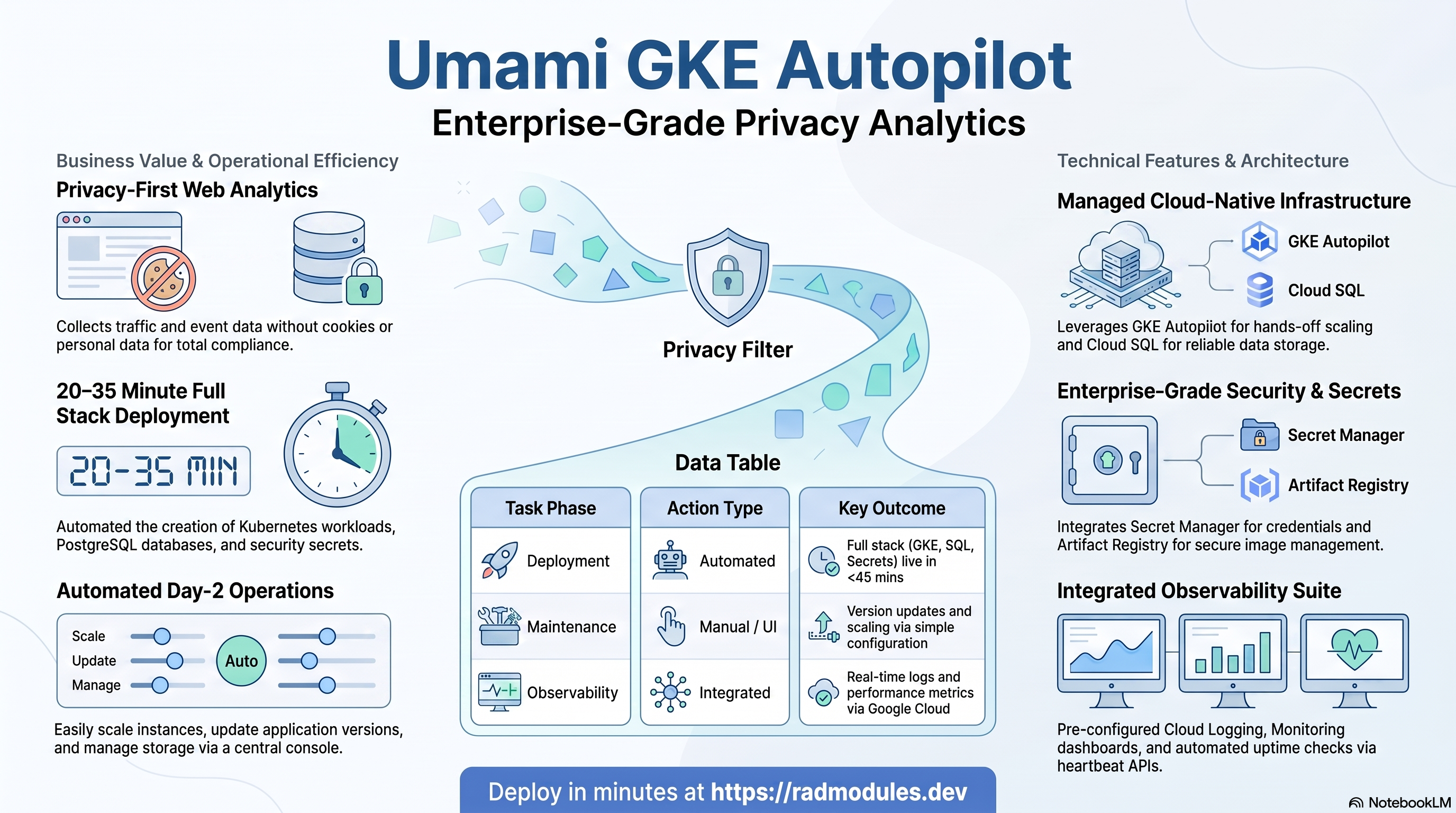
This guide describes every configuration variable available in the Umami_GKE module. Umami_GKE is a wrapper module that combines the generic App_GKE infrastructure module with the Umami_Common shared application configuration to deploy the Umami privacy-focused web analytics platform on Google Kubernetes Engine (GKE) Autopilot.
Most configuration options in Umami GKE map directly to the same options in App GKE. Where a variable is identical in behaviour, this guide references the App GKE guide rather than repeating the same documentation. Only the variables and defaults that are specific to Umami are described in full here.
Note: Variables marked as platform-managed are set and maintained by the platform. You do not normally need to change them.
What Umami costs on RAD, and how that compares
Running Umami on GKE Autopilot in your own Google Cloud project costs about US$104.74/month in Google Cloud charges (about US$177.74 if this isn't your only Autopilot cluster), on top of a one-off 110-credit RAD module fee (US$11) — higher than the Cloud Run module's fee because this variant also runs a shared NFS volume on GKE. GKE Autopilot suits Umami that must stay up or scale across pods; for the lowest cost, see the Cloud Run guide instead. In a RAD-managed project the module fee drops to 99 credits (10% lower) — see Pause it for free below.
What you pay on RAD
| Own project | RAD-managed project | |
|---|---|---|
| Module fee (one-off) | 110 credits | 99 credits (10% lower) |
| Build time | ~3-6 credits per build, either way | ~3-6 credits per build, either way |
| Google Cloud running cost | US$104.74/month, billed by Google at list price | ~92 credits/day (about 2760/month, US$276 at the top-up price), metered at list price plus RAD's margin |
10 credits cost US$1 on a one-off top-up, and less on a monthly plan.
Default running cost in your own project
| Resource (module default) | Per month |
|---|---|
| GKE Autopilot pod, 1x vCPU / 0.5 GiB | US$34.29 |
| Cloud SQL for PostgreSQL, 1 vCPU / 3.75 GB, zonal, 10 GB SSD | US$51.02 |
| NFS/cache file server (small VM) | US$13.43 |
| Cloud NAT and networking | US$5 |
| Cloud Storage (add-ons, backups) | US$1 |
| Total | US$104.74 |
The GKE cluster management fee is excluded from the total above because it is shared across every GKE app in the project — $0 if this is the only one, otherwise roughly $73/month split across however many you run.
How it compares
- Umami's own hosted Umami Cloud runs a free Hobby tier, then Pro at $20/month and Business at $200/month — verified on Umami's pricing page, 8 October 2026. RAD's own-project running cost is a flat ~US$105/month regardless of event volume.
- A self-managed VPS comparison, sized to Umami's 1 vCPU / 0.5 GiB default: a Hetzner CPX11 or DigitalOcean 1 vCPU/2GB Droplet runs about $6-12/month — plus your own time for backups and patching, and no Kubernetes control plane to run.
- Most of this module's cost above the Cloud Run variant is the GKE pod and the NFS volume; the Cloud Run module needs neither and is the cheaper default for Umami.
Pause it for free: delete a RAD-managed project, restore it when you need it
This is the headline advantage of a RAD-managed project, and it costs nothing while paused. Deleting a RAD-managed project unlinks its billing first, then asks Google to delete the project outright — Google's own 30-day recoverable soft delete. Unlike deleting one module, this does not tear down Cloud SQL, any VM, or the compute resource one by one: the whole project simply stops, and nothing is charged while it waits, because billing is already unlinked.
Restoring, within 30 days and only by the project's owner, asks Google to undelete the project and reattaches its billing account, then asks you to run Update on each deployment to confirm everything came back. Because nothing was individually destroyed, that Update finds the same resources already there — it is a check, not a rebuild, and an Update never charges the module fee again. This costs only a handful of credits (under US$1) in total for a typical 2-3-deployment chain.
What this needs: you must own the project (not one RAD only manages billing for), you must restore it yourself within 30 days — after that Google deletes it for good — and restoring is admitted like creating a new project, so your purchased credit balance must still clear the tier's floor (100 credits for the sandbox tier most study/demo use fits). Google says most services are fully working again within 36 hours of a restore.
One real gap: nightly backups are written to a bucket inside the project, and that bucket has Cloud Storage's soft-delete explicitly turned off, so it is very likely gone as soon as you delete the project — even though the project itself is recoverable for 30 days. If you've customised Umami and want to keep that work, copy a backup out (to Google Drive, or a bucket outside the project) before deleting. For a default install with nothing irreplaceable in it, this does not matter.
Pay only while you use it, the other way: delete and redeploy
In your own project, or once 30 days have passed on a RAD-managed one, there is no free pause — deleting removes the resources for good, and bringing Umami back means redeploying from scratch. That costs about 113-116 credits in your own project, or about 102-105 credits in a RAD-managed one.
Deleting only saves money once Umami would otherwise sit unused long enough to clear that redeploy cost against its own running cost — about 3 days or more in your own project (about US$3.49 a day), or about 1 days or more in a RAD-managed one (92 credits a day).
Keep data first: nightly backups go to a bucket inside the deployment and are deleted with it, so copy the latest backup out before deleting if you want to keep it.
Lab sessions and Managed Environments
Lab sessions, for training: a trainer runs a session for a class. Each participant gets the app in their own Google Cloud project for 15 minutes to 24 hours, within an allowance the trainer sets. Either the trainer funds every place, or each participant pays for their own. Everything is deleted when the session ends and unused credits go back to the trainer.
Managed Environments, for consultancies: a partner runs the app for a client from a ring-fenced wallet it funds, and settles with the client directly. If the wallet runs low, billing pauses and the data is kept, so nobody receives an unexpected charge. At the end the partner hands the project over and the deployments become the client's own.
Credits can be bought in more than 20 currencies, including XAF, XOF, NGN, GHS, KES and ZAR, by card, bank transfer or mobile money.
Sources (8 October 2026): Google Cloud Billing Catalog API list prices; radmodules.dev/pricing for RAD's own fees and daily-credit estimates; Google's project delete/restore documentation for the pause/restore claims; Umami pricing.
Standard Configuration Reference
The following configuration areas are provided by the underlying App_GKE module. Consult the linked sections of the App_GKE Configuration Guide for full documentation.
| Configuration Area | App GKE.md Section | Umami-Specific Notes |
|---|---|---|
| Project & Identity | §2 IAM & Access Control | Identical. |
| Application Identity | §3.A Compute (GKE Autopilot) | Umami-specific defaults; see Group 2: Application Identity. |
| Runtime & Scaling | §3.A Compute (GKE Autopilot) | Umami-specific defaults for container_port, cpu_limit, memory_limit; see Group 3: Runtime & Scaling. |
| Environment Variables & Secrets | §3 Core Service Configuration | APP_SECRET auto-generated; DATABASE_URL assembled at runtime; see Group 5: Environment Variables & Secrets. |
| Networking & Network Policies | §3.D Networking & Network Policies | Identical. |
| Initialization Jobs & CronJobs | §3.E Initialization Jobs & CronJobs | db-init job supplied automatically by Umami Common; see Group 8: Jobs & Scheduled Tasks. |
| Additional Services | §3.F Additional Services | Identical. |
| Storage — NFS | §3.C Storage (NFS / GCS / GCS Fuse) | enable_nfs defaults to false — Umami is stateless and needs no shared filesystem. |
| Storage — GCS | §3.C Storage (NFS / GCS / GCS Fuse) | No storage buckets provisioned by default; see Group 14: Cloud Storage. |
| Database Configuration | §3.B Database (Cloud SQL) | PostgreSQL required; see Group 16: Database Configuration. |
| Backup Schedule & Retention | §3.B Database (Cloud SQL) | Identical. |
| Custom SQL Scripts | §3.E Initialization Jobs & CronJobs | Identical. |
| Observability & Health Checks | §3.A Compute (GKE Autopilot) | Health endpoint /api/heartbeat; see Group 10: Observability & Health. |
| Cloud Armor WAF | §4.A Cloud Armor WAF | Identical. |
| Identity-Aware Proxy | §4.B Identity-Aware Proxy (IAP) | Identical. |
| Binary Authorization | §4.C Binary Authorization | Identical. |
| VPC Service Controls | §4.D VPC Service Controls | Identical. |
| Secrets Store CSI Driver | §4.E Secrets Store CSI Driver | Always enabled — no configuration required. |
| Traffic & Ingress | §5 Traffic & Ingress | Identical. |
| CDN | §5.B CDN | Identical. |
| Custom Domain & Static IP | §5.C Static IP Reservation | See Group 19: Custom Domain & Static IP. |
| Cloud Build Triggers | §6.A Cloud Build Triggers | Identical. |
| Cloud Deploy Pipeline | §6.B Cloud Deploy Pipeline | Identical. |
| Image Mirroring | §6.C Image Mirroring | Enabled by default to avoid GitHub Container Registry rate limits. |
| Pod Disruption Budgets | §7.A Pod Disruption Budgets | Identical. |
| Topology Spread Constraints | §7.B Topology Spread Constraints | Identical. |
| Resource Quotas | §7.C Resource Quotas | Identical. |
| Auto Password Rotation | §7.D Auto Password Rotation | See Group 16: Database Configuration. |
| Redis Cache | §8.A Redis / Memorystore | Redis not wired — Umami does not require it; see Group: Redis Cache. |
| Backup Import | §8.B Backup Import | See Group 21: Backup Import. |
| Service Mesh (ASM) | §8.C Service Mesh (ASM via Fleet) | Identical. |
| Multi-Cluster Services | §8.D Multi-Cluster Services (MCS) | Identical. |
How Umami GKE Relates to App GKE
Umami GKE passes all variables through to App GKE and adds a Umami Common sub-module that supplies Umami-specific defaults and application configuration. The main effects are:
- PostgreSQL is required. Umami requires PostgreSQL for all data storage. The
database_typedefault is"POSTGRES"(the generic PostgreSQL option). DATABASE_URLis assembled at runtime. The custom Umami entrypoint constructsDATABASE_URLfrom platform-injected DB_* variables. This avoids storing a plaintext connection string in environment variables or Terraform state.APP_SECRETis auto-generated.Umami Commongenerates a 32-character alphanumeric secret and stores it in Secret Manager. It is injected into the pod asAPP_SECRET.- No storage buckets are provisioned by default. Umami is a stateless analytics service — all data lives in PostgreSQL.
storage_bucketsdefaults to an empty list. - A
db-initjob runs on first deployment.Umami Commonsupplies a defaultdb-initKubernetes Job that pre-creates the Umami PostgreSQL database and user. Umami then runs its own Prisma migrations on startup. - Resource defaults are sized for Umami. The default
cpu_limit(1 vCPU) andmemory_limit(512Mi) reflect Umami's lightweight footprint. - Health probes target
/api/heartbeat. Umami's dedicated health endpoint, not a generic root path. - Redis is not used. Umami stores everything in PostgreSQL; the module wires no Redis connection (the mirrored
enable_redisdeclaration is not forwarded to the Foundation). - Image mirroring is enabled by default. Umami is distributed via GitHub Container Registry (
ghcr.io). The module mirrors the image to Artifact Registry to avoid rate limits in production.
Group 1: Project & Identity
Identical to App_GKE. See App_GKE.
| Variable | Default | Description |
|---|---|---|
project_id | (required) | GCP project ID. Required. |
region | "us-central1" | GCP region for Cloud SQL, GCS, and other resources. |
Group 2: Application Identity
These variables behave identically to App_GKE. See App_GKE for descriptions.
Umami-specific defaults:
| Variable | Umami GKE Default | App GKE Default | Notes |
|---|---|---|---|
application_name | "umami" | "gkeapp" | Used as the base name for all GCP and Kubernetes resources. Do not change after deployment. |
application_display_name | "Umami" | "App GKE Application" | Shown in the platform UI and dashboards. Can be changed freely. |
application_description | "Umami Analytics on GKE Autopilot" | "App GKE Custom Application…" | Descriptive label. Can be changed freely. |
application_version | "postgresql-latest" | "1.0.0" | The Umami release version to build and deploy. Must use a postgresql- prefixed tag. |
deploy_application | true | true | Set false to provision supporting infrastructure only without deploying the Umami workload. |
Group 3: Runtime & Scaling
Most variables behave identically to App_GKE. See App_GKE Group 4.
Umami-specific defaults and behaviour:
| Variable | Umami GKE Default | App GKE Default | Notes |
|---|---|---|---|
container_port | 3000 | 8080 | Umami's native Next.js port. Do not change unless your custom Dockerfile binds Umami to a different port. |
container_resources | { cpu_limit="1000m", memory_limit="512Mi" } | { cpu_limit="1000m", memory_limit="512Mi" } | Same defaults — Umami is lightweight. Increase memory_limit to 1Gi for high-traffic analytics dashboards. |
min_instance_count | 1 | varies | GKE default is 1 pod minimum. Set to a higher value for high-availability deployments. |
max_instance_count | 10 | 3 | Umami scales horizontally safely — all state is in PostgreSQL, allowing many concurrent instances. |
container_image_source | "custom" | "custom" | The custom mode builds a wrapper image that assembles DATABASE_URL from DB_* variables. Set to "prebuilt" only if providing DATABASE_URL manually. |
enable_cloudsql_volume | true | true | Cloud SQL Auth Proxy sidecar. Required for Umami to connect to Cloud SQL via Unix socket. |
workload_type | "Deployment" | "Deployment" | Umami is stateless — Deployment is the correct workload type. Do not use StatefulSet unless attaching persistent local storage for a non-standard use case. |
enable_vertical_pod_autoscaling: Defaults to false. Enable to allow GKE Autopilot to automatically right-size Umami pods based on observed resource usage. Useful for cost optimisation in production.
The remaining runtime variables (enable_image_mirroring, container_build_config, container_protocol, timeout_seconds, cloudsql_volume_mount_path, service_annotations, service_labels, termination_grace_period_seconds, deployment_timeout) behave as described in App_GKE Group 4.
Group 4: Access & Networking
These variables behave identically to App_GKE. See App_GKE, App_GKE, and App_GKE.
| Variable | Default | Description |
|---|---|---|
enable_iap | false | Enables Identity-Aware Proxy authentication on the load balancer. |
iap_authorized_users | [] | Individual users or service accounts granted IAP access. |
iap_authorized_groups | [] | Google Groups granted IAP access. |
iap_oauth_client_id | "" | OAuth client ID for IAP configuration. |
iap_oauth_client_secret | "" | OAuth client secret for IAP configuration. |
iap_support_email | "" | Support email shown on the Google OAuth consent screen. |
enable_cloud_armor | false | Attaches a Cloud Armor security policy to the GKE Ingress backend. |
admin_ip_ranges | [] | Admin CIDR ranges permitted through Cloud Armor. |
cloud_armor_policy_name | "default-waf-policy" | Name of the Cloud Armor security policy to attach. |
enable_vpc_sc | false | Enables VPC Service Controls perimeter enforcement. |
network_name | "" | VPC network name. Leave empty to auto-discover. |
network_tags | [] | Firewall tags applied to GKE cluster nodes. |
enable_network_segmentation | false | Applies Kubernetes NetworkPolicy rules to restrict pod-to-pod traffic. |
IAP note for Umami: IAP protects the Umami analytics dashboard. If applying IAP, note that the tracking script endpoint (/script.js) and event collection endpoint (/api/send) must remain publicly accessible for tracked websites to report data. Consider routing architecture carefully if restricting access.
Group 5: Environment Variables & Secrets
These variables behave identically to App_GKE. See App_GKE.
Umami-specific behaviour:
Umami Common generates APP_SECRET and injects it as the APP_SECRET environment variable. No SMTP defaults are pre-populated — Umami does not send email natively.
Use environment_variables for Umami configuration options:
environment_variables = {
  DISABLE_TELEMETRY = "1"    # Disable Umami's anonymous telemetry reporting
  TRACKER_SCRIPT_NAME = "analytics.js"  # Rename tracking script to avoid ad blockers
  ALLOWED_FRAME_URLS = "https://example.com"  # Allow Umami to be embedded in iframes
}
| Variable | Default | Description |
|---|---|---|
environment_variables | {} | Plain-text environment variables injected into the pod at runtime. |
secret_environment_variables | {} | Secret Manager references injected as environment variables. |
secret_rotation_period | '2592000s' | Rotation period for Secret Manager secrets (30 days). |
secret_propagation_delay | 30 | Seconds to wait after secret creation before proceeding. |
Group 6: GKE Cluster
| Variable | Default | Description |
|---|---|---|
gke_cluster_name | "" | Name of the target GKE Autopilot cluster. Leave empty to auto-discover. |
namespace_name | "" | Kubernetes namespace. Auto-generated from application_name and tenant_id when empty. |
service_type | "LoadBalancer" | Kubernetes Service type. "LoadBalancer" (the default) exposes Umami directly on an external IP; use "ClusterIP" for internal-only access behind an Ingress. |
session_affinity | "None" | Session affinity mode. "None" is correct for Umami — all state is in PostgreSQL, so any pod can handle any request. |
enable_multi_cluster_service | false | Registers the service with GKE Multi Cluster Services. |
configure_service_mesh | false | Injects Anthos Service Mesh (Istio) sidecar proxies. |
termination_grace_period_seconds | 30 | Seconds Kubernetes waits for the pod to terminate before force-killing. |
deployment_timeout | 1800 | Maximum seconds to wait for the GKE deployment to reach a healthy state. |
gke_cluster_selection_mode | "primary" | Strategy for choosing the target cluster. |
Group 7: Backup & Maintenance
| Variable | Default | Notes |
|---|---|---|
backup_schedule | "0 2 * * *" | Daily at 02:00 UTC. Adjust to your preferred maintenance window. |
backup_retention_days | 7 | 7-day retention. Increase for production deployments (30–90 days recommended). |
Group 8: Jobs & Scheduled Tasks
These variables behave as described in App_GKE, with one important Umami-specific behaviour.
Umami default db-init job:
When initialization_jobs is left as the default (empty list []), Umami Common automatically supplies a db-init job:
| Field | Value |
|---|---|
| Job name | db-init |
| Image | PostgreSQL client image |
| Purpose | Pre-creates the Umami PostgreSQL database and user before Umami runs its own Prisma migrations |
| Execute on every apply | true |
| CPU / Memory | 1000m / 512Mi |
Override initialization_jobs with a non-empty list to replace this default with your own jobs. Each custom job must specify at least one of command, args, or script_path.
CronJobs: The cron_jobs and additional_services variables are available and behave identically to App_GKE. Use cron_jobs for tasks such as regular analytics data exports or database maintenance.
Note: The
cron_jobsschema inUmami GKEuses Kubernetes CronJob fields —restart_policy,concurrency_policy,failed_jobs_history_limit,successful_jobs_history_limit,starting_deadline_seconds,suspend.
Group 9: Reliability Policies
Identical to App_GKE. See App_GKE.
| Variable | Default | Notes |
|---|---|---|
enable_pod_disruption_budget | true | Enabled by default. Prevents all Umami pods from being evicted simultaneously during cluster maintenance. |
pdb_min_available | "1" | At least one Umami pod must remain available during voluntary disruptions. |
enable_topology_spread | false | Enable for high-availability deployments to distribute pods across zones. |
topology_spread_strict | false | When true, uses DoNotSchedule spread constraint. |
Group 10: Observability & Health
These variables behave identically to App_GKE. See App_GKE.
Umami health endpoint: Umami exposes /api/heartbeat as its dedicated health endpoint. This endpoint returns HTTP 200 when Umami is running and connected to PostgreSQL. All probe configuration defaults use this path.
| Variable | Umami GKE Default | Notes |
|---|---|---|
startup_probe_config | { enabled=true, path="/api/heartbeat", initial_delay_seconds=30, failure_threshold=30 } | High failure_threshold accommodates first-boot Prisma migrations. |
health_check_config | { enabled=true, path="/api/heartbeat", initial_delay_seconds=30, failure_threshold=3 } | Liveness probe — restarts unhealthy pods. |
uptime_check_config | { enabled=false, path="/api/heartbeat" } | Cloud Monitoring uptime check. Disabled by default. |
alert_policies | [] | Custom Cloud Monitoring metric alert policies. |
Startup probe note: The failure_threshold = 30 with period_seconds = 10 gives Umami up to 5 minutes (plus the 30-second initial delay) to complete startup and run Prisma migrations on a fresh database. On subsequent restarts (migrations already applied), startup is much faster.
Group 11: Workload Automation (Jobs)
| Variable | Default | Description |
|---|---|---|
initialization_jobs | [] | Kubernetes Jobs to run before the Umami application starts. Leave empty for Umami Common to supply the default db-init job. |
cron_jobs | [] | Recurring Kubernetes CronJob resources. |
additional_services | [] | Sidecar or helper services deployed alongside the main Umami container. |
Group 12: CI/CD & GitHub Integration
Identical to App_GKE. See App_GKE.
| Variable | Default | Description |
|---|---|---|
enable_cicd_trigger | false | Provisions a Cloud Build GitHub trigger. |
github_repository_url | "" | Full HTTPS URL of the GitHub repository. |
github_token | "" | GitHub Personal Access Token. Sensitive. |
github_app_installation_id | "" | GitHub App installation ID. |
cicd_trigger_config | { branch_pattern = "^main$" } | Advanced Cloud Build trigger configuration. |
enable_cloud_deploy | false | Switches to a managed Google Cloud Deploy pipeline. |
cloud_deploy_stages | [dev, staging, prod(approval)] | Ordered promotion stages. |
enable_binary_authorization | false | Enforces Binary Authorization policy on the GKE cluster. |
binauthz_evaluation_mode | "ALWAYS_ALLOW" | Binary Authorization enforcement mode. Not referenced. |
Group 13: NFS
Umami does not require NFS. enable_nfs defaults to false. All Umami data is stored in PostgreSQL.
| Variable | Default | Description |
|---|---|---|
enable_nfs | false | Provisions a Cloud Filestore (NFS) instance. Not required for Umami. |
nfs_mount_path | "/mnt/nfs" | Container NFS mount path. Only used when enable_nfs = true. |
nfs_instance_name | "" | Name of an existing NFS GCE VM. Auto-discovered when empty. |
nfs_instance_base_name | "app-nfs" | Base name for an inline NFS GCE VM. |
nfs_volume_name | "nfs-data-volume" | Kubernetes volume name for the NFS mount. |
Group 14: Cloud Storage
Umami does not require GCS buckets. storage_buckets defaults to an empty list.
| Variable | Default | Description |
|---|---|---|
create_cloud_storage | true | Controls whether the module provisions GCS buckets defined in storage_buckets. |
storage_buckets | [] | GCS bucket configurations. Empty by default — Umami is stateless. |
gcs_volumes | [] | GCS buckets to mount via GCS Fuse CSI driver. |
manage_storage_kms_iam | false | Creates a CMEK KMS keyring for GCS buckets. |
enable_artifact_registry_cmek | false | Creates an Artifact Registry KMS key for at-rest image encryption. |
max_images_to_retain | 7 | Maximum container images to keep in Artifact Registry. |
delete_untagged_images | true | Automatically deletes untagged images from Artifact Registry. |
image_retention_days | 30 | Days after which images are eligible for deletion. |
Group 16: Database Configuration
These variables behave identically to App_GKE. See App_GKE.
Umami-specific defaults and restrictions:
| Variable | Umami GKE Default | App GKE Default | Notes |
|---|---|---|---|
database_type | "POSTGRES" | "POSTGRES" | Umami requires PostgreSQL. Do not change to MySQL or NONE. |
application_database_name | "umami" | "gkeappdb" | Do not change after deployment — changing recreates the database and destroys all analytics data. |
application_database_user | "umami" | "gkeappuser" | Do not change after deployment. |
database_password_length | 32 | 32 | Auto-generated password length. Range: 16–64. |
Automatic password rotation:
| Variable | Default | Description |
|---|---|---|
enable_auto_password_rotation | false | Deploys an automated database password rotation job. |
rotation_propagation_delay_sec | 90 | Seconds to wait after rotation before restarting pods. |
PostgreSQL extensions:
| Variable | Default | Description |
|---|---|---|
enable_postgres_extensions | false | Enables installation of PostgreSQL extensions after provisioning. |
postgres_extensions | [] | List of extensions to install (e.g., ['uuid-ossp', 'pg_trgm']). |
Group 19: Custom Domain & Static IP
Identical to App_GKE. See App_GKE.
| Variable | Default | Description |
|---|---|---|
enable_custom_domain | true | Provisions a Kubernetes Ingress resource for custom domain routing. Enabled by default. |
application_domains | [] | Custom domain names (e.g., ["analytics.example.com"]). |
reserve_static_ip | true | Reserves a Global Static IP for the load balancer. Recommended for production deployments. |
static_ip_name | "" | Name for the reserved IP. Auto-generated if empty. |
enable_cdn | false | Enables Cloud CDN on the GKE Ingress backend. |
network_tags | [] | VPC firewall network tags applied to GKE nodes. |
network_name | "" | VPC network name. Auto-discovered when empty. |
Group 21: Backup Import
| Variable | Default | Description |
|---|---|---|
enable_backup_import | false | Triggers a one-time database import job during deployment. |
backup_source | "gcs" | Source for the backup file: "gcs" or "gdrive". |
backup_file | "backup.sql" | Filename of the backup to import. |
backup_format | "sql" | Backup format: sql, tar, gz, tgz, tar.gz, zip, auto. |
Group 8: Resource Quota
Identical to App_GKE. See App_GKE.
| Variable | Default | Description |
|---|---|---|
enable_resource_quota | false | Creates a Kubernetes ResourceQuota in the application namespace. |
quota_cpu_requests | "" | Total CPU requests allowed in the namespace. |
quota_cpu_limits | "" | Total CPU limits allowed in the namespace. |
quota_memory_requests | "" | Total memory requests. Must use binary unit suffixes (e.g., "4Gi", "8192Mi"). |
quota_memory_limits | "" | Total memory limits. Must use binary unit suffixes. |
Warning:
quota_memory_requestsandquota_memory_limitsmust use binary suffixes (Gi,Mi) when set. Bare integers (e.g.,"4") are treated as bytes by Kubernetes and will block all pod scheduling with a quota-exceeded error.
Redis Cache
Umami does not use Redis — it stores all analytics data directly in PostgreSQL with no caching layer. The enable_redis variable is declared in Umami_GKE only to satisfy Foundation variable mirroring; it is not forwarded to the App_GKE call, so changing it has no effect.
| Variable | Default | Description |
|---|---|---|
enable_redis | true | Inert declaration (Foundation mirroring only) — not forwarded to App_GKE, so no Redis env vars are injected regardless of value. |
If you require Redis for a custom integration or adjacent service, use additional_services to deploy a Redis sidecar, or configure Memorystore independently.
Group 22: VPC Service Controls
| Variable | Default | Description |
|---|---|---|
enable_vpc_sc | false | Enforces VPC Service Controls perimeters around GCP APIs. |
vpc_cidr_ranges | [] | VPC subnet CIDR ranges for VPC-SC network access level. |
vpc_sc_dry_run | true | Logs violations without blocking. |
organization_id | "" | GCP Organization ID for VPC-SC. Auto-discovered when empty. |
enable_audit_logging | false | Enables detailed Cloud Audit Logs. |
Exploring with the GCP Console
After a successful deployment, explore the Umami installation in the GCP Console:
GKE workload:
Navigate to Kubernetes Engine → Workloads. Find the Deployment named after your application_name and tenant_id. Click to view:
- Pod status, restart count, and age.
- Logs tab — streams container logs from running Umami pods.
- Details tab — shows the Deployment spec, resource limits, probe configuration, and environment variables (non-sensitive).
- Revision history — lists previous ReplicaSets.
GKE Services & Ingress: Navigate to Kubernetes Engine → Services & Ingress. Find the Service for your Umami deployment. View:
- The external IP address (if
service_type = "LoadBalancer"orreserve_static_ip = true). - Port mappings.
- Load balancer health check status.
Cloud SQL instance:
Navigate to SQL. Find the instance named app-sql-<deployment_id>. Explore:
- Overview — connection name, PostgreSQL version, storage usage.
- Databases — the
umamidatabase with all analytics tables. - Users — the
umamiapplication user. - Operations — history of maintenance, failovers, and backups.
Secret Manager:
Navigate to Security → Secret Manager. Find the secret-<tenant_resource_prefix>-<application_name>-app-secret secret (injected as APP_SECRET) for this deployment. Click to view:
- Secret versions and creation timestamps.
- Access log showing when GKE pods read the secret.
- Rotation configuration.
Artifact Registry: Navigate to Artifact Registry. Find the repository for this deployment. View mirrored Umami images from GitHub Container Registry, their tags, and retention policy.
Cloud Monitoring:
If uptime_check_config.enabled = true was set, navigate to Monitoring → Uptime checks to view the /api/heartbeat uptime check results across GCP regions. Navigate to Monitoring → Dashboards to find the auto-provisioned GKE dashboard with CPU, memory, and request metrics.
Exploring with gcloud and kubectl
Use these commands to inspect the Umami GKE deployment. Replace PROJECT_ID, CLUSTER_NAME, REGION, NAMESPACE, and DEPLOYMENT_NAME with your values.
# Get GKE cluster credentials
gcloud container clusters get-credentials CLUSTER_NAME \
  --region=REGION \
  --project=PROJECT_ID

# List pods in the Umami namespace
kubectl get pods -n NAMESPACE

# Describe the Umami deployment
kubectl describe deployment DEPLOYMENT_NAME -n NAMESPACE

# View Umami pod logs
kubectl logs -n NAMESPACE -l app=DEPLOYMENT_NAME --tail=100

# Follow live logs from all Umami pods
kubectl logs -n NAMESPACE -l app=DEPLOYMENT_NAME -f

# Check resource usage across Umami pods
kubectl top pods -n NAMESPACE

# Check HPA status (horizontal pod autoscaling)
kubectl get hpa -n NAMESPACE

# Describe the Kubernetes Service
kubectl get service -n NAMESPACE
kubectl describe service SERVICE_NAME -n NAMESPACE

# Check pod environment variables (non-sensitive)
kubectl exec -n NAMESPACE POD_NAME -- env | grep -v PASSWORD | grep -v SECRET

# Test health endpoint from inside a pod
kubectl exec -n NAMESPACE POD_NAME -- \
  wget -qO- http://localhost:3000/api/heartbeat

# Check Cloud SQL instance
gcloud sql instances describe INSTANCE_NAME \
  --project=PROJECT_ID \
  --format="table(name,state,databaseVersion,settings.tier)"

# List databases
gcloud sql databases list \
  --instance=INSTANCE_NAME \
  --project=PROJECT_ID

# Check Secret Manager secrets
gcloud secrets list \
  --project=PROJECT_ID \
  --filter="name~umami" \
  --format="table(name,createTime)"

# List Artifact Registry images
gcloud artifacts docker images list \
  REGION-docker.pkg.dev/PROJECT_ID/REPOSITORY_NAME \
  --project=PROJECT_ID \
  --format="table(image,tags,createTime)"

# Check Kubernetes namespace resource quota (if enabled)
kubectl describe resourcequota -n NAMESPACE

# View PodDisruptionBudget
kubectl get pdb -n NAMESPACE

# Check recent Kubernetes events for the namespace
kubectl get events -n NAMESPACE --sort-by='.metadata.creationTimestamp' | tail -20

# Check Cloud Monitoring uptime checks
gcloud monitoring uptime list-configs \
  --project=PROJECT_ID \
  --format="table(displayName,httpCheck.path,period,timeout)"
Module Outputs
Umami GKE exposes the following Terraform outputs:
| Output | Description |
|---|---|
service_name | Name of the Kubernetes Service. |
service_url | External URL of the GKE load balancer. |
service_external_ip | External IP address of the load balancer. |
project_id | GCP project ID. |
deployment_id | Deployment ID suffix. |
namespace | Kubernetes namespace. |
database_instance_name | Name of the Cloud SQL instance. |
database_name | Name of the application database. |
database_user | Name of the application database user. |
database_password_secret | Secret Manager secret name for the database password. |
storage_buckets | Created GCS storage buckets (empty for Umami). |
container_image | Container image used for the deployment. |
cicd_enabled | Whether the CI/CD pipeline is enabled. |
github_repository_url | GitHub repository URL connected for CI/CD. |
kubernetes_ready | true when the GKE cluster endpoint is reachable and all Kubernetes workload resources are deployed. false on the first apply of a new inline cluster — re-run apply to complete the deployment. |
Configuration Pitfalls & Sensible Defaults
Risk levels: Critical (data loss, full outage, security breach) — High (service unavailable or significant degradation) — Medium (degraded function or increased cost) — Low (minor impact).
| Variable | Sensible Default | Risk | Consequence of Incorrect Value |
|---|---|---|---|
project_id | (required) | Critical | No default — deployment fails immediately. |
database_type | "POSTGRES" | Critical | Umami requires PostgreSQL. Setting to MySQL or NONE causes DATABASE_URL assembly to fail and Umami cannot connect to the database. |
application_database_name | "umami" | Critical | Changing this after initial deployment destroys all collected analytics data. The database is recreated empty while the old data remains orphaned in Cloud SQL. |
application_database_user | "umami" | Critical | Changing this after initial deployment recreates the Cloud SQL user, invalidating credentials and breaking all database connectivity. |
container_port | 3000 | Critical | Umami listens on 3000. Mismatching this causes all health probes to fail and Kubernetes to continuously restart the pod. |
container_image_source | "custom" | High | The official Umami image does not accept individual DB_* variables — it requires a fully-formed DATABASE_URL. Using "prebuilt" without manually setting DATABASE_URL in environment_variables will cause Umami to fail at startup with a missing database connection error. |
application_version | "postgresql-latest" | High | Must use a postgresql- prefixed tag. Plain tags (e.g., latest) do not exist for the PostgreSQL variant of Umami. An invalid tag causes the container pull to fail. |
admin_password | (change on first login) | Critical | Default credentials (admin / umami) are publicly known. Leaving them unchanged exposes the analytics dashboard and all tracked data to anyone who knows the service URL. |
container_resources.memory_limit | "512Mi" | Medium | 512Mi is sufficient for light to moderate traffic. Under heavy concurrent dashboard use or complex analytics queries, Umami may OOM. Increase to 1Gi if memory pressure is observed. |
enable_cloudsql_volume | true | Critical | Umami connects to Cloud SQL via the Auth Proxy Unix socket. Disabling this removes the socket, causing all database connections to fail. |
startup_probe_config.failure_threshold | 30 | High | With period_seconds = 10, a failure_threshold of 30 gives Umami up to 5 minutes to start and run Prisma migrations. Reducing this below 10 may cause Kubernetes to restart the pod before migrations complete, creating a restart loop on fresh deployments. |
session_affinity | "None" | Low | Umami is fully stateless — no session affinity is required. All requests can be handled by any pod without consistency issues. |
min_instance_count | 1 | Medium | At least one Umami pod must always be running for analytics data to be collected. Scale-to-zero would cause data gaps during periods of no dashboard traffic. |
quota_memory_requests / quota_memory_limits | "" | Critical (GKE-specific) | Must use binary suffixes (Gi, Mi) when set. Bare integers are treated as bytes, blocking all pod scheduling with a quota-exceeded error. |
enable_pod_disruption_budget | true | Medium | Already enabled by default. Disabling allows all pods to be terminated simultaneously during GKE Autopilot node upgrades, causing brief service interruptions. |
backup_retention_days | 7 | Medium | Analytics data loss is difficult to recover from. Increase to 30+ days for production deployments where historical analytics data has business value. |
enable_backup_import | false | High | Setting this to true triggers a database restore on every apply. Only enable for the initial migration from an existing Umami instance; set back to false immediately after. |
enable_vpc_sc | false | Medium | VPC-SC perimeter is only active when organization_id is also set. Without both, enable_vpc_sc = true has no enforcement effect. |
Related guides
- Hands-on lab: Umami on GKE Autopilot — deploy it step by step, with the console screens and commands at each stage.
- Umami on Google Cloud Run — the same application on Cloud Run, for when you need the other deployment target.
- Umami Common Shared Configuration Module — the configuration shared by both deployment targets.
Need RAD to do something it does not do yet? Request it on the roadmap, or vote on what is already there.