PCA Certification Preparation Guide: Section 3 — Designing for security and compliance (~17.5% of the exam)
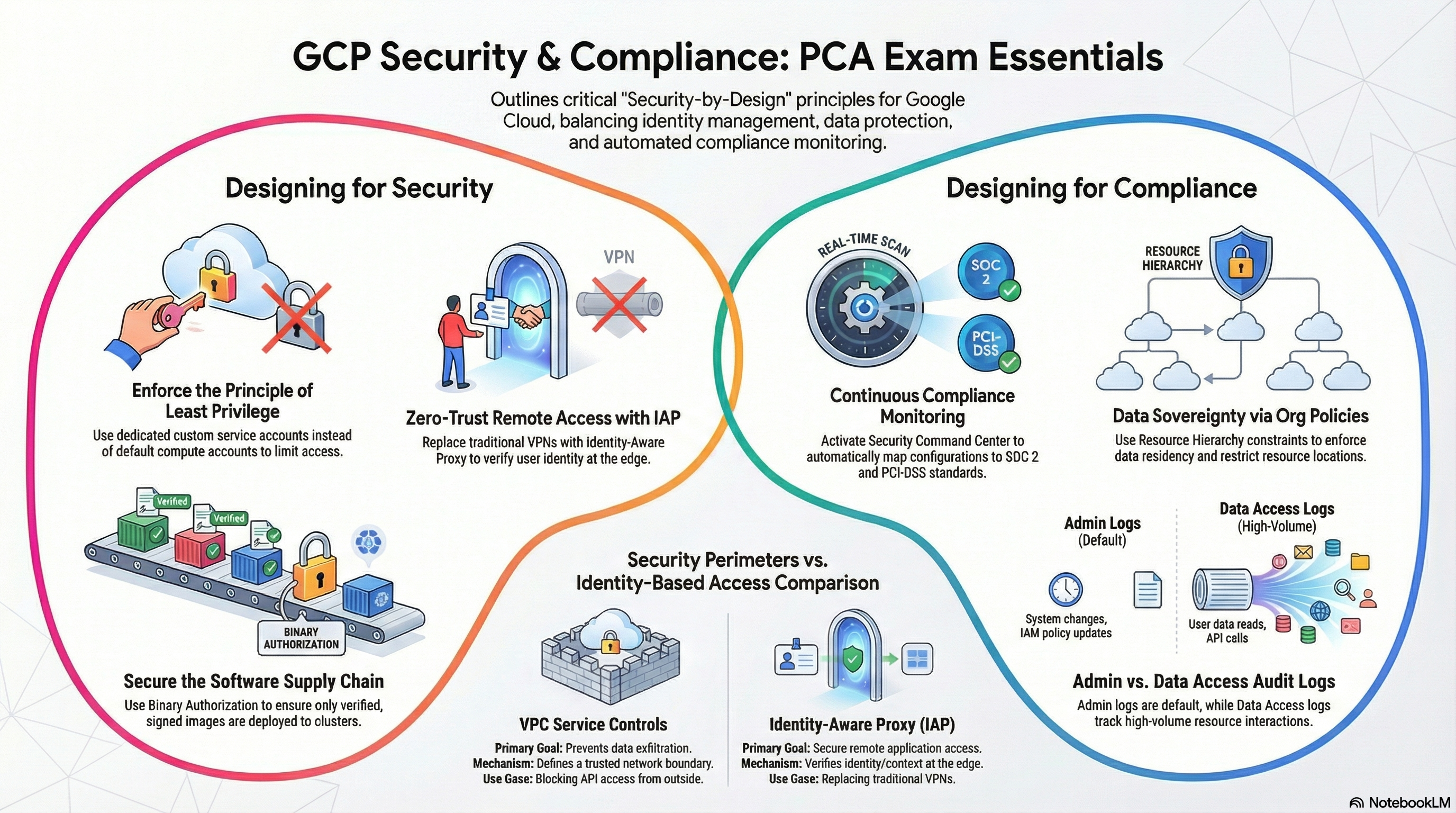
Security design is where the RAD modules are at their densest: dedicated service accounts everywhere, secrets that never touch Terraform state, CMEK with automatic rotation and even automatic key recovery, Binary Authorization, VPC Service Controls with a deliberately staged dry-run rollout, and zero-trust access via IAP. Deploy the Security and delivery profile from the Lab Map on top of a baseline deployment. Modules exercised: Services_GCP, App_CloudRun (or App_GKE), and the App_Common security layers (secrets, IAM, CMEK, and VPC-SC).
3.1 Designing for security
⏱ ~2–3 h · 💰 moderate — KMS keys and the Cloud Armor load balancer; Binary Authorization and VPC-SC are free · ⚙️ Requires: Security and delivery profile (VPC-SC additionally needs the project in a GCP organization and non-empty
admin_ip_ranges)
Why the exam cares — PCA security questions are layered-defense design: who can act (IAM, separation of duties), how data is protected (encryption at rest/in transit, CMEK control), what can run (supply-chain integrity), where data can flow (perimeters, network segmentation), and who can reach the app (zero-trust access). The exam tests choosing the right layer for a requirement — e.g. data-exfiltration prevention is VPC-SC, not firewall rules.
How RAD implements it
Identity and least privilege. Services_GCP creates dedicated service accounts per duty — cloudrun-sa-{prefix}, cloudbuild-sa-{prefix}, clouddeploy-sa-{prefix}, gke-sa-{prefix}, nfs-sa-{prefix} — never the default compute SA. The platform's IAM layer grants resource-scoped bindings: roles/secretmanager.secretAccessor per secret and roles/storage.objectAdmin per bucket, plus roles/iam.serviceAccountUser for controlled impersonation by the build SA. On GKE, Workload Identity binds a per-namespace KSA to the GCP SA via roles/iam.workloadIdentityUser — no key files anywhere.
Secrets. The platform's secrets layer generates the 32-character database password and stores it in Secret Manager; the GitHub token is written with gcloud secrets versions add precisely so it never enters deployment state. secret_rotation_period (default 2592000s = 30 days) and enable_auto_password_rotation (default false) drive a dual-version, zero-downtime rotation flow: an Eventarc-triggered dispatcher runs a rotator job that executes ALTER USER, adds the new secret version, and disables the old one only after a propagation delay.
Encryption. enable_cmek (default false) creates a keyring with separate keys for Cloud SQL, Artifact Registry, and GCS, rotating every cmek_key_rotation_period (default 7776000s = 90 days), and grants roles/cloudkms.cryptoKeyEncrypterDecrypter to each service agent. A plan-time recovery step in the platform's object-storage layer detects key versions scheduled for destruction or disabled and restores them before any encrypted resource is provisioned — operational self-healing for the classic "someone scheduled the key for destruction" incident.
Supply chain. enable_binary_authorization (default false) with binauthz_evaluation_mode (default ALWAYS_ALLOW; set REQUIRE_ATTESTATION to enforce) creates a KMS RSA-2048 signing key, a Container Analysis note and attestor, and an additive policy that blocks and audit-logs non-conforming images. GKE clusters enforce the project's singleton Binary Authorization policy when enabled. enable_vulnerability_scanning turns on Artifact Registry scanning.
Perimeters. enable_vpc_sc (default false, vpc_sc_dry_run default true) builds a perimeter restricting ~15 services with four access levels (VPC CIDRs, admin_ip_ranges, the IAP SA, CI/CD SAs). The organization ID is resolved from the project (with an explicit organization_id variable override available in App_CloudRun/App_GKE — needed when the project sits under a folder, where auto-discovery returns nothing), and a permission probe checks the caller's Access Context Manager rights, skipping with a warning instead of failing the apply.
Edge and runtime. enable_iap grants roles/run.invoker to the IAP service agent and roles/iap.httpsResourceAccessor to iap_authorized_users/iap_authorized_groups (validation requires at least one). enable_cloud_armor deploys OWASP preconfigured WAF rules (sqli/xss/lfi/rce, v33-stable), Adaptive Protection, and a 500 req/min/IP rate limit with a 300 s ban. application_domains is optional — the module derives a nip.io managed certificate when it is empty. On GKE, enable_network_segmentation (default false) creates default-deny-shaped NetworkPolicies on Dataplane V2: ingress only from the same namespace plus Google LB health-check and IAP ranges; egress only to DNS, HTTPS (including the restricted/private googleapis ranges 199.36.153.4/30 and 199.36.153.8/30), Cloud SQL on 3307, the metadata server, and NFS when enabled.
Try it
- In Console > IAM & Admin > Service Accounts, list the five platform SAs; pick one and inspect its bindings:
gcloud projects get-iam-policy <project-id> \
  --flatten="bindings[].members" \
  --filter="bindings.members:cloudrun-sa-" \
  --format="table(bindings.role)"
- In Console > Security > Secret Manager, open the database password secret — confirm versions exist but values are never shown in plan output or the portal.
- Enable
REQUIRE_ATTESTATION, then attempt to deploy an unsigned image and watch the denial in Console > Logging > Logs Explorer (filter on Binary Authorization audit events). - With VPC-SC enabled in dry-run, review the perimeter:
gcloud access-context-manager perimeters list --policy=<policy-id> \
  --format="table(name,title,spec.restrictedServices.list():label=DRY_RUN_SERVICES)"
- On GKE with segmentation enabled:
kubectl describe networkpolicy -n <namespace>and trace each rule to a trust decision. - You know it worked when the unsigned image is blocked, the perimeter shows in dry-run (
specpopulated, notstatus), and every IAM binding you find is scoped to a specific resource or duty.
Check yourself
Q1: A regulator requires that your company control — and be able to revoke — the encryption keys protecting customer data, with rotation at least quarterly. Which platform settings satisfy this, and what is the operational risk the module mitigates?
A: enable_cmek = true with the default cmek_key_rotation_period = "7776000s" (90 days) gives customer-managed keys with quarterly rotation; disabling/destroying the key revokes access to the data. The operational risk is self-inflicted denial of service — a key version scheduled for destruction bricks every encrypted bucket and repo — which the platform's plan-time key-recovery step mitigates by restoring versions that were scheduled for destruction or disabled.
Q2: A security team wants to guarantee that only images built by the official CI pipeline run in production. Which control, and what mode?
A: Binary Authorization with binauthz_evaluation_mode = "REQUIRE_ATTESTATION" — the CI pipeline signs (attests) each image digest with the KMS key, and the policy blocks unattested images at deploy time while audit-logging the decision. Vulnerability scanning alone only reports; IAM alone controls who deploys, not what is deployed.
Q3: Why is vpc_sc_dry_run = true the default, and what is the rollout sequence the exam (and this module's variable description) expects?
A: An enforced perimeter with wrong access levels instantly breaks CI/CD, deployments, and admin access — VPC-SC denials are hard failures at the API layer. Correct sequence: deploy in dry-run, monitor audit logs for would-be violations for days, add missing IPs/SAs to access levels, then flip vpc_sc_dry_run = false. Dry-run logs violations without blocking.
Beyond the modules — Two examined areas are absent. (1) Resource hierarchy and organization policies: folders, inheritance, constraints like iam.disableServiceAccountKeyCreation — study "Organization Policy Service" and try gcloud resource-manager org-policies list in an org-attached project. (2) Hierarchical firewall policies and Cloud NGFW — the modules use classic VPC firewall rules only. (Workload Identity Federation, formerly absent, is now live: enable_workload_identity_federation in Services_GCP creates pool wif-pool with a GitHub Actions / GitLab CI / generic OIDC provider per wif_provider_type — a working keyless-CI lab.)
⚠️ Exam trap — IAP and Cloud Armor answer different questions: IAP authenticates identities (who are you?); Cloud Armor filters traffic (is this request malicious?). "Only employees may access the app" → IAP; "block SQL injection and DDoS" → Cloud Armor. Scenarios often need both, but never one as a substitute for the other.
3.2 Designing for compliance
⏱ ~60 min · 💰 low–moderate — Data Access audit logs can grow log storage costs · ⚙️ Requires:
enable_audit_logging = true; SCC steps needenable_security_command_center = true(org-level roles required for notifications)
Why the exam cares — Compliance questions test evidence and control mapping: which logs prove who did what (Admin Activity vs Data Access), how findings are surfaced and routed, and how regional/regulatory constraints (HIPAA, PCI-DSS, data residency) shape architecture.
How RAD implements it
Audit trail. enable_audit_logging (default false) configures allServices audit logs for ADMIN_READ, DATA_READ, and DATA_WRITE — Admin Activity (ADMIN_WRITE) is always on and free, but Data Access logs must be explicitly opted in, which is exactly what the platform does, plus explicit per-service configs for Secret Manager and Cloud KMS so secret and key access is provably logged.
Findings and posture. enable_security_command_center (default false) plus enable_scc_notifications route findings to a Pub/Sub topic (scc-{prefix}-findings). The notification config is gated by an org-permission probe — if the deploying SA lacks org-level SCC roles, the feature is skipped with a warning rather than failing the apply. GKE clusters additionally enable security posture management (mode BASIC, vulnerability mode VULNERABILITY_BASIC).
Exfiltration and residency controls. VPC-SC (3.1) is also the compliance answer for data-boundary requirements; region placement is controlled by availability_regions.
Try it
- Enable
enable_audit_logging = true, then read or write a secret version and find the access event:
gcloud logging read \
  'logName:"cloudaudit.googleapis.com%2Fdata_access" AND protoPayload.serviceName="secretmanager.googleapis.com"' \
  --limit=5 --format="table(timestamp, protoPayload.methodName, protoPayload.authenticationInfo.principalEmail)"
- In Console > IAM & Admin > Audit Logs, verify Data Read/Write are enabled for "All services" with per-service rows for Secret Manager and KMS.
- If SCC is active, browse Console > Security > Security Command Center > Findings and check for the
scc-{prefix}-findingstopic in Pub/Sub. - You know it worked when the log query returns the principal email and method for your secret access — audit evidence on demand.
Check yourself
Q1: An auditor asks for proof of every read of patient-data secrets in the last 30 days. Default project logging cannot provide it — why, and what does this platform change?
A: Reads are Data Access (DATA_READ) events, which Google disables by default for cost reasons; only Admin Activity is always on. enable_audit_logging = true opts all services into ADMIN_READ/DATA_READ/DATA_WRITE, with explicit Secret Manager coverage — making the read trail queryable in Logs Explorer (and exportable to BigQuery for long retention).
Q2: Why does the SCC notification feature "silently skip with a warning" instead of failing, and what design principle is that?
A: SCC notification configs require org-level permissions the deploying service account may not hold in every tenant project. The permission probe degrades gracefully — partial security posture rather than a failed platform deployment. The principle: separate mechanism availability from privilege availability, and never let an optional control block the critical path. Know for the exam that full SCC management is organization-scoped.
Beyond the modules — Not covered: Assured Workloads (regulated regions/personnel controls), Access Transparency (logs of Google personnel access), org-policy-based data residency (gcp.resourceLocations), DLP/Sensitive Data Protection for PII discovery and masking, and formal compliance mappings (HIPAA BAA, PCI-DSS responsibility splits). Study the "Compliance resource center" and run a DLP inspection template against a sample bucket in a scratch project.
⚠️ Exam trap — Admin Activity logs are free, always on, and immutable; Data Access logs are opt-in, high-volume, and billable (BigQuery and some services differ). A scenario about "who changed the firewall" needs no configuration at all; "who read the data" needs Data Access logs enabled before the incident — you cannot enable them retroactively.
Need RAD to do something it does not do yet? Request it on the roadmap, or vote on what is already there.