Engineering Practices
Overview
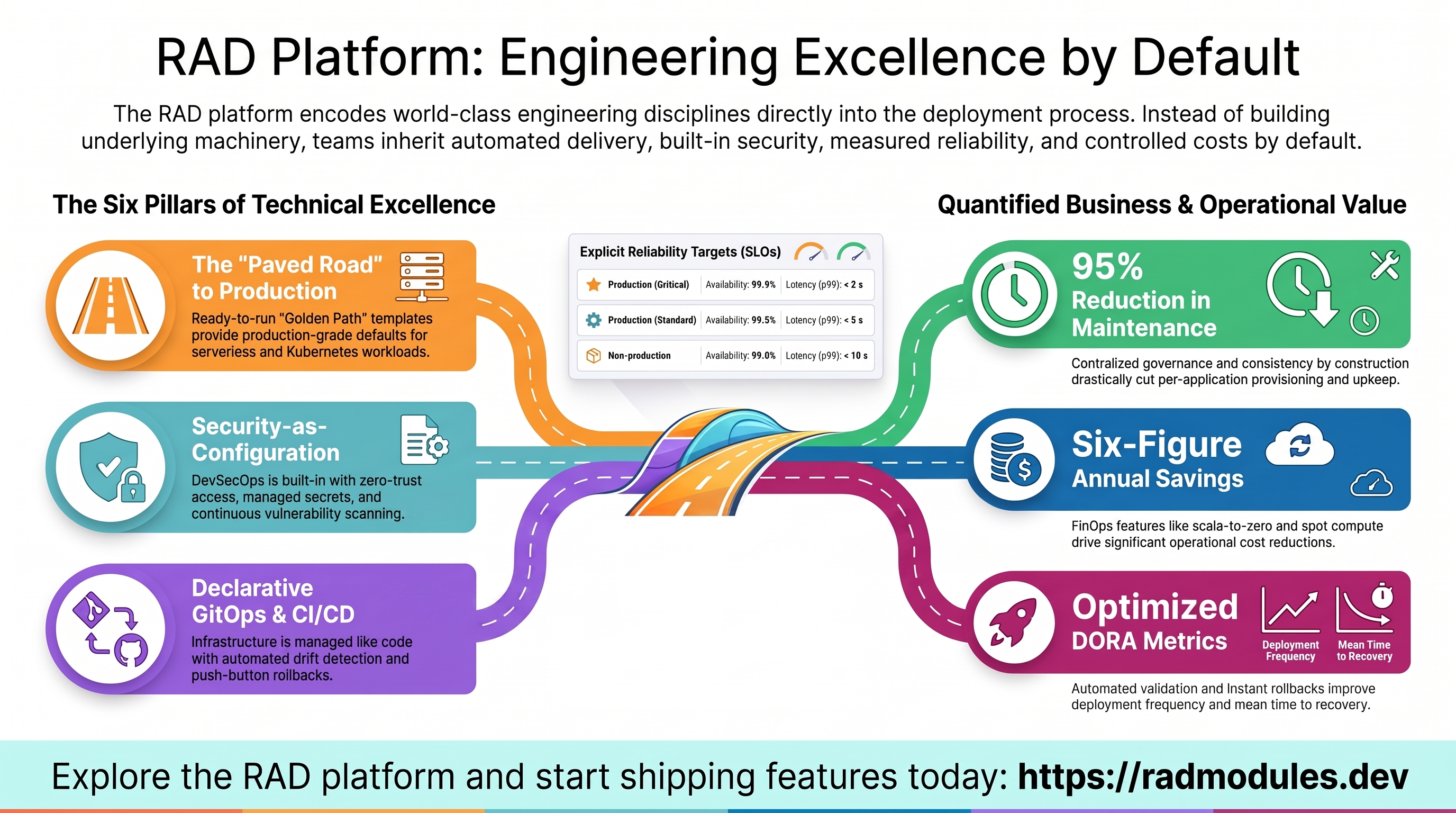
The platform does more than deploy applications — it encodes the engineering disciplines that the world's leading technology organisations rely on to run software safely at scale. Every solution you deploy inherits these practices by default: delivery is automated, security is built in, reliability is measured, and cost is controlled — without you writing or maintaining any of the underlying machinery.
This document summarises six disciplines the platform applies on your behalf — Platform Engineering, GitOps & Infrastructure as Code, CI/CD, DevSecOps, Site Reliability Engineering, and FinOps — and the configuration variables through which you shape them.
1. Platform Engineering
A paved-road platform: the common, hard parts of running production workloads are solved once and offered as self-service, so teams ship features instead of assembling infrastructure.
- A catalogue of ready-to-run solutions. Every supported application is available as a turnkey deployment in two runtimes (serverless and Kubernetes), so launching a new workload is a configuration exercise, not an engineering project.
- Golden paths. Opinionated, pre-hardened templates cover the common archetypes — stateless web services, stateful workloads, and AI/inference services — each wired with production-grade defaults.
- Centralised governance, decentralised consumption. Cross-cutting controls (identity, encryption, perimeters, image policy) are defined once at the platform level and inherited automatically by every deployment — roughly a 95% reduction in per-application maintenance across a typical portfolio.
- Consistency by construction. Every deployment follows the same naming, structure, and configuration model, so any solution is legible to any operator and resources are self-identifying in the console, billing, and audit logs.
- Multi-region ready. The same solution can be deployed to additional regions for geo-redundancy or lower latency, fronted by global routing.
- Guided onboarding. New teams start from the catalogue and a reference implementation rather than a blank page, reaching a working deployment in minutes.
2. GitOps & Infrastructure as Code
Infrastructure is described declaratively and managed like application code — version controlled, reviewed, and reproducible.
- Declarative and version-controlled. Every deployment is fully described by its configuration; the desired state lives in version control, not in an operator's memory.
- Isolated state per deployment. Each tenant and application has its own independent state, eliminating cross-deployment interference and lock contention.
- Drift detection. Changes made outside the platform are detected and reconciled back to the declared state, so reality and intent never silently diverge.
- Reproducibility. Every deployment is pinned to an exact source version, so any prior state can be reconstructed and re-provisioned in another project or region.
- Push-button rollback. Reverting a change converges infrastructure back to its previous state; application releases roll back independently in seconds.
- Reviewed change, with blast-radius-aware approval. Higher-impact changes — those affecting shared foundations — require additional review before they are applied.
3. Continuous Integration & Delivery (CI/CD)
From a single change to a running deployment, automatically and safely.
- Managed build and delivery. Container images are built, tested, and deployed through managed pipelines — no build servers to provision or maintain.
- Flexible image sourcing. Deploy a pre-built image, build from source, or mirror
an upstream image into your private registry (
container_image_source,enable_image_mirroring). - Progressive delivery. Releases can move through environments — development →
staging → production — with optional automatic promotion and human approval gates
between stages (
enable_cloud_deploy,cloud_deploy_stages). - Validation before provisioning. Misconfigurations are rejected up front, before any resource is created, so broken changes never reach your environment.
- Safety gates on destructive actions. Teardown and other high-impact operations require explicit human approval — they are never triggered automatically.
- Automated post-deployment steps. Database initialisation, migrations, and plugin/extension installs run automatically with each deployment.
- Failure visibility. Pipeline failures surface immediately through configurable notification channels.
4. DevSecOps
Security is built into every deployment from the first apply — not bolted on later.
- Security as configuration. Every guardrail is a reviewed, version-controlled setting, applied consistently across all deployments.
- Least-privilege identity. Each application runs as its own identity with only the permissions it needs. External identity providers can be federated in without long-lived keys.
- Zero-trust access. Identity-aware access can front any application with a single
switch (
enable_iap), replacing VPNs with per-request identity checks. - Managed secrets. Credentials are stored in a managed secret store, injected at
runtime, never hard-coded, and can rotate automatically on a schedule
(
enable_auto_password_rotation). - Service perimeters. Per-tenant perimeters (
enable_vpc_sc,vpc_sc_dry_run) isolate data and services, with a safe dry-run-first rollout. - Supply-chain integrity. Signed-image admission (
enable_binary_authorization), continuous vulnerability scanning, and software bill-of-materials generation ensure only trusted images run. Integrity extends to the deployment tooling itself: provider and dependency versions are pinned with cryptographic hashes, so a changed binary is detected between runs rather than silently adopted. - Encryption everywhere. Customer-managed encryption keys protect data at rest, and TLS terminates every ingress path with automatically managed, auto-rotating certificates.
- Network protection. A managed web application firewall with DDoS protection
(
enable_cloud_armor), deny-by-default micro-segmentation (enable_network_segmentation), and admin-path restrictions (admin_ip_ranges) defend every workload. - Policy-as-code across the fleet. Organisation-wide guardrails are enforced from a single policy source applied to every cluster, with violations reported centrally — so the same admission and configuration rules hold everywhere, not per deployment.
- Continuous audit. A built-in security audit surfaces misconfiguration before it becomes an incident, and findings are aggregated in a single view.
5. Site Reliability Engineering (SRE)
Reliability is defined, measured, and engineered — not hoped for.
- Service-level objectives. Reliability targets are explicit, with recommended starting points by criticality:
| Tier | Availability | Latency (p99) | Error budget (30d) |
|---|---|---|---|
| Production (critical) | 99.9% | < 2 s | 43 min |
| Production (standard) | 99.5% | < 5 s | 3.6 hr |
| Non-production | 99.0% | < 10 s | 7.2 hr |
- Error-budget policy. When a budget is materially consumed, non-critical feature delivery pauses in favour of reliability work — making the reliability-versus-velocity trade-off explicit and data-driven.
- Burn-rate alerting. Error budgets are protected by multi-window burn-rate alerts — a fast-burn alert (budget consumed at roughly 14× the sustainable rate over a short window) catches acute incidents, while a slow-burn alert (roughly 6× over a longer window) catches gradual erosion — minimising both false pages and missed incidents.
- Reliability codified. Disruption budgets (
enable_pod_disruption_budget,pdb_min_available), health probes, and deterministic rollout deadlines (deployment_timeout) are applied by default, so reliability decisions live in configuration rather than operator memory. - Toil reduction. Recurring operational chores — revision pruning, stale-resource cleanup, dependency readiness waits — are automated away.
- Measured delivery (DORA). The platform directly improves the four industry-standard delivery metrics:
| Metric | How the platform helps |
|---|---|
| Deployment frequency | One-trigger deploys make frequent releases routine |
| Lead time for changes | Thin, standardised deployments turn changes around in minutes |
| Change failure rate | Standardised foundations and up-front validation cut failures |
| Mean time to recovery | Instant rollback and scripted restore shorten recovery |
- Incident response and learning. A runbook of known issue patterns speeds diagnosis; significant incidents are followed by blameless post-mortems whose action items feed back into the platform's safeguards.
- Resilience testing. Failure is exercised deliberately — instance eviction, probe failure, dependency loss, and cold-start behaviour — to confirm the system degrades gracefully.
6. FinOps
Cost is a first-class engineering concern — controlled by default and visible per tenant.
- Scale-to-zero economics. Serverless workloads cost nothing when idle and bill per
request and per second (
min_instance_count); Kubernetes workloads are billed for the resources actually requested and continuously right-sized. - Spot compute for interruptible work. Interruption-tolerant or non-production workloads can run on Spot capacity, cutting node costs by roughly 60–90% in exchange for the possibility of short-notice preemption — a deliberate cost/durability trade-off.
- Automated lifecycle policies. Old revisions, untagged images, and aged objects are
pruned automatically (
max_revisions_to_retain, plus image-retention and bucket-lifecycle controls), preventing storage-cost creep. - Per-tenant cost allocation. Self-identifying resource naming flows into billing, enabling per-tenant chargeback and per-customer spend caps for SaaS scenarios.
- Tier-configurable services. Every expensive backing service — databases, cache, file storage, compute — is sized through configuration, so you pay for the tier you need.
- Explicit cost/performance profiles. Documented Low-Cost, Low-Latency, and Balanced profiles make the trade-off a deliberate choice.
- Edge offload. Caching at the global edge (
enable_cdn) shifts read-heavy traffic off compute, with projected savings of 30–50% on compute and egress. - Proactive spend control. Budget alerts, anomaly detection, and committed-use and sustained-use discount guidance catch overspend early and capture savings on always-on components.
- Cross-boundary egress awareness. When workloads span clouds or regions, cross-boundary traffic travels public paths and incurs egress charges on both sides; private interconnect or VPN gives predictable latency and lower egress for production multi-location topologies.
- Orphan detection. Idle and abandoned resources are surfaced for cleanup so spend tracks actual usage.
Quantified outcome. For a representative ten-application portfolio, the model projects roughly 95% reductions in both provisioning time and ongoing maintenance effort, and six-figure annual operational savings. Adjust the inputs — portfolio size, team cost, baseline effort — to your own situation before presenting to stakeholders.
Practices at a glance
| Discipline | What the platform does for you |
|---|---|
| Platform Engineering | Self-service catalogue, golden paths, centralised governance, consistency by construction |
| GitOps & IaC | Declarative, version-controlled, reproducible deployments with drift detection and instant rollback |
| CI/CD | Managed build and progressive delivery, validation gates, approval on destructive actions |
| DevSecOps | Least-privilege identity, managed secrets, perimeters, supply-chain integrity, policy-as-code, encryption, WAF |
| SRE | SLOs and error budgets with burn-rate alerting, codified resilience, toil reduction, DORA gains, blameless learning |
| FinOps | Scale-to-zero, spot compute, lifecycle automation, per-tenant cost allocation, tiering, edge offload, spend alerts |
In summary
These six disciplines are not optional add-ons or a maturity model you grow into — they are the platform's default operating posture. Every solution you deploy is delivered through automated pipelines, secured with defence-in-depth, measured against reliability objectives, and cost-controlled from the first deployment. You inherit the engineering practices of a mature platform team and shape them through configuration, rather than building and maintaining them yourself.
Need RAD to do something it does not do yet? Request it on the roadmap, or vote on what is already there.